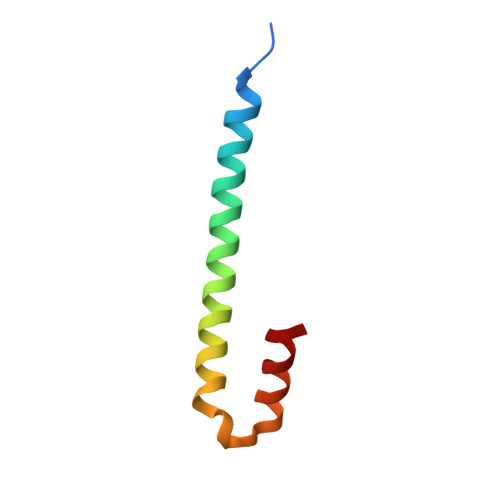
5N74 | pdb_00005n74

Microtubule end binding protein complex


Experimental Data Snapshot

  • Method: X-RAY DIFFRACTION
  • Resolution: 2.30 Å
  • R-Value Free: 
    0.271 (Depositor), 0.245 (DCC) 
  • R-Value Work: 
    0.230 (Depositor), 0.234 (DCC) 
  • R-Value Observed: 
    0.232 (Depositor) 

Starting Model: experimental
View more details

wwPDB Validation 3D Report Full Report

Validation slider image for 5N74

This is version 1.2 of the entry. See complete history

Literature

Short Linear Sequence Motif LxxPTPh Targets Diverse Proteins to Growing Microtubule Ends.

Kumar, A.Manatschal, C.Rai, A.Grigoriev, I.Degen, M.S.Jaussi, R.Kretzschmar, I.Prota, A.E.Volkmer, R.Kammerer, R.A.Akhmanova, A.Steinmetz, M.O.

(2017) Structure 25: 924-932.e4

  • DOI: https://doi.org/10.1016/j.str.2017.04.010
  • Primary Citation Related Structures: 
    5N74

  • PubMed Abstract: 

    Microtubule plus-end tracking proteins (+TIPs) are involved in virtually all microtubule-based processes. End-binding (EB) proteins are considered master regulators of +TIP interaction networks, since they autonomously track growing microtubule ends and recruit a plethora of proteins to this location. Two major EB-interacting elements have been described: CAP-Gly domains and linear SxIP sequence motifs. Here, we identified LxxPTPh as a third EB-binding motif that enables major +TIPs to interact with EBs at microtubule ends. In contrast to EB-SxIP and EB-CAP-Gly, the EB-LxxPTPh binding mode does not depend on the C-terminal tail region of EB. Our study reveals that +TIPs developed additional strategies besides CAP-Gly and SxIP to target EBs at growing microtubule ends. They further provide a unique basis to discover novel +TIPs, and to dissect the role of key interaction nodes and their differential regulation for hierarchical +TIP network organization and function in eukaryotic organisms.


  • Organizational Affiliation
    • Laboratory of Biomolecular Research, Division of Biology and Chemistry, Paul Scherrer Institut, 5232 Villigen PSI, Switzerland.

Macromolecule Content 

  • Total Structure Weight: 73.7 kDa 
  • Atom Count: 4,447 
  • Modeled Residue Count: 529 
  • Deposited Residue Count: 632 
  • Unique protein chains: 2

Macromolecules

Find similar proteins by:|  3D Structure
Entity ID: 1
MoleculeChains  Sequence LengthOrganismDetailsImage
Microtubule-associated protein RP/EB family member 1
A, B, C, D, E
A, B, C, D, E, F, G, H
58Homo sapiensMutation(s): 0 
Gene Names: MAPRE1
UniProt
Find proteins for H0XPX6 (Otolemur garnettii)
Explore H0XPX6 
Go to UniProtKB:  H0XPX6
Entity Groups
Sequence Clusters30% Identity50% Identity70% Identity90% Identity95% Identity100% Identity
UniProt GroupH0XPX6
Sequence Annotations
Expand
Reference Sequence
Find similar proteins by:  Sequence   |   3D Structure  
Entity ID: 2
MoleculeChains  Sequence LengthOrganismDetailsImage
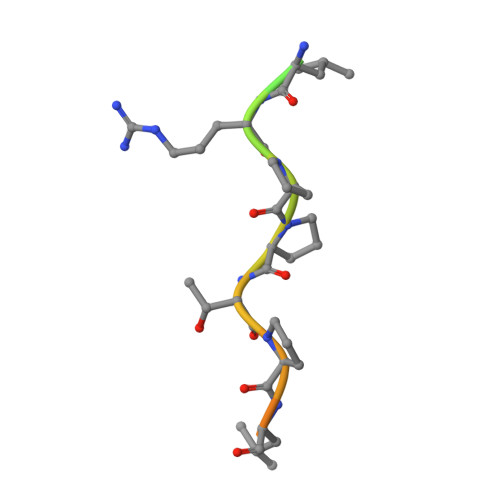
Karyogamy protein KAR9
I, J, K, L, M
I, J, K, L, M, N, O, P
21Saccharomyces cerevisiaeMutation(s): 0 
Gene Names: KAR9YPL269W
UniProt
Find proteins for P32526 (Saccharomyces cerevisiae (strain ATCC 204508 / S288c))
Explore P32526 
Go to UniProtKB:  P32526
Entity Groups
Sequence Clusters30% Identity50% Identity70% Identity90% Identity95% Identity100% Identity
UniProt GroupP32526
Sequence Annotations
Expand
Reference Sequence

Experimental Data & Validation

Experimental Data

  • Method: X-RAY DIFFRACTION
  • Resolution: 2.30 Å
  • R-Value Free:  0.271 (Depositor), 0.245 (DCC) 
  • R-Value Work:  0.230 (Depositor), 0.234 (DCC) 
  • R-Value Observed: 0.232 (Depositor) 
Space Group: P 1 21 1
Unit Cell:
Length ( Å )Angle ( ˚ )
a = 42.35α = 90
b = 183.272β = 112.33
c = 42.387γ = 90
Software Package:
Software NamePurpose
REFMACrefinement
XDSdata reduction
XSCALEdata scaling
PHASERphasing

Structure Validation

View Full Validation Report


Entry History 

& Funding Information

Deposition Data


Funding OrganizationLocationGrant Number
Swiss National Science FoundationSwitzerland310030B_138659

Revision History  (Full details and data files)

  • Version 1.0: 2017-06-14
    Type: Initial release
  • Version 1.1: 2020-03-11
    Changes: Database references, Source and taxonomy, Structure summary
  • Version 1.2: 2024-01-17
    Changes: Data collection, Database references, Refinement description