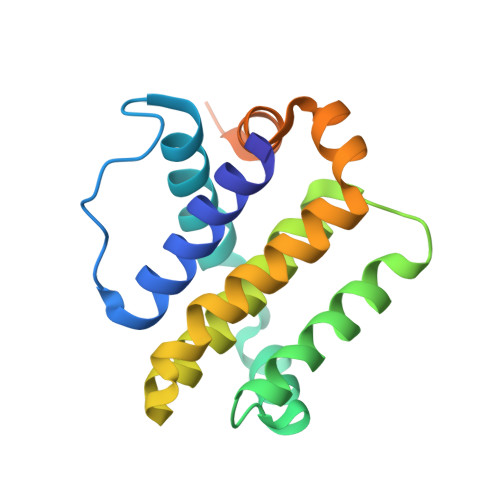
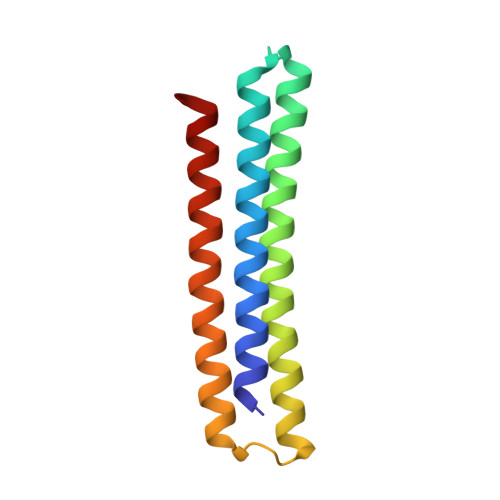
5JSB | pdb_00005jsb

Crystal structure of Mcl1-inhibitor complex


Experimental Data Snapshot

  • Method: X-RAY DIFFRACTION
  • Resolution: 2.74 Å
  • R-Value Free: 
    0.230 (Depositor), 0.227 (DCC) 
  • R-Value Work: 
    0.191 (Depositor), 0.194 (DCC) 
  • R-Value Observed: 
    0.193 (Depositor) 

Starting Model: in silico
View more details

wwPDB Validation 3D Report Full Report

Validation slider image for 5JSB

This is version 1.5 of the entry. See complete history

Literature

Computationally designed high specificity inhibitors delineate the roles of BCL2 family proteins in cancer.

Berger, S.Procko, E.Margineantu, D.Lee, E.F.Shen, B.W.Zelter, A.Silva, D.A.Chawla, K.Herold, M.J.Garnier, J.M.Johnson, R.MacCoss, M.J.Lessene, G.Davis, T.N.Stayton, P.S.Stoddard, B.L.Fairlie, W.D.Hockenbery, D.M.Baker, D.

(2016) Elife 5

  • DOI: https://doi.org/10.7554/eLife.20352
  • Primary Citation Related Structures: 
    5JSB, 5JSN

  • PubMed Abstract: 

    Many cancers overexpress one or more of the six human pro-survival BCL2 family proteins to evade apoptosis. To determine which BCL2 protein or proteins block apoptosis in different cancers, we computationally designed three-helix bundle protein inhibitors specific for each BCL2 pro-survival protein. Following in vitro optimization, each inhibitor binds its target with high picomolar to low nanomolar affinity and at least 300-fold specificity. Expression of the designed inhibitors in human cancer cell lines revealed unique dependencies on BCL2 proteins for survival which could not be inferred from other BCL2 profiling methods. Our results show that designed inhibitors can be generated for each member of a closely-knit protein family to probe the importance of specific protein-protein interactions in complex biological processes.


  • Organizational Affiliation
    • Department of Bioengineering, University of Washington, Seattle, United States.

Macromolecule Content 

  • Total Structure Weight: 202.32 kDa 
  • Atom Count: 13,069 
  • Modeled Residue Count: 1,602 
  • Deposited Residue Count: 1,770 
  • Unique protein chains: 2

Macromolecules

Find similar proteins by:|  3D Structure
Entity ID: 1
MoleculeChains  Sequence LengthOrganismDetailsImage
Induced myeloid leukemia cell differentiation protein Mcl-1
A, C, E, G, I
A, C, E, G, I, K
179Homo sapiensMutation(s): 0 
Gene Names: MCL1BCL2L3
UniProt & NIH Common Fund Data Resources
Find proteins for Q07820 (Homo sapiens)
Explore Q07820 
Go to UniProtKB:  Q07820
PHAROS:  Q07820
GTEx:  ENSG00000143384 
Entity Groups
Sequence Clusters30% Identity50% Identity70% Identity90% Identity95% Identity100% Identity
UniProt GroupQ07820
Sequence Annotations
Expand
Reference Sequence
Find similar proteins by:|  3D Structure
Entity ID: 2
MoleculeChains  Sequence LengthOrganismDetailsImage
Mcl-1 inhibitor
B, D, F, H, J
B, D, F, H, J, L
116synthetic constructMutation(s): 0 

Experimental Data & Validation

Experimental Data

  • Method: X-RAY DIFFRACTION
  • Resolution: 2.74 Å
  • R-Value Free:  0.230 (Depositor), 0.227 (DCC) 
  • R-Value Work:  0.191 (Depositor), 0.194 (DCC) 
  • R-Value Observed: 0.193 (Depositor) 
Space Group: P 1 21 1
Unit Cell:
Length ( Å )Angle ( ˚ )
a = 61.917α = 90
b = 92.246β = 92.39
c = 162.005γ = 90
Software Package:
Software NamePurpose
REFMACrefinement
HKL-2000data collection
HKL-2000data scaling
PHASERphasing
HKL-2000data reduction

Structure Validation

View Full Validation Report


Entry History 

& Funding Information

Deposition Data


Funding OrganizationLocationGrant Number
National Institutes of Health/National Institute of General Medical Sciences (NIH/NIGMS)United StatesNIH R01 GM115545

Revision History  (Full details and data files)

  • Version 1.0: 2016-11-16
    Type: Initial release
  • Version 1.1: 2016-12-07
    Changes: Other
  • Version 1.2: 2017-09-20
    Changes: Author supporting evidence
  • Version 1.3: 2019-12-25
    Changes: Author supporting evidence
  • Version 1.4: 2024-03-06
    Changes: Data collection, Database references, Refinement description
  • Version 1.5: 2024-04-03
    Changes: Refinement description