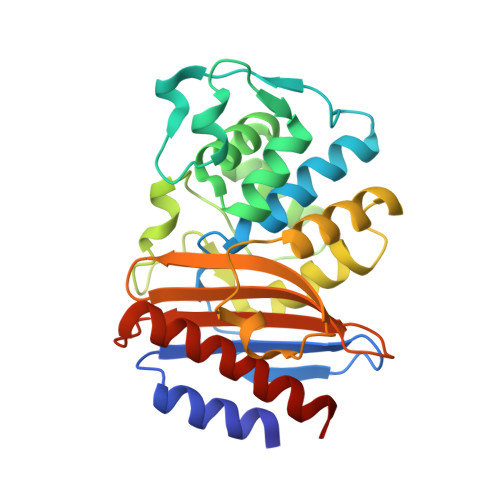
5FQM | pdb_00005fqm

Last common ancestor of Gram Negative Bacteria (GNCA) Class A beta- lactamase


Experimental Data Snapshot

  • Method: X-RAY DIFFRACTION
  • Resolution: 1.50 Å
  • R-Value Free: 
    0.198 (Depositor), 0.197 (DCC) 
  • R-Value Work: 
    0.176 (Depositor), 0.178 (DCC) 
  • R-Value Observed: 
    0.177 (Depositor) 

Starting Model: experimental
View more details

wwPDB Validation 3D Report Full Report

Validation slider image for 5FQM

This is version 1.2 of the entry. See complete history

Literature

De novo active sites for resurrected Precambrian enzymes.

Risso, V.A.Martinez-Rodriguez, S.Candel, A.M.Kruger, D.M.Pantoja-Uceda, D.Ortega-Munoz, M.Santoyo-Gonzalez, F.Gaucher, E.A.Kamerlin, S.C.L.Bruix, M.Gavira, J.A.Sanchez-Ruiz, J.M.

(2017) Nat Commun 8: 16113-16113

  • DOI: https://doi.org/10.1038/ncomms16113
  • Primary Citation Related Structures: 
    4UHU, 5FQI, 5FQJ, 5FQK, 5FQM, 5FQQ

  • PubMed Abstract: 

    Protein engineering studies often suggest the emergence of completely new enzyme functionalities to be highly improbable. However, enzymes likely catalysed many different reactions already in the last universal common ancestor. Mechanisms for the emergence of completely new active sites must therefore either plausibly exist or at least have existed at the primordial protein stage. Here, we use resurrected Precambrian proteins as scaffolds for protein engineering and demonstrate that a new active site can be generated through a single hydrophobic-to-ionizable amino acid replacement that generates a partially buried group with perturbed physico-chemical properties. We provide experimental and computational evidence that conformational flexibility can assist the emergence and subsequent evolution of new active sites by improving substrate and transition-state binding, through the sampling of many potentially productive conformations. Our results suggest a mechanism for the emergence of primordial enzymes and highlight the potential of ancestral reconstruction as a tool for protein engineering.


  • Organizational Affiliation
    • Departamento de Quimica Fisica, Facultad de Ciencias University of Granada, 18071 Granada, Spain.

Macromolecule Content 

  • Total Structure Weight: 30.07 kDa 
  • Atom Count: 2,503 
  • Modeled Residue Count: 262 
  • Deposited Residue Count: 269 
  • Unique protein chains: 1

Macromolecules

Find similar proteins by:|  3D Structure
Entity ID: 1
MoleculeChains  Sequence LengthOrganismDetailsImage
GNCA BETA LACTAMASE269synthetic constructMutation(s): 0 

Small Molecules

Ligands 2 Unique
IDChains Name / Formula / InChI Key2D Diagram3D Interactions
SO4

Query on SO4


Download:Ideal Coordinates CCD File
B [auth A]SULFATE ION
O4 S
QAOWNCQODCNURD-UHFFFAOYSA-L
GOL

Query on GOL


Download:Ideal Coordinates CCD File
C [auth A]
D [auth A]
E [auth A]
F [auth A]
G [auth A]
C [auth A],
D [auth A],
E [auth A],
F [auth A],
G [auth A],
H [auth A],
I [auth A],
J [auth A],
K [auth A],
L [auth A],
M [auth A]
GLYCEROL
C3 H8 O3
PEDCQBHIVMGVHV-UHFFFAOYSA-N

Experimental Data & Validation

Experimental Data

  • Method: X-RAY DIFFRACTION
  • Resolution: 1.50 Å
  • R-Value Free:  0.198 (Depositor), 0.197 (DCC) 
  • R-Value Work:  0.176 (Depositor), 0.178 (DCC) 
  • R-Value Observed: 0.177 (Depositor) 
Space Group: I 41
Unit Cell:
Length ( Å )Angle ( ˚ )
a = 94.23α = 90
b = 94.23β = 90
c = 93.58γ = 90
Software Package:
Software NamePurpose
PHENIXrefinement
MOSFLMdata reduction
SCALAdata scaling
MOLREPphasing

Structure Validation

View Full Validation Report


Entry History 

Deposition Data

Revision History  (Full details and data files)

  • Version 1.0: 2017-01-18
    Type: Initial release
  • Version 1.1: 2017-07-26
    Changes: Database references
  • Version 1.2: 2024-01-10
    Changes: Data collection, Database references, Derived calculations, Other, Refinement description