Download Mendeley
De novo active sites for resurrected Precambrian enzymes.
Risso, V.A., Martinez-Rodriguez, S., Candel, A.M., Kruger, D.M., Pantoja-Uceda, D., Ortega-Munoz, M., Santoyo-Gonzalez, F., Gaucher, E.A., Kamerlin, S.C.L., Bruix, M., Gavira, J.A., Sanchez-Ruiz, J.M.(2017) Nat Commun 8: 16113-16113
- PubMed: 28719578 Search on PubMedSearch on PubMed Central
- DOI: https://doi.org/10.1038/ncomms16113
- Primary Citation Related Structures:
4UHU, 5FQI, 5FQJ, 5FQK, 5FQM, 5FQQ - PubMed Abstract:
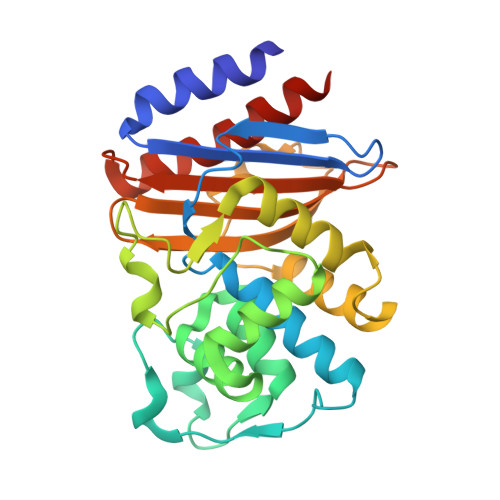
Protein engineering studies often suggest the emergence of completely new enzyme functionalities to be highly improbable. However, enzymes likely catalysed many different reactions already in the last universal common ancestor. Mechanisms for the emergence of completely new active sites must therefore either plausibly exist or at least have existed at the primordial protein stage. Here, we use resurrected Precambrian proteins as scaffolds for protein engineering and demonstrate that a new active site can be generated through a single hydrophobic-to-ionizable amino acid replacement that generates a partially buried group with perturbed physico-chemical properties. We provide experimental and computational evidence that conformational flexibility can assist the emergence and subsequent evolution of new active sites by improving substrate and transition-state binding, through the sampling of many potentially productive conformations. Our results suggest a mechanism for the emergence of primordial enzymes and highlight the potential of ancestral reconstruction as a tool for protein engineering.
- Departamento de Quimica Fisica, Facultad de Ciencias University of Granada, 18071 Granada, Spain.
Organizational Affiliation: