5B4I | pdb_00005b4i

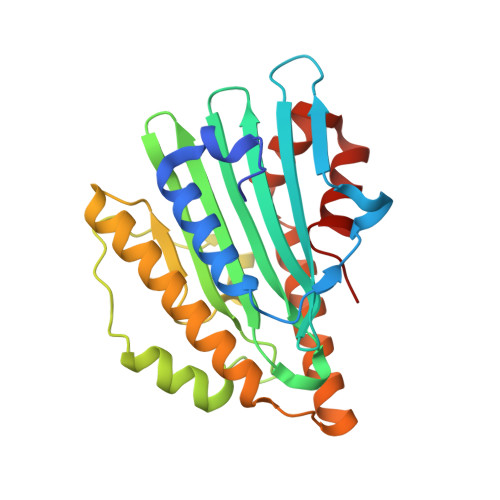
Crystal structure of I86D mutant of phycocyanobilin:ferredoxin oxidoreductase in complex with biliverdin (data 2)


Experimental Data Snapshot

  • Method: X-RAY DIFFRACTION
  • Resolution: 1.11 Å
  • R-Value Free: 
    0.152 (Depositor), 0.139 (DCC) 
  • R-Value Work: 
    0.127 (Depositor), 0.135 (DCC) 

Starting Model: experimental
View more details

wwPDB Validation 3D Report Full Report

Validation slider image for 5B4I

Ligand Structure Quality Assessment 


This is version 1.2 of the entry. See complete history

Literature

Atomic-resolution structure of the phycocyanobilin:ferredoxin oxidoreductase I86D mutant in complex with fully protonated biliverdin

Hagiwara, Y.Wada, K.Irikawa, T.Sato, H.Unno, M.Yamamoto, K.Fukuyama, K.Sugishima, M.

(2016) FEBS Lett 590: 3425-3434

  • DOI: https://doi.org/10.1002/1873-3468.12387
  • Primary Citation Related Structures: 
    5B4H, 5B4I, 5B4J

  • PubMed Abstract: 

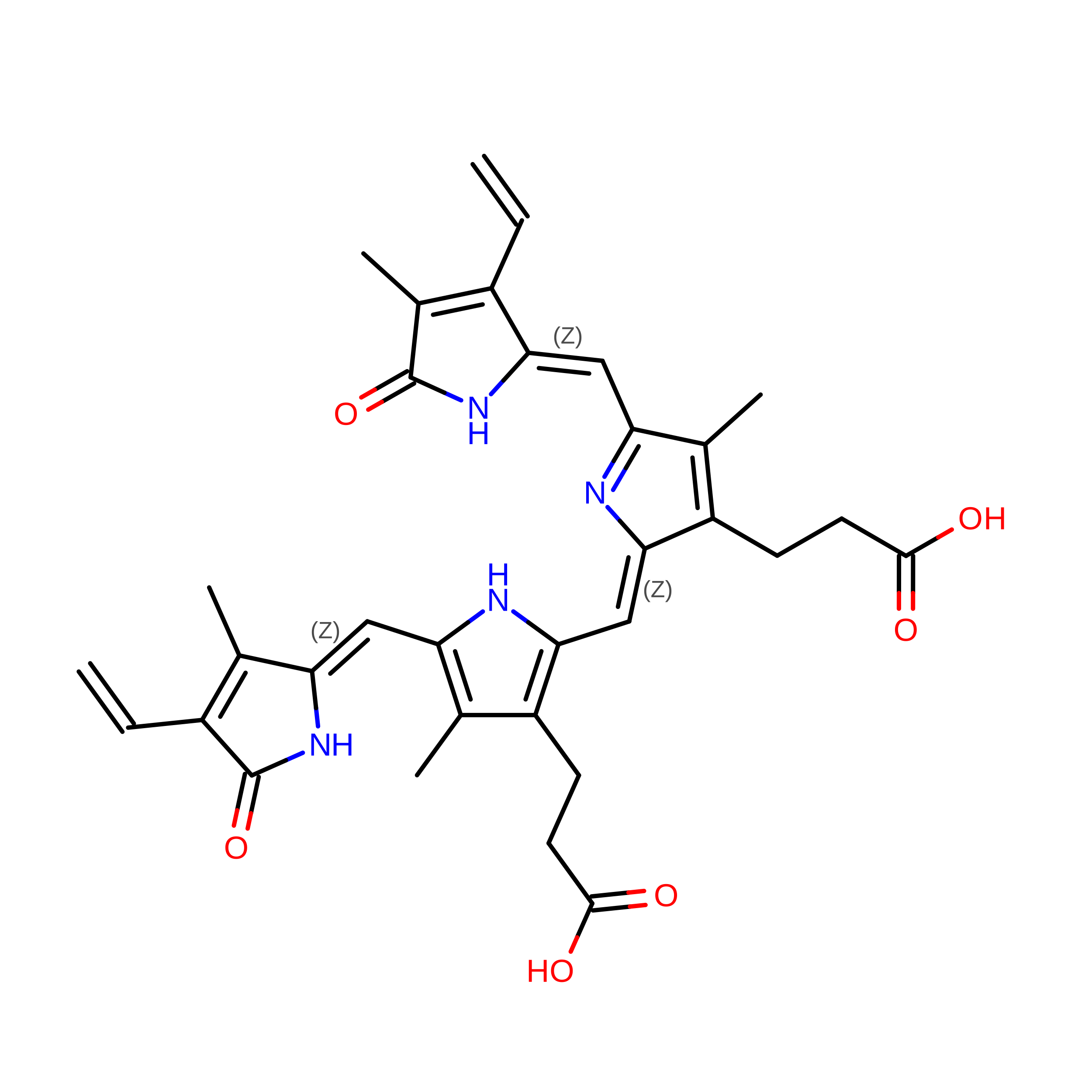
    Phycocyanobilin:ferredoxin oxidoreductase (PcyA) catalyzes the reduction of biliverdin (BV) to produce phycocyanobilin, a linear tetrapyrrole pigment used for light harvesting and light sensing. Spectroscopic and HPLC analyses inidicate that BV bound to the I86D mutant of PcyA is fully protonated (BVH + ) and can accept an electron, but I86D is unable to donate protons for the reduction; therefore, compared to the wild-type PcyA, the I86D mutant stabilizes BVH + . To elucidate the structural basis of the I86D mutation, we determined the atomic-resolution structure of the I86D-BVH + complex and the protonation states of the essential residues Asp105 and Glu76 in PcyA. Our study revealed that Asp105 adopted a fixed conformation in the I86D mutant, although it had dual conformations in wild-type PcyA which reflected the protonation states of BV. Taken together with biochemical/spectroscopic results, our analysis of the I86D-BVH + structure supports the hypothesis that flexibility of Asp105 is essential for the catalytic activity of PcyA.


  • Organizational Affiliation
    • Department of Biochemistry and Applied Chemistry, National Institute of Technology, Kurume College, Kurume, Japan.

Macromolecule Content 

  • Total Structure Weight: 28.74 kDa 
  • Atom Count: 2,457 
  • Modeled Residue Count: 240 
  • Deposited Residue Count: 248 
  • Unique protein chains: 1

Macromolecules

Find similar proteins by:|  3D Structure
Entity ID: 1
MoleculeChains  Sequence LengthOrganismDetailsImage
Phycocyanobilin:ferredoxin oxidoreductase248Synechocystis sp. PCC 6803Mutation(s): 1 
Gene Names: pcyA
EC: 1.3.7.5
UniProt
Find proteins for Q55891 (Synechocystis sp. (strain ATCC 27184 / PCC 6803 / Kazusa))
Explore Q55891 
Go to UniProtKB:  Q55891
Entity Groups
Sequence Clusters30% Identity50% Identity70% Identity90% Identity95% Identity100% Identity
UniProt GroupQ55891
Sequence Annotations
Expand
Reference Sequence

Small Molecules

Ligands 1 Unique
IDChains Name / Formula / InChI Key2D Diagram3D Interactions
BLA

Query on BLA


Download:Ideal Coordinates CCD File
B [auth A]BILIVERDINE IX ALPHA
C33 H34 N4 O6
GWZYPXHJIZCRAJ-SRVCBVSDSA-N

Experimental Data & Validation

Experimental Data

  • Method: X-RAY DIFFRACTION
  • Resolution: 1.11 Å
  • R-Value Free:  0.152 (Depositor), 0.139 (DCC) 
  • R-Value Work:  0.127 (Depositor), 0.135 (DCC) 
Space Group: P 21 21 2
Unit Cell:
Length ( Å )Angle ( ˚ )
a = 70.833α = 90
b = 95.691β = 90
c = 42.398γ = 90
Software Package:
Software NamePurpose
SHELXL-97refinement
PHENIXphasing
HKL-2000data reduction
HKL-2000data scaling
SHELXphasing

Structure Validation

View Full Validation Report


Ligand Structure Quality Assessment 


Entry History 

& Funding Information

Deposition Data


Funding OrganizationLocationGrant Number
JSPSJapan20370037
JSPSJapan22770096
JSPSJapan23370052
JSPSJapan24570122
JSPSJapan24870030
JSPSJapan25840026
MEXT, Program to Disseminate Tenura TrackingJapan--

Revision History  (Full details and data files)

  • Version 1.0: 2017-03-15
    Type: Initial release
  • Version 1.1: 2020-02-26
    Changes: Data collection
  • Version 1.2: 2023-11-08
    Changes: Data collection, Database references, Refinement description