5A2B | pdb_00005a2b

Crystal Structure of Anoxybacillus Alpha-amylase Provides Insights into a New Glycosyl Hydrolase Subclass


Experimental Data Snapshot

  • Method: X-RAY DIFFRACTION
  • Resolution: 1.85 Å
  • R-Value Free: 
    0.193 (Depositor), 0.202 (DCC) 
  • R-Value Work: 
    0.155 (Depositor), 0.166 (DCC) 
  • R-Value Observed: 
    0.157 (Depositor) 

Starting Model: experimental
View more details

wwPDB Validation 3D Report Full Report

Validation slider image for 5A2B

This is version 2.1 of the entry. See complete history

Literature

Crystal Structure of Anoxybacillus Alpha-Amylase Provides Insights Into Maltose Binding of a New Glycosyl Hydrolase Subclass.

Chai, K.P.Othman, N.F.B.Teh, A.Ho, K.L.Chan, K.Shamsir, M.S.Goh, K.M.Ng, C.L.

(2016) Sci Rep 6: 23126

  • DOI: https://doi.org/10.1038/srep23126
  • Primary Citation Related Structures: 
    5A2A, 5A2B, 5A2C

  • PubMed Abstract: 

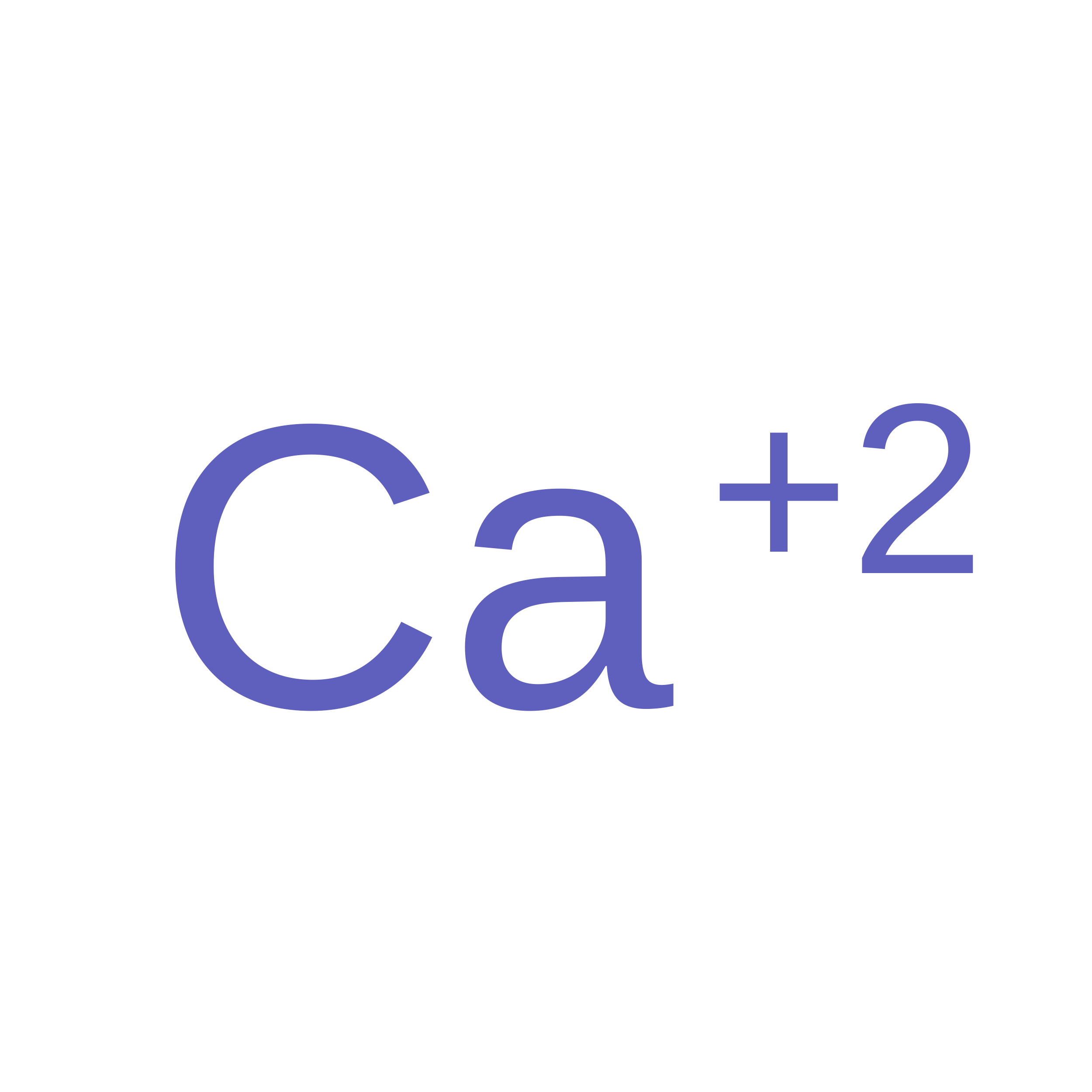
    A new subfamily of glycosyl hydrolase family GH13 was recently proposed for α-amylases from Anoxybacillus species (ASKA and ADTA), Geobacillus thermoleovorans (GTA, Pizzo, and GtamyII), Bacillus aquimaris (BaqA), and 95 other putative protein homologues. To understand this new GH13 subfamily, we report crystal structures of truncated ASKA (TASKA). ASKA is a thermostable enzyme capable of producing high levels of maltose. Unlike GTA, biochemical analysis showed that Ca(2+) ion supplementation enhances the catalytic activities of ASKA and TASKA. The crystal structures reveal the presence of four Ca(2+) ion binding sites, with three of these binding sites are highly conserved among Anoxybacillus α-amylases. This work provides structural insights into this new GH13 subfamily both in the apo form and in complex with maltose. Furthermore, structural comparison of TASKA and GTA provides an overview of the conformational changes accompanying maltose binding at each subsite.


  • Organizational Affiliation
    • Universiti Teknologi Malaysia, Faculty of Biosciences and Medical Engineering, 81310 Skudai, Johor, Malaysia.

Macromolecule Content 

  • Total Structure Weight: 58.67 kDa 
  • Atom Count: 4,226 
  • Modeled Residue Count: 452 
  • Deposited Residue Count: 497 
  • Unique protein chains: 1

Macromolecules

Find similar proteins by:|  3D Structure
Entity ID: 1
MoleculeChains  Sequence LengthOrganismDetailsImage
ANOXYBACILLUS ALPHA-AMYLASE497Anoxybacillus ayderensisMutation(s): 0 
EC: 3.2.1.1
UniProt
Find proteins for I1VWH9 (Anoxybacillus ayderensis)
Explore I1VWH9 
Go to UniProtKB:  I1VWH9
Entity Groups
Sequence Clusters30% Identity50% Identity70% Identity90% Identity95% Identity100% Identity
UniProt GroupI1VWH9
Sequence Annotations
Expand
Reference Sequence

Oligosaccharides

Help  
Entity ID: 2
MoleculeChains Length2D Diagram GlycosylationD Interactions
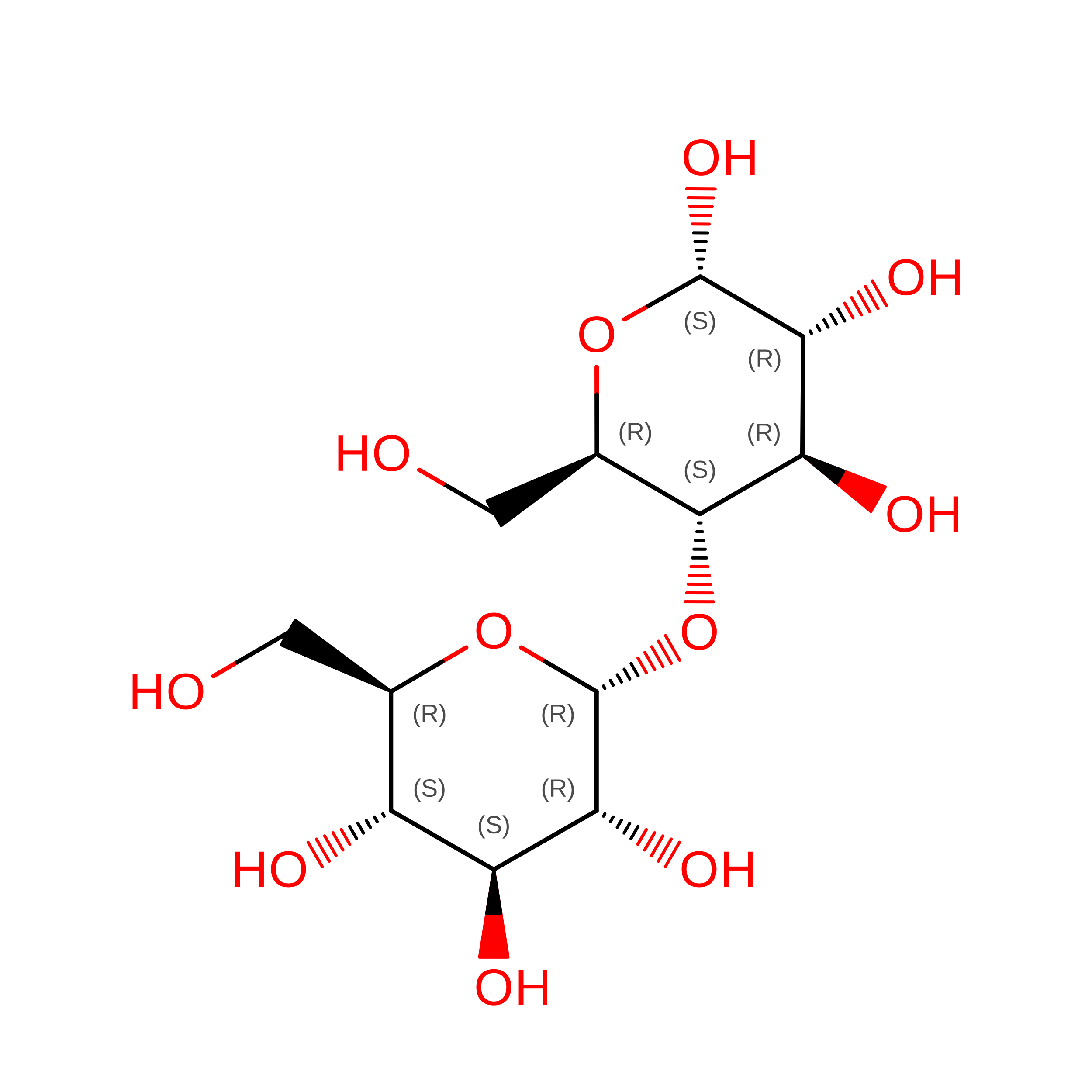
alpha-D-glucopyranose-(1-4)-alpha-D-glucopyranose
B
2N/A
Glycosylation Resources
GlyTouCan: G07411ON
GlyCosmos: G07411ON

Biologically Interesting Molecules (External Reference) 

1 Unique

Experimental Data & Validation

Experimental Data

  • Method: X-RAY DIFFRACTION
  • Resolution: 1.85 Å
  • R-Value Free:  0.193 (Depositor), 0.202 (DCC) 
  • R-Value Work:  0.155 (Depositor), 0.166 (DCC) 
  • R-Value Observed: 0.157 (Depositor) 
Space Group: P 21 21 21
Unit Cell:
Length ( Å )Angle ( ˚ )
a = 64.013α = 90
b = 65.296β = 90
c = 126.708γ = 90
Software Package:
Software NamePurpose
REFMACrefinement
XDSdata reduction
XSCALEdata scaling
PHASERphasing

Structure Validation

View Full Validation Report


Entry History 

Deposition Data

Revision History  (Full details and data files)

  • Version 1.0: 2016-03-30
    Type: Initial release
  • Version 2.0: 2020-07-29
    Type: Remediation
    Reason: Carbohydrate remediation
    Changes: Advisory, Atomic model, Data collection, Derived calculations, Non-polymer description, Other, Structure summary
  • Version 2.1: 2024-01-10
    Changes: Data collection, Database references, Refinement description, Structure summary