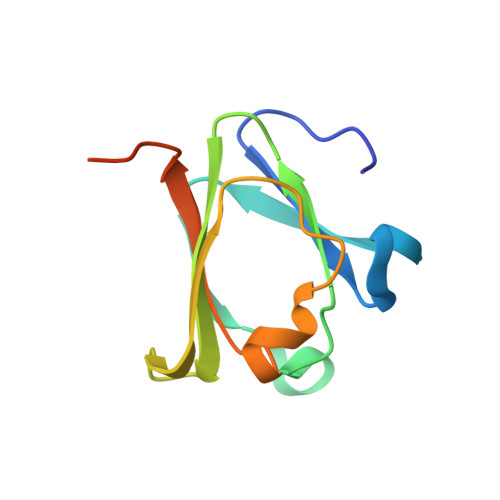
5Z6E | pdb_00005z6e

Crystal structure of a beta gamma-crystallin domain of Abundant Perithecial Protein (APP) from Neurospora crassa in the Ca2+-bound form


Experimental Data Snapshot

  • Method: X-RAY DIFFRACTION
  • Resolution: 1.86 Å
  • R-Value Free: 
    0.201 (Depositor), 0.201 (DCC) 
  • R-Value Work: 
    0.159 (Depositor), 0.160 (DCC) 
  • R-Value Observed: 
    0.161 (Depositor) 

Starting Model: experimental
View more details

wwPDB Validation 3D Report Full Report

Validation slider image for 5Z6E

This is version 1.2 of the entry. See complete history

Literature

Interface interactions between beta gamma-crystallin domain and Ig-like domain render Ca2+-binding site inoperative in abundant perithecial protein of Neurospora crassa.

Swaroop Srivastava, S.Raman, R.Kiran, U.Garg, R.Chadalawada, S.Pawar, A.D.Sankaranarayanan, R.Sharma, Y.

(2018) Mol Microbiol 110: 955-972

  • DOI: https://doi.org/10.1111/mmi.14130
  • Primary Citation Related Structures: 
    5Z6D, 5Z6E

  • PubMed Abstract: 

    We describe a set of proteins in which a βγ-crystallin domain pairs with an Ig-like domain, and which are confined to microbes, like bacteria, slime molds and fungi. DdCAD-1 (Ca 2+ -dependent cell adhesion molecule-1) and abundant perithecial protein (APP) represent this class of molecules. Using the crystal structure of APP-NTD (N-terminal domain of APP), we describe its mode of Ca 2+ binding and provide a generalized theme for correct identification of the Ca 2+ -binding site within this class of molecules. As a common feature, one of the two Ca 2+ -binding sites is non-functional in the βγ-crystallin domains of these proteins. While APP-NTD binds Ca 2+ with a micromolar affinity which is comparable to DdCAD-1, APP surprisingly does not bind Ca 2+ . Crystal structures of APP and Ca 2+ -bound APP-NTD reveal that the interface interactions in APP render its Ca 2+ -binding site inoperative. Thus, heterodomain association provides a novel mode of Ca 2+ -binding regulation in APP. Breaking the interface interactions (mutating Asp30Ala, Leu132Ala and Ile135Ala) or separation from the Ig-like domain removes the constraints upon the required conformational transition and enables the βγ-crystallin domain to bind Ca 2+ . In mechanistic detail, our work demonstrates an interdomain interface adapted to distinct functional niches in APP and its homolog DdCAD-1.


  • Organizational Affiliation
    • CSIR - Centre for Cellular and Molecular Biology (CCMB), Hyderabad, 500 007, India.

Macromolecule Content 

  • Total Structure Weight: 11.24 kDa 
  • Atom Count: 815 
  • Modeled Residue Count: 90 
  • Deposited Residue Count: 101 
  • Unique protein chains: 1

Macromolecules

Find similar proteins by:|  3D Structure
Entity ID: 1
MoleculeChains  Sequence LengthOrganismDetailsImage
DUF1881 domain-containing protein101Neurospora crassa OR74AMutation(s): 0 
Gene Names: appNCU04533
UniProt
Find proteins for Q7RY31 (Neurospora crassa (strain ATCC 24698 / 74-OR23-1A / CBS 708.71 / DSM 1257 / FGSC 987))
Explore Q7RY31 
Go to UniProtKB:  Q7RY31
Entity Groups
Sequence Clusters30% Identity50% Identity70% Identity90% Identity95% Identity100% Identity
UniProt GroupQ7RY31
Sequence Annotations
Expand
Reference Sequence

Experimental Data & Validation

Experimental Data

  • Method: X-RAY DIFFRACTION
  • Resolution: 1.86 Å
  • R-Value Free:  0.201 (Depositor), 0.201 (DCC) 
  • R-Value Work:  0.159 (Depositor), 0.160 (DCC) 
  • R-Value Observed: 0.161 (Depositor) 
Space Group: P 32 2 1
Unit Cell:
Length ( Å )Angle ( ˚ )
a = 48.951α = 90
b = 48.951β = 90
c = 81.844γ = 120
Software Package:
Software NamePurpose
PHENIXrefinement
HKL-2000data reduction
HKL-2000data scaling
PHENIXphasing

Structure Validation

View Full Validation Report


Entry History 

& Funding Information

Deposition Data


Funding OrganizationLocationGrant Number
Council of Scientific and Industrial ResearchIndia--

Revision History  (Full details and data files)

  • Version 1.0: 2019-01-23
    Type: Initial release
  • Version 1.1: 2019-08-07
    Changes: Data collection, Database references
  • Version 1.2: 2023-11-22
    Changes: Data collection, Database references, Derived calculations, Refinement description