5YOK | pdb_00005yok

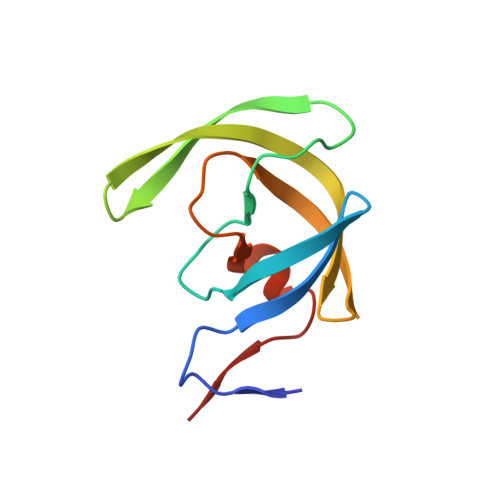
Structure of HIV-1 Protease in Complex with Inhibitor KNI-1657


Experimental Data Snapshot

  • Method: X-RAY DIFFRACTION
  • Resolution: 0.85 Å
  • R-Value Free: 
    0.125 (Depositor), 0.118 (DCC) 
  • R-Value Work: 
    0.103 (Depositor), 0.102 (DCC) 

wwPDB Validation 3D Report Full Report

Validation slider image for 5YOK

Ligand Structure Quality Assessment 


This is version 1.1 of the entry. See complete history

Literature

Identification of Highly Potent Human Immunodeficiency Virus Type-1 Protease Inhibitors against Lopinavir and Darunavir Resistant Viruses from Allophenylnorstatine-Based Peptidomimetics with P2 Tetrahydrofuranylglycine.

Hidaka, K.Kimura, T.Sankaranarayanan, R.Wang, J.McDaniel, K.F.Kempf, D.J.Kameoka, M.Adachi, M.Kuroki, R.Nguyen, J.T.Hayashi, Y.Kiso, Y.

(2018) J Med Chem 61: 5138-5153

  • DOI: https://doi.org/10.1021/acs.jmedchem.7b01709
  • Primary Citation Related Structures: 
    5YOJ, 5YOK

  • PubMed Abstract: 

    The emergence of drug-resistant HIV from a widespread antiviral chemotherapy targeting HIV protease in the past decades is unavoidable and provides a challenge to develop alternative inhibitors. We synthesized a series of allophenylnorstatine-based peptidomimetics with various P 3 , P 2 , and P 2 ́ moieties. The derivatives with P 2 tetrahydrofuranylglycine (Thfg) were found to be potent against wild type HIV-1 protease and the virus, leading to a highly potent compound 21f (KNI-1657) against lopinavir/ritonavir- or darunavir-resistant strains. Co-crystal structures of 21f and the wild-type protease revealed numerous key hydrogen bonding interactions with Thfg. These results suggest that the strategy to design allophenylnorstatine-based peptidomimetics combined with Thfg residue would be promising for generating candidates to overcome multidrug resistance.


  • Organizational Affiliation
    • Laboratory of Medicinal Chemistry, Faculty of Pharmaceutical Sciences , Kobe Gakuin University , Kobe 650-8586 , Japan.

Macromolecule Content 

  • Total Structure Weight: 22.68 kDa 
  • Atom Count: 2,395 
  • Modeled Residue Count: 198 
  • Deposited Residue Count: 200 
  • Unique protein chains: 1

Macromolecules

Find similar proteins by:|  3D Structure
Entity ID: 1
MoleculeChains  Sequence LengthOrganismDetailsImage
HIV-1 PROTEASE
A, B
100Human immunodeficiency virus 1Mutation(s): 0 
Gene Names: pol
UniProt
Find proteins for P03367 (Human immunodeficiency virus type 1 group M subtype B (isolate BRU/LAI))
Explore P03367 
Go to UniProtKB:  P03367
Entity Groups
Sequence Clusters30% Identity50% Identity70% Identity90% Identity95% Identity100% Identity
UniProt GroupP03367
Sequence Annotations
Expand
Reference Sequence

Small Molecules

Ligands 2 Unique
IDChains Name / Formula / InChI Key2D Diagram3D Interactions
8Z0

Query on 8Z0


Download:Ideal Coordinates CCD File
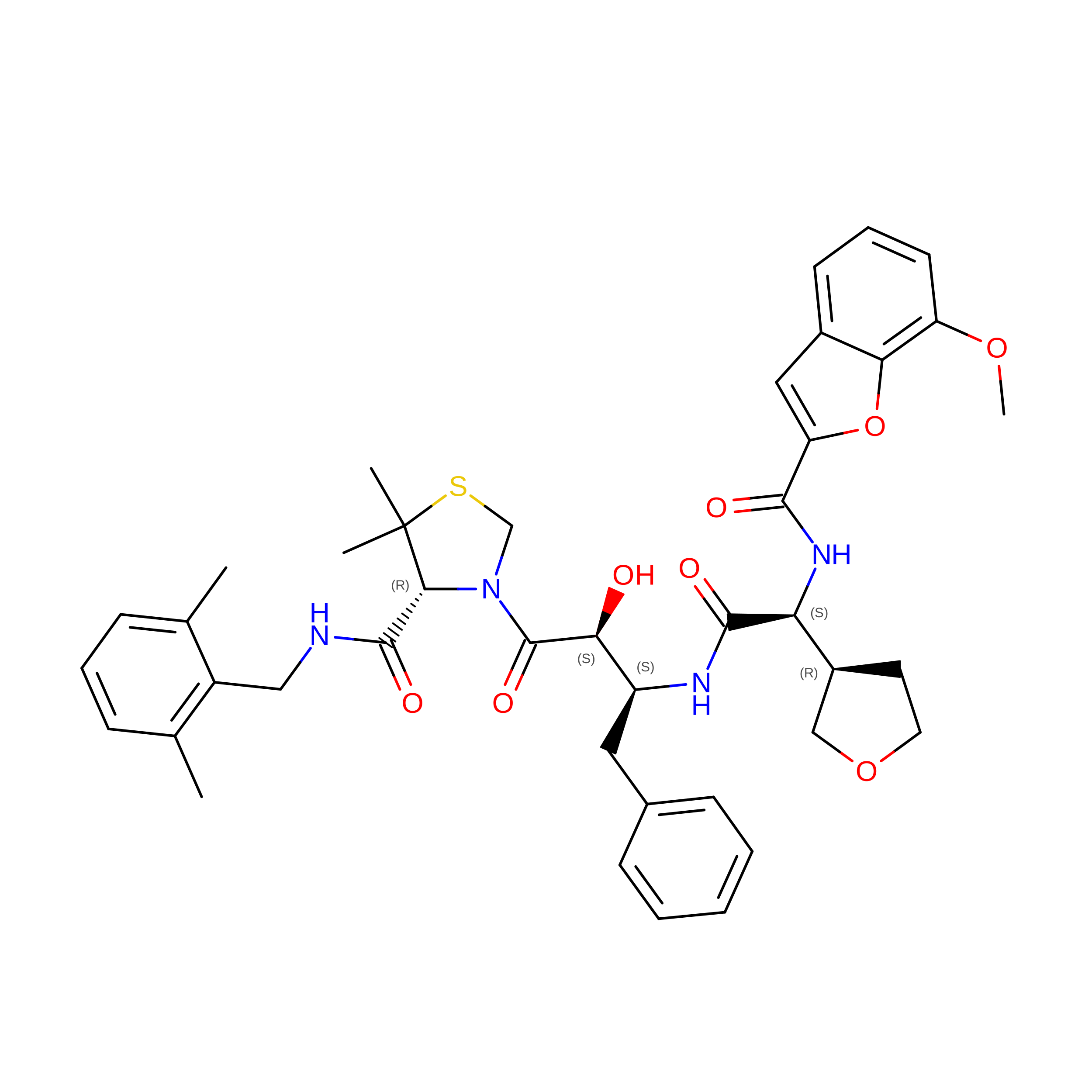
C [auth A](4R)-N-[(2,6-dimethylphenyl)methyl]-3-[(2S,3S)-3-[[(2S)-2-[(7-methoxy-1-benzofuran-2-yl)carbonylamino]-2-[(3R)-oxolan-3 -yl]ethanoyl]amino]-2-oxidanyl-4-phenyl-butanoyl]-5,5-dimethyl-1,3-thiazolidine-4-carboxamide
C41 H48 N4 O8 S
ZNVSERMHCCYPMY-JZILQDPNSA-N
GOL

Query on GOL


Download:Ideal Coordinates CCD File
D [auth B],
E [auth B]
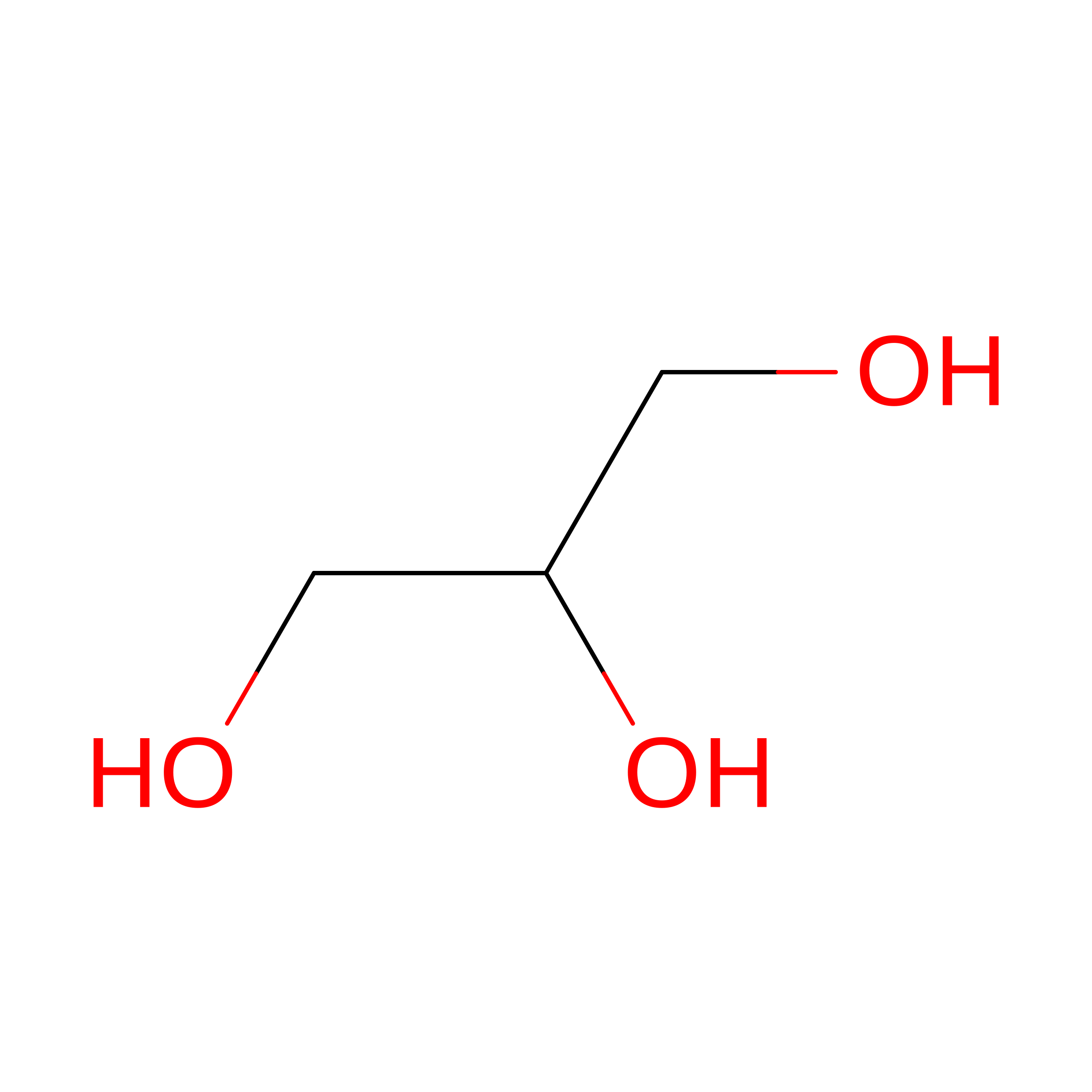
GLYCEROL
C3 H8 O3
PEDCQBHIVMGVHV-UHFFFAOYSA-N

Experimental Data & Validation

Experimental Data

  • Method: X-RAY DIFFRACTION
  • Resolution: 0.85 Å
  • R-Value Free:  0.125 (Depositor), 0.118 (DCC) 
  • R-Value Work:  0.103 (Depositor), 0.102 (DCC) 
Space Group: P 21 21 2
Unit Cell:
Length ( Å )Angle ( ˚ )
a = 58.25α = 90
b = 85.948β = 90
c = 46.529γ = 90
Software Package:
Software NamePurpose
SHELXLrefinement
HKL-2000data reduction
SCALAdata scaling
PHENIXphasing

Structure Validation

View Full Validation Report


Ligand Structure Quality Assessment 


Entry History 

& Funding Information

Deposition Data


Funding OrganizationLocationGrant Number
Ministry of Education, Culture, Sports, Science and Technology (Japan)Japan--

Revision History  (Full details and data files)

  • Version 1.0: 2018-07-18
    Type: Initial release
  • Version 1.1: 2024-03-27
    Changes: Data collection, Database references, Derived calculations, Structure summary