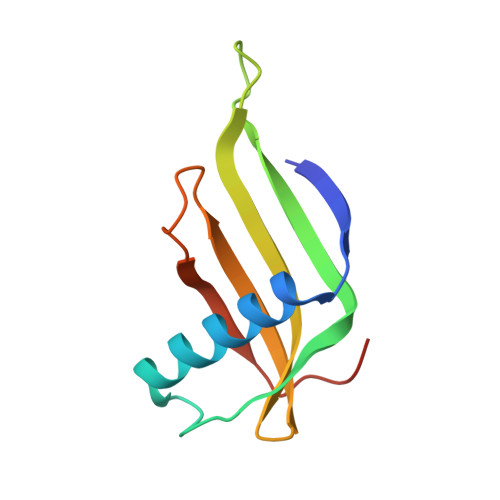
5YCT | pdb_00005yct

Engineered hairpin loop3 mutant monomer in Single-chain Monellin


Experimental Data Snapshot

  • Method: X-RAY DIFFRACTION
  • Resolution: 1.85 Å
  • R-Value Free: 
    0.227 (Depositor), 0.229 (DCC) 
  • R-Value Work: 
    0.192 (Depositor), 0.195 (DCC) 
  • R-Value Observed: 
    0.194 (Depositor) 

Starting Model: experimental
View more details

wwPDB Validation 3D Report Full Report

Validation slider image for 5YCT

This is version 1.2 of the entry. See complete history

Literature

A five-residue motif for the design of domain swapping in proteins.

Nandwani, N.Surana, P.Negi, H.Mascarenhas, N.M.Udgaonkar, J.B.Das, R.Gosavi, S.

(2019) Nat Commun 10: 452-452

  • DOI: https://doi.org/10.1038/s41467-019-08295-x
  • Primary Citation Related Structures: 
    5YCT, 5YCU, 5YCW, 6IWJ

  • PubMed Abstract: 

    Domain swapping is the process by which identical monomeric proteins exchange structural elements to generate dimers/oligomers. Although engineered domain swapping is a compelling strategy for protein assembly, its application has been limited due to the lack of simple and reliable design approaches. Here, we demonstrate that the hydrophobic five-residue 'cystatin motif' (QVVAG) from the domain-swapping protein Stefin B, when engineered into a solvent-exposed, tight surface loop between two β-strands prevents the loop from folding back upon itself, and drives domain swapping in non-domain-swapping proteins. High-resolution structural studies demonstrate that engineering the QVVAG stretch independently into various surface loops of four structurally distinct non-domain-swapping proteins enabled the design of different modes of domain swapping in these proteins, including single, double and open-ended domain swapping. These results suggest that the introduction of the QVVAG motif can be used as a mutational approach for engineering domain swapping in diverse β-hairpin proteins.


  • Organizational Affiliation
    • National Centre for Biological Sciences, Tata Institute of Fundamental Research, Bengaluru, 560065, India.

Macromolecule Content 

  • Total Structure Weight: 22.99 kDa 
  • Atom Count: 1,675 
  • Modeled Residue Count: 187 
  • Deposited Residue Count: 200 
  • Unique protein chains: 1

Macromolecules

Find similar proteins by:|  3D Structure
Entity ID: 1
MoleculeChains  Sequence LengthOrganismDetailsImage
Single chain Monellin
A, B
100Dioscoreophyllum cumminsiiMutation(s): 0 
UniProt
Find proteins for P02881 (Dioscoreophyllum cumminsii)
Explore P02881 
Go to UniProtKB:  P02881
Find proteins for P02882 (Dioscoreophyllum cumminsii)
Explore P02882 
Go to UniProtKB:  P02882
Entity Groups
Sequence Clusters30% Identity50% Identity70% Identity90% Identity95% Identity100% Identity
UniProt GroupsP02881P02882
Sequence Annotations
Expand
Reference Sequence

Experimental Data & Validation

Experimental Data

  • Method: X-RAY DIFFRACTION
  • Resolution: 1.85 Å
  • R-Value Free:  0.227 (Depositor), 0.229 (DCC) 
  • R-Value Work:  0.192 (Depositor), 0.195 (DCC) 
  • R-Value Observed: 0.194 (Depositor) 
Space Group: P 1 21 1
Unit Cell:
Length ( Å )Angle ( ˚ )
a = 35.601α = 90
b = 48.103β = 103.67
c = 62.712γ = 90
Software Package:
Software NamePurpose
PHENIXrefinement
HKL-3000data reduction
Aimlessdata scaling
MOLREPphasing

Structure Validation

View Full Validation Report


Entry History 

Deposition Data

Revision History  (Full details and data files)

  • Version 1.0: 2018-11-28
    Type: Initial release
  • Version 1.1: 2019-02-13
    Changes: Data collection, Database references
  • Version 1.2: 2023-11-22
    Changes: Data collection, Database references, Refinement description