Download Mendeley
4-Amino-2-Sulfanylbenzoic Acid as a Potent Subclass B3 Metallo-beta-Lactamase-Specific Inhibitor Applicable for Distinguishing Metallo-beta-Lactamase Subclasses.
Wachino, J., Kanechi, R., Nishino, E., Mochizuki, M., Jin, W., Kimura, K., Kurosaki, H., Arakawa, Y.(2019) Antimicrob Agents Chemother 63
- PubMed: 31405855 Search on PubMedSearch on PubMed Central
- DOI: https://doi.org/10.1128/AAC.01197-19
- Primary Citation Related Structures:
5Y5B, 6JED, 6K4T, 6K4X - PubMed Abstract:
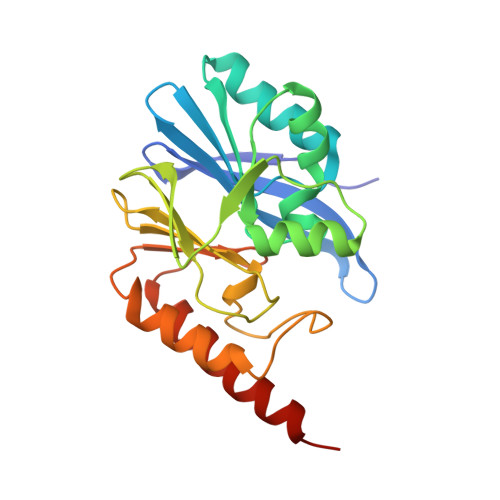
The number of cases of infection with carbapenem-resistant Enterobacteriaceae (CRE) has been increasing and has become a major clinical and public health concern. Production of metallo-β-lactamases (MBLs) is one of the principal carbapenem resistance mechanisms in CRE. Therefore, developing MBL inhibitors is a promising strategy to overcome the problems of carbapenem resistance conferred by MBLs. To date, the development and evaluation of MBL inhibitors have focused on subclass B1 MBLs but not on B3 MBLs. In the present study, we searched for B3 MBL (specifically, SMB-1) inhibitors and found thiosalicylic acid (TSA) to be a potent inhibitor of B3 SMB-1 MBL (50% inhibitory concentration [IC 50 ], 0.95 μM). TSA inhibited the purified SMB-1 to a considerable degree but was not active against Escherichia coli cells producing SMB-1, as the meropenem (MEM) MIC for the SMB-1 producer was only slightly reduced with TSA. We then introduced a primary amine to TSA and synthesized 4-amino-2-sulfanylbenzoic acid (ASB), which substantially reduced the MEM MICs for SMB-1 producers. X-ray crystallographic analyses revealed that ASB binds to the two zinc ions, Ser221, and Thr223 at the active site of SMB-1. These are ubiquitously conserved residues across clinically relevant B3 MBLs. ASB also significantly inhibited other B3 MBLs, including AIM-1, LMB-1, and L1. Therefore, the characterization of ASB provides a starting point for the development of optimum B3 MBL inhibitors.
- Department of Bacteriology, Nagoya University Graduate School of Medicine, Nagoya, Aichi, Japan wachino@med.nagoya-u.ac.jp.
Organizational Affiliation: