5XZV | pdb_00005xzv

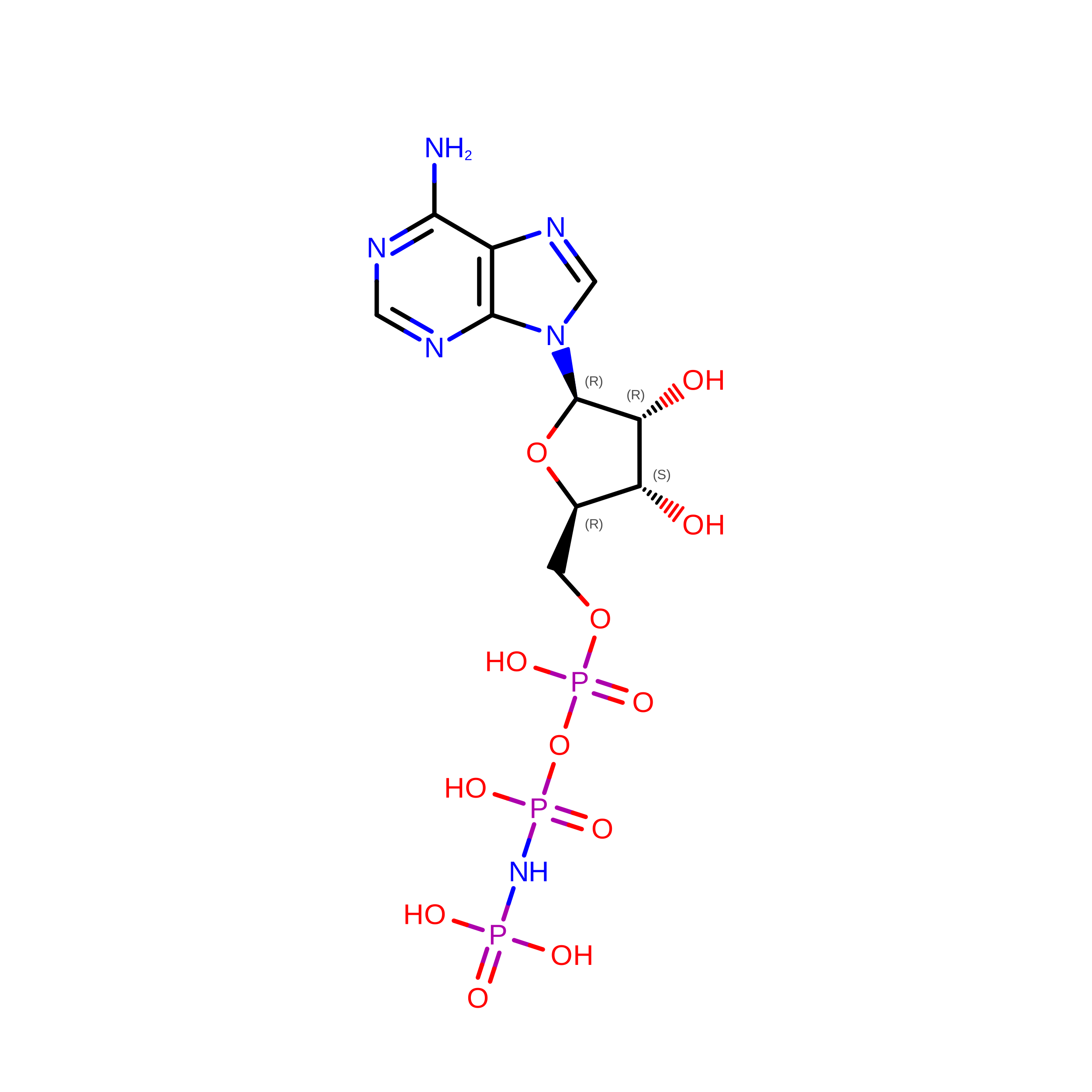
Crystal structure of Rad53 1-466 in complex with AMP-PNP


Experimental Data Snapshot

  • Method: X-RAY DIFFRACTION
  • Resolution: 3.10 Å
  • R-Value Free: 
    0.289 (Depositor), 0.289 (DCC) 
  • R-Value Work: 
    0.272 (Depositor), 0.278 (DCC) 
  • R-Value Observed: 
    0.273 (Depositor) 

wwPDB Validation 3D Report Full Report

Validation slider image for 5XZV

Ligand Structure Quality Assessment 


This is version 1.1 of the entry. See complete history

Literature

Phospho-Priming Confers Functionally Relevant Specificities for Rad53 Kinase Autophosphorylation

Chen, E.S.Weng, J.H.Chen, Y.H.Wang, S.C.Liu, X.X.Huang, W.C.Matsui, T.Kawano, Y.Liao, J.H.Lim, L.H.Bessho, Y.Huang, K.F.Wu, W.J.Tsai, M.D.

(2017) Biochemistry 56: 5112-5124

  • DOI: https://doi.org/10.1021/acs.biochem.7b00689
  • Primary Citation Related Structures: 
    5XZV, 5XZW

  • PubMed Abstract: 

    The vast majority of in vitro structural and functional studies of the activation mechanism of protein kinases use the kinase domain alone. Well-demonstrated effects of regulatory domains or allosteric factors are scarce for serine/threonine kinases. Here we use a site-specifically phosphorylated SCD1-FHA1-kinase three-domain construct of the serine/threonine kinase Rad53 to show the effect of phospho-priming, an in vivo regulatory mechanism, on the autophosphorylation intermediate and specificity. Unphosphorylated Rad53 is a flexible monomer in solution but is captured in an asymmetric enzyme:substrate complex in crystal with the two FHA domains separated from each other. Phospho-priming induces formation of a stable dimer via intermolecular pT-FHA binding in solution. Importantly, autophosphorylation of unprimed and phospho-primed Rad53 produced predominantly inactive pS350-Rad53 and active pT354-Rad53, respectively. The latter mechanism was also demonstrated in vivo. Our results show that, while Rad53 can display active conformations under various conditions, simulation of in vivo regulatory conditions confers functionally relevant autophosphorylation.


  • Organizational Affiliation
    • Institute of Biological Chemistry, Academia Sinica , Taipei 115, Taiwan.

Macromolecule Content 

  • Total Structure Weight: 106.03 kDa 
  • Atom Count: 5,444 
  • Modeled Residue Count: 746 
  • Deposited Residue Count: 942 
  • Unique protein chains: 1

Macromolecules

Find similar proteins by:|  3D Structure
Entity ID: 1
MoleculeChains  Sequence LengthOrganismDetailsImage
Serine/threonine-protein kinase RAD53
A, B
471Saccharomyces cerevisiae S288CMutation(s): 0 
Gene Names: RAD53MEC2SAD1SPK1YPL153CP2588
EC: 2.7.12.1
UniProt
Find proteins for P22216 (Saccharomyces cerevisiae (strain ATCC 204508 / S288c))
Explore P22216 
Go to UniProtKB:  P22216
Entity Groups
Sequence Clusters30% Identity50% Identity70% Identity90% Identity95% Identity100% Identity
UniProt GroupP22216
Sequence Annotations
Expand
Reference Sequence

Small Molecules

Experimental Data & Validation

Experimental Data

  • Method: X-RAY DIFFRACTION
  • Resolution: 3.10 Å
  • R-Value Free:  0.289 (Depositor), 0.289 (DCC) 
  • R-Value Work:  0.272 (Depositor), 0.278 (DCC) 
  • R-Value Observed: 0.273 (Depositor) 
Space Group: P 32 2 1
Unit Cell:
Length ( Å )Angle ( ˚ )
a = 116.69α = 90
b = 116.69β = 90
c = 140.804γ = 120
Software Package:
Software NamePurpose
PHENIXrefinement
HKL-2000data reduction
SCALEPACKdata scaling
PHENIXphasing

Structure Validation

View Full Validation Report


Ligand Structure Quality Assessment 


Entry History 

Deposition Data

Revision History  (Full details and data files)

  • Version 1.0: 2017-10-11
    Type: Initial release
  • Version 1.1: 2024-03-27
    Changes: Data collection, Database references