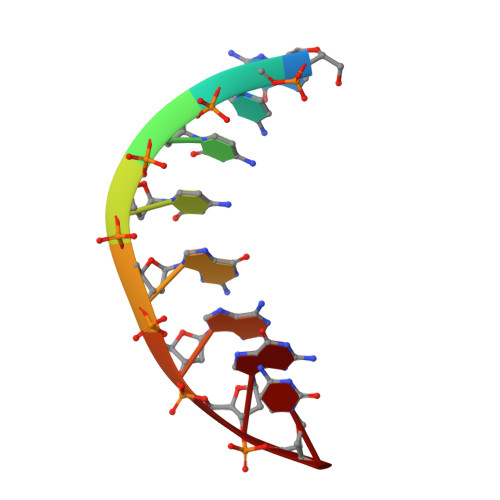
5XK0 | pdb_00005xk0

Structure of 8-mer DNA2

  • Classification: DNA
  • Organism(s): synthetic construct
  • Mutation(s): No 

  • Deposited: 2017-05-04 Released: 2017-12-06 
  • Deposition Author(s): Liu, H.H., Gan, J.H.
  • Funding Organization(s): National Natural Science Foundation of China

Experimental Data Snapshot

  • Method: X-RAY DIFFRACTION
  • Resolution: 1.45 Å
  • R-Value Free: 
    0.196 (Depositor), 0.203 (DCC) 
  • R-Value Work: 
    0.180 (Depositor), 0.185 (DCC) 
  • R-Value Observed: 
    0.181 (Depositor) 

Starting Model: experimental
View more details

wwPDB Validation 3D Report Full Report

Validation slider image for 5XK0

This is version 1.1 of the entry. See complete history

Literature

A DNA Structure Containing AgI -Mediated G:G and C:C Base Pairs

Liu, H.H.Shen, F.S.Haruehanroengra, P.Yao, Q.Q.Cheng, Y.S.Chen, Y.Q.Yang, C.Zhang, J.Wu, B.X.Luo, Q.Cui, R.X.Li, J.X.Ma, J.B.Sheng, J.Gan, J.H.

(2017) Angew Chem Int Ed Engl 56: 9430-9434

  • DOI: https://doi.org/10.1002/anie.201704891
  • Primary Citation Related Structures: 
    5XJZ, 5XK0, 5XK1

  • PubMed Abstract: 

    Metal-mediated base pairs have been extensively utilized in many research fields, including genetic-code extension, novel therapeutics development, and nanodevice design. Compared to other cations, Ag I is more flexible in pairing with natural base pairs. Herein, we present a DNA structure containing two C-Ag I -C pairs and the first reported G-Ag I -G pair in a short 8mer DNA strand. This structure not only provides detailed insight into these Ag I -mediated base-pairing patterns in DNA, but also represents the first nonhelical DNA structure driven by heavy-metal ions, thus further contributing to the structural diversity of DNA. This unique complex structure is highly sequence-dependent, thus implying functional potentials as a new DNA aptamer that can bind and recognize silver ions. These results not only advance our understanding of the interactions between Ag I and nucleobases, but also provide a unique structural component for the rational design of new DNA nanodevices.


  • Organizational Affiliation
    • State Key Laboratory of Genetic Engineering, Collaborative Innovation Center of Genetics and Development, Department of Physiology and Biophysics, School of Life Sciences, Fudan University, Shanghai, 200433, China.

Macromolecule Content 

  • Total Structure Weight: 2.41 kDa 
  • Atom Count: 196 
  • Modeled Residue Count: 8 
  • Deposited Residue Count: 8 
  • Unique nucleic acid chains: 1

Macromolecules

Find similar nucleic acids by:  Sequence
Entity ID: 1
MoleculeChains LengthOrganismImage
DNA (5'-D(*GP*CP*CP*CP*GP*AP*GP*C)-3')8synthetic construct
Sequence Annotations
Expand
Reference Sequence

Experimental Data & Validation

Experimental Data

  • Method: X-RAY DIFFRACTION
  • Resolution: 1.45 Å
  • R-Value Free:  0.196 (Depositor), 0.203 (DCC) 
  • R-Value Work:  0.180 (Depositor), 0.185 (DCC) 
  • R-Value Observed: 0.181 (Depositor) 
Space Group: P 43 21 2
Unit Cell:
Length ( Å )Angle ( ˚ )
a = 42.012α = 90
b = 42.012β = 90
c = 25.016γ = 90
Software Package:
Software NamePurpose
PHENIXrefinement
HKL-3000data reduction
HKL-3000data scaling
PHASERphasing

Structure Validation

View Full Validation Report


Entry History 

& Funding Information

Deposition Data


Funding OrganizationLocationGrant Number
National Natural Science Foundation of ChinaChina31370728

Revision History  (Full details and data files)

  • Version 1.0: 2017-12-06
    Type: Initial release
  • Version 1.1: 2023-11-22
    Changes: Data collection, Database references, Refinement description