5XHR | pdb_00005xhr

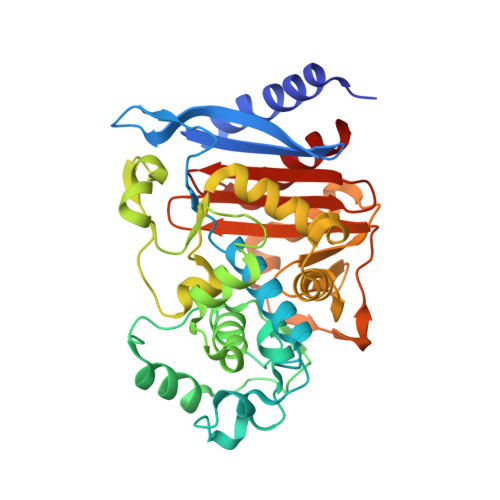
Crystal structure of P99 beta-lactamase in complex with a penicillin derivative MPC-1


Experimental Data Snapshot

  • Method: X-RAY DIFFRACTION
  • Resolution: 1.80 Å
  • R-Value Free: 
    0.233 (Depositor), 0.241 (DCC) 
  • R-Value Work: 
    0.212 (Depositor), 0.219 (DCC) 
  • R-Value Observed: 
    0.213 (Depositor) 

Starting Model: experimental
View more details

wwPDB Validation 3D Report Full Report

Validation slider image for 5XHR

Ligand Structure Quality Assessment 


This is version 1.3 of the entry. See complete history

Literature

Modified Penicillin Molecule with Carbapenem-Like Stereochemistry Specifically Inhibits Class C beta-Lactamases

Pan, X.He, Y.Chen, T.Chan, K.F.Zhao, Y.

(2017) Antimicrob Agents Chemother 61

  • DOI: https://doi.org/10.1128/AAC.01288-17
  • Primary Citation Related Structures: 
    5XHR

  • PubMed Abstract: 

    Bacterial β-lactamases readily inactivate most penicillins and cephalosporins by hydrolyzing and "opening" their signature β-lactam ring. In contrast, carbapenems resist hydrolysis by many serine-based class A, C, and D β-lactamases due to their unique stereochemical features. To improve the resistance profile of penicillins, we synthesized a modified penicillin molecule, MPC-1, by "grafting" carbapenem-like stereochemistry onto the penicillin core. Chemical modifications include the trans conformation of hydrogen atoms at C-5 and C-6 instead of cis , and a 6-α hydroxyethyl moiety to replace the original 6-β aminoacyl group. MPC-1 selectively inhibits class C β-lactamases, such as P99, by forming a nonhydrolyzable acyl adduct, and its inhibitory potency is ∼2 to 5 times higher than that for clinically used β-lactamase inhibitors clavulanate and sulbactam. The crystal structure of MPC-1 forming the acyl adduct with P99 reveals a novel binding mode for MPC-1 that resembles carbapenem bound in the active site of class A β-lactamases. Furthermore, in this novel binding mode, the carboxyl group of MPC-1 blocks the deacylation reaction by occluding the critical catalytic water molecule and renders the acyl adduct nonhydrolyzable. Our results suggest that by incorporating carbapenem-like stereochemistry, the current collection of over 100 penicillins and cephalosporins can be modified into candidate compounds for development of novel β-lactamase inhibitors.


  • Organizational Affiliation
    • Department of Chemistry, Jinan University, Guangzhou, People's Republic of China.

Macromolecule Content 

  • Total Structure Weight: 39.91 kDa 
  • Atom Count: 2,992 
  • Modeled Residue Count: 359 
  • Deposited Residue Count: 365 
  • Unique protein chains: 1

Macromolecules

Find similar proteins by:|  3D Structure
Entity ID: 1
MoleculeChains  Sequence LengthOrganismDetailsImage
Beta-lactamase365Enterobacter cloacaeMutation(s): 0 
Gene Names: ampC
EC: 3.5.2.6
UniProt
Find proteins for P05364 (Enterobacter cloacae)
Explore P05364 
Go to UniProtKB:  P05364
Entity Groups
Sequence Clusters30% Identity50% Identity70% Identity90% Identity95% Identity100% Identity
UniProt GroupP05364
Sequence Annotations
Expand
Reference Sequence

Small Molecules

Ligands 1 Unique
IDChains Name / Formula / InChI Key2D Diagram3D Interactions
PXH

Query on PXH


Download:Ideal Coordinates CCD File
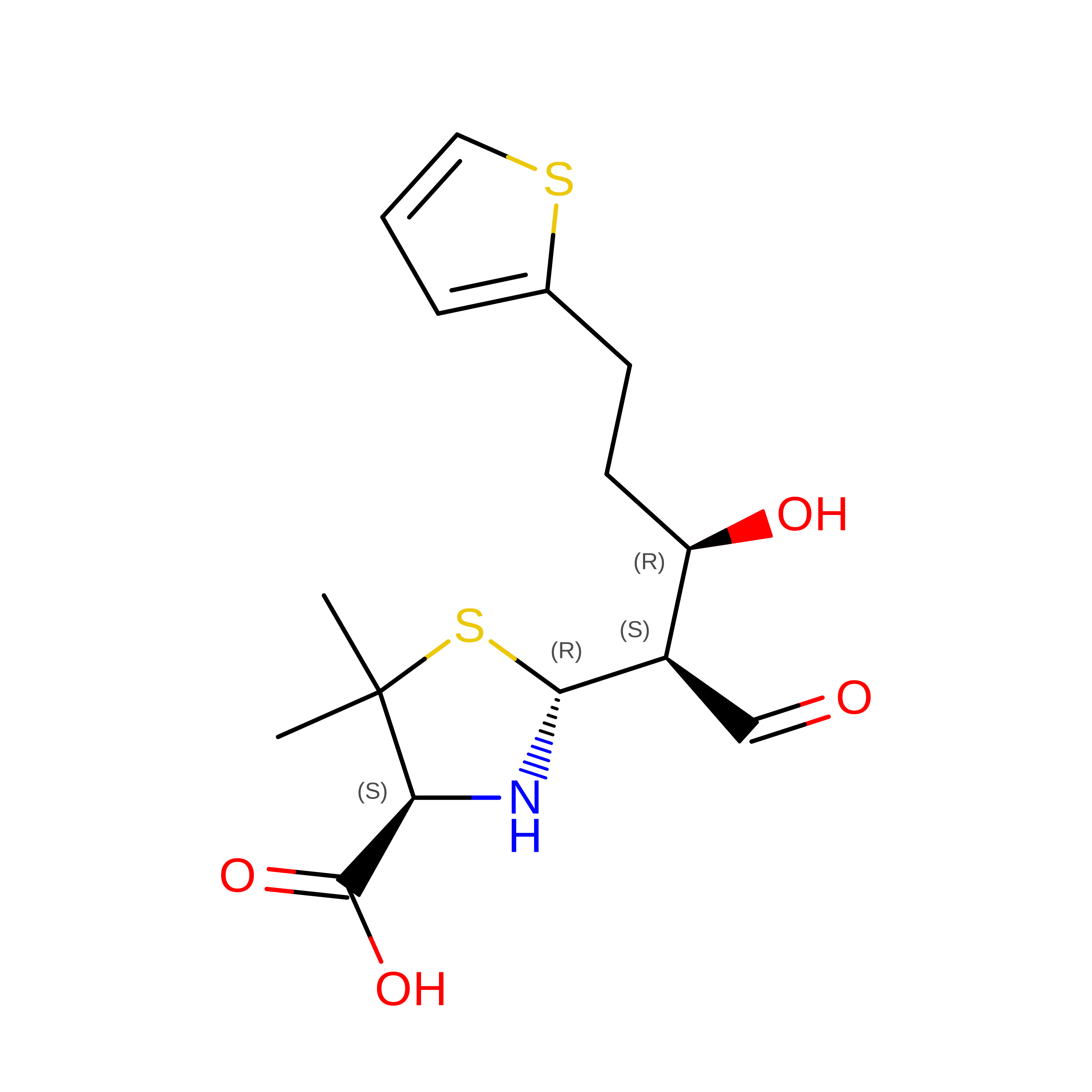
B [auth A](2~{R},4~{S})-5,5-dimethyl-2-[(2~{S},3~{R})-3-oxidanyl-1-oxidanylidene-5-thiophen-2-yl-pentan-2-yl]-1,3-thiazolidine-4-carboxylic acid
C15 H21 N O4 S2
RTEPAFLPRWPVOF-FVCCEPFGSA-N

Experimental Data & Validation

Experimental Data

  • Method: X-RAY DIFFRACTION
  • Resolution: 1.80 Å
  • R-Value Free:  0.233 (Depositor), 0.241 (DCC) 
  • R-Value Work:  0.212 (Depositor), 0.219 (DCC) 
  • R-Value Observed: 0.213 (Depositor) 
Space Group: P 2 21 21
Unit Cell:
Length ( Å )Angle ( ˚ )
a = 61.16α = 90
b = 69.33β = 90
c = 76.85γ = 90
Software Package:
Software NamePurpose
REFMACrefinement
iMOSFLMdata reduction
SCALAdata scaling
PHASERphasing

Structure Validation

View Full Validation Report


Ligand Structure Quality Assessment 


Entry History 

Deposition Data

Revision History  (Full details and data files)

  • Version 1.0: 2017-09-27
    Type: Initial release
  • Version 1.1: 2017-12-06
    Changes: Database references
  • Version 1.2: 2023-11-22
    Changes: Data collection, Database references, Refinement description
  • Version 1.3: 2024-10-30
    Changes: Structure summary