5XEF | pdb_00005xef

Crystal structure of flagellar chaperone from bacteria


Experimental Data Snapshot

  • Method: X-RAY DIFFRACTION
  • Resolution: 2.00 Å
  • R-Value Free: 
    0.227 (Depositor), 0.232 (DCC) 
  • R-Value Work: 
    0.194 (Depositor), 0.200 (DCC) 
  • R-Value Observed: 
    0.196 (Depositor) 

wwPDB Validation 3D Report Full Report

Validation slider image for 5XEF

This is version 1.2 of the entry. See complete history

Literature

Crystal structure of the flagellar chaperone FliS from Bacillus cereus and an invariant proline critical for FliS dimerization and flagellin recognition

Lee, C.Kim, M.I.Park, J.Jeon, B.Y.Yoon, S.I.Hong, M.

(2017) Biochem Biophys Res Commun 487: 381-387

  • DOI: https://doi.org/10.1016/j.bbrc.2017.04.070
  • Primary Citation Related Structures: 
    5XEF

  • PubMed Abstract: 

    FliS is a cytoplasmic flagellar chaperone for the flagellin, which polymerizes into filaments outside of the flagellated bacteria. Cytoplasmic interaction between FliS and flagellin is critical to retain the flagellin protein in a monomeric form, which is transported from the cytoplasm through the flagellar export apparatus to the extracellular space for filament assembly. Defects in the FliS protein directly diminish bacterial motility, pathogenicity, and viability. Although the overall structure of FliS is known, structural and mutational studies on FliS from other bacterial species are still required to reveal any unresolved biophysical features of FliS itself or functionally critical residues for flagellin recognition. Here, we present the crystal structure of FliS from Bacillus cereus (BcFliS) at 2.0 Å resolution. FliS possesses a highly dynamic N-terminal region, which is appended to the common four-helix bundle structure. An invariant proline residue (Pro17 in B. cereus FliS) was identified in all known FliS sequences between the N-terminal region and the four-helix bundle. The N-terminal proline residue functions as a helix breaker critical for FliS dimerization and flagellin recognition.


  • Organizational Affiliation
    • Division of Biological Science and Technology, Yonsei University, Wonju 26493, Republic of Korea.

Macromolecule Content 

  • Total Structure Weight: 14.89 kDa 
  • Atom Count: 1,132 
  • Modeled Residue Count: 123 
  • Deposited Residue Count: 123 
  • Unique protein chains: 1

Macromolecules

Find similar proteins by:|  3D Structure
Entity ID: 1
MoleculeChains  Sequence LengthOrganismDetailsImage
Flagellar protein fliS123Bacillus cereus ATCC 14579Mutation(s): 0 
Gene Names: BC_1639
UniProt
Find proteins for Q81FF1 (Bacillus cereus (strain ATCC 14579 / DSM 31 / CCUG 7414 / JCM 2152 / NBRC 15305 / NCIMB 9373 / NCTC 2599 / NRRL B-3711))
Explore Q81FF1 
Go to UniProtKB:  Q81FF1
Entity Groups
Sequence Clusters30% Identity50% Identity70% Identity90% Identity95% Identity100% Identity
UniProt GroupQ81FF1
Sequence Annotations
Expand
Reference Sequence

Small Molecules

Modified Residues  1 Unique
IDChains TypeFormula2D DiagramParent
MSE
Query on MSE
A
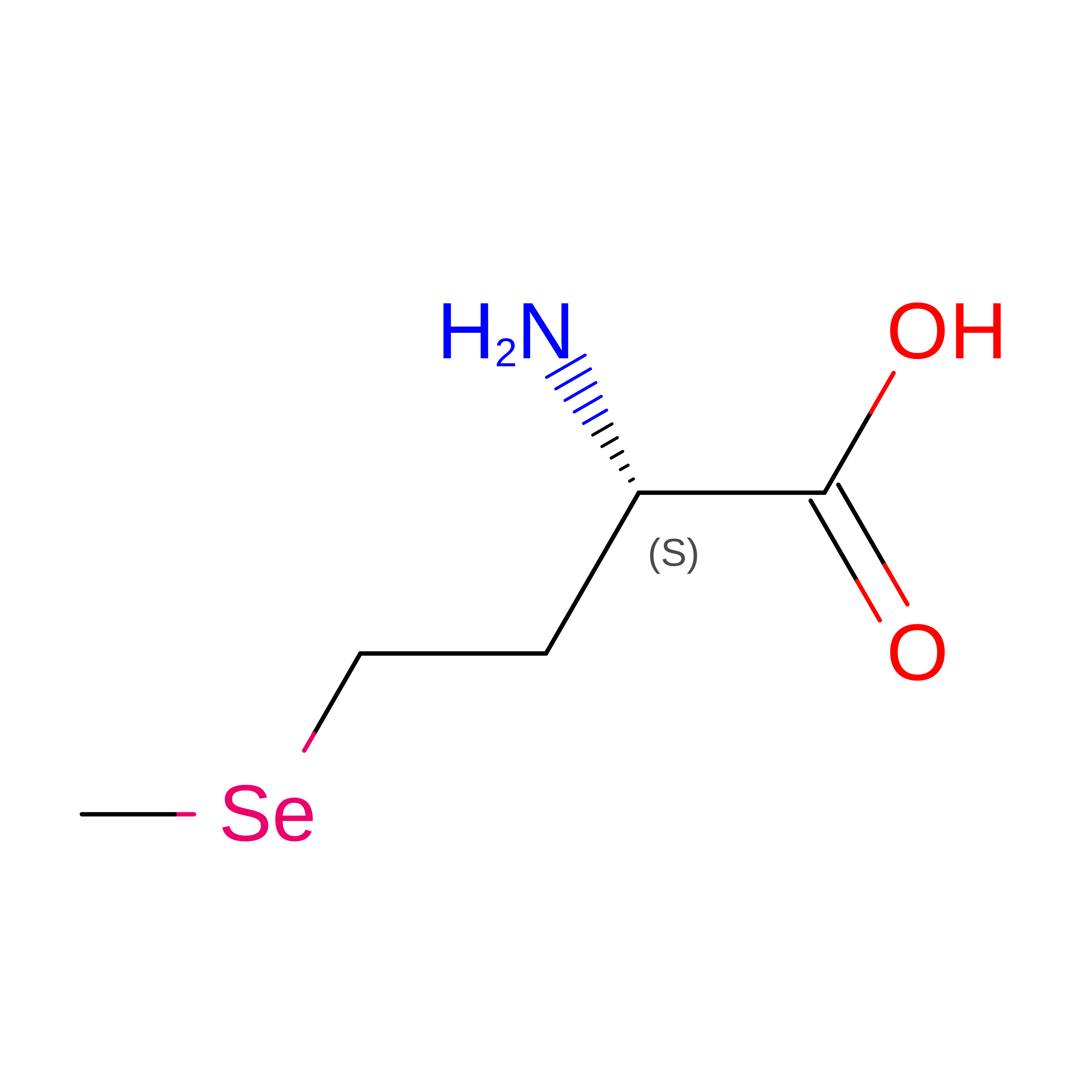
L-PEPTIDE LINKINGC5 H11 N O2 SeMET

Experimental Data & Validation

Experimental Data

  • Method: X-RAY DIFFRACTION
  • Resolution: 2.00 Å
  • R-Value Free:  0.227 (Depositor), 0.232 (DCC) 
  • R-Value Work:  0.194 (Depositor), 0.200 (DCC) 
  • R-Value Observed: 0.196 (Depositor) 
Space Group: P 62
Unit Cell:
Length ( Å )Angle ( ˚ )
a = 83.207α = 90
b = 83.207β = 90
c = 47.771γ = 120
Software Package:
Software NamePurpose
SCALEPACKdata scaling
REFMACrefinement
PDB_EXTRACTdata extraction
DENZOdata reduction
PHENIXphasing

Structure Validation

View Full Validation Report


Entry History 

& Funding Information

Deposition Data


Funding OrganizationLocationGrant Number
the Ministry of Science, ICT & Future PlanningKorea, Republic Of2015R1D1A1A01057574
the Ministry of Health & WelfareKorea, Republic OfHI15C2890

Revision History  (Full details and data files)

  • Version 1.0: 2018-06-27
    Type: Initial release
  • Version 1.1: 2019-02-20
    Changes: Data collection, Source and taxonomy
  • Version 1.2: 2024-11-06
    Changes: Data collection, Database references, Structure summary