5WJF | pdb_00005wjf

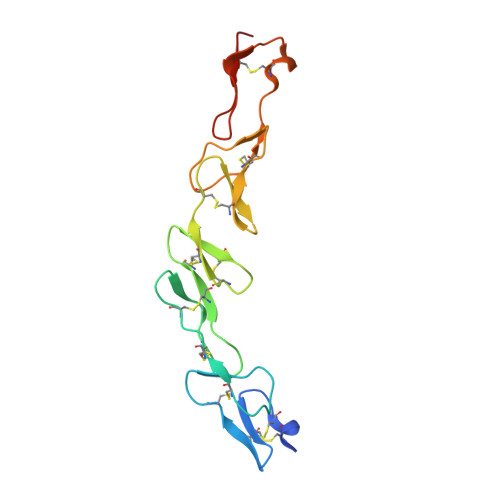
Crystal structure of murine 4-1BB from HEK293T cells in P21212 space group


Experimental Data Snapshot

  • Method: X-RAY DIFFRACTION
  • Resolution: 2.60 Å
  • R-Value Free: 
    0.288 (Depositor), 0.291 (DCC) 
  • R-Value Work: 
    0.222 (Depositor), 0.229 (DCC) 
  • R-Value Observed: 
    0.228 (Depositor) 

wwPDB Validation 3D Report Full Report

Validation slider image for 5WJF

Ligand Structure Quality Assessment 


This is version 1.3 of the entry. See complete history

Literature

Crystal structure of murine 4-1BB and its interaction with 4-1BBL support a role for galectin-9 in 4-1BB signaling.

Bitra, A.Doukov, T.Wang, J.Picarda, G.Benedict, C.A.Croft, M.Zajonc, D.M.

(2018) J Biological Chem 293: 1317-1329

  • DOI: https://doi.org/10.1074/jbc.M117.814905
  • Primary Citation Related Structures: 
    5WI8, 5WIW, 5WJF

  • PubMed Abstract: 

    4-1BB (CD137) is a TNF receptor superfamily (TNFRSF) member that is thought to undergo receptor trimerization upon binding to its trimeric TNF superfamily ligand (4-1BBL) to stimulate immune responses. 4-1BB also can bind to the tandem repeat-type lectin galectin-9 (Gal-9), and signaling through mouse (m)4-1BB is reduced in galectin-9 (Gal-9)-deficient mice, suggesting a pivotal role of Gal-9 in m4-1BB activation. Here, using sulfur-SAD phasing, we determined the crystal structure of m4-1BB to 2.2-Å resolution. We found that similar to other TNFRSFs, m4-1BB has four cysteine-rich domains (CRDs). However, the organization of CRD1 and the orientation of CRD3 and CRD4 with respect to CRD2 in the m4-1BB structure distinctly differed from those of other TNFRSFs. Moreover, we mapped two Asn residues within CRD4 that are N -linked glycosylated and mediate m4-1BB binding to Gal-9. Kinetics studies of m4-1BB disclosed a very tight nanomolar binding affinity to m4-1BBL with an unexpectedly strong avidity effect. Both N- and C-terminal domains of Gal-9 bound m4-1BB, but with lower affinity compared with m4-1BBL. Although the TNF homology domain (THD) of human (h)4-1BBL forms non-covalent trimers, we found that m4-1BBL formed a covalent dimer via 2 cysteines absent in h4-1BBL. As multimerization and clustering is a prerequisite for TNFR intracellular signaling, and as m4-1BBL can only recruit two m4-1BB monomers, we hypothesize that m4-1BBL and Gal-9 act together to aid aggregation of m4-1BB monomers to efficiently initiate m4-1BB signaling.


  • Organizational Affiliation
    • From the Division of Immune Regulation, La Jolla Institute for Allergy and Immunology (LJI), La Jolla, California 92037.

Macromolecule Content 

  • Total Structure Weight: 31.92 kDa 
  • Atom Count: 2,117 
  • Modeled Residue Count: 269 
  • Deposited Residue Count: 286 
  • Unique protein chains: 1

Macromolecules

Find similar proteins by:|  3D Structure
Entity ID: 1
MoleculeChains  Sequence LengthOrganismDetailsImage
Tumor necrosis factor receptor superfamily member 9
A, B
143Mus musculusMutation(s): 0 
Gene Names: Tnfrsf9Cd137IlaLy63
UniProt & NIH Common Fund Data Resources
Find proteins for P20334 (Mus musculus)
Explore P20334 
Go to UniProtKB:  P20334
IMPC:  MGI:1101059
Entity Groups
Sequence Clusters30% Identity50% Identity70% Identity90% Identity95% Identity100% Identity
UniProt GroupP20334
Glycosylation
Glycosylation Sites: 1Go to GlyGen: P20334-1
Sequence Annotations
Expand
Reference Sequence

Experimental Data & Validation

Experimental Data

  • Method: X-RAY DIFFRACTION
  • Resolution: 2.60 Å
  • R-Value Free:  0.288 (Depositor), 0.291 (DCC) 
  • R-Value Work:  0.222 (Depositor), 0.229 (DCC) 
  • R-Value Observed: 0.228 (Depositor) 
Space Group: P 21 21 2
Unit Cell:
Length ( Å )Angle ( ˚ )
a = 65.05α = 90
b = 67.76β = 90
c = 87.99γ = 90
Software Package:
Software NamePurpose
REFMACrefinement
XSCALEdata scaling
PDB_EXTRACTdata extraction
XDSdata reduction
BUCCANEERmodel building
ARP/wARPmodel building

Structure Validation

View Full Validation Report


Ligand Structure Quality Assessment 


Entry History 

Deposition Data

Revision History  (Full details and data files)

  • Version 1.0: 2017-12-20
    Type: Initial release
  • Version 1.1: 2018-04-25
    Changes: Data collection, Database references
  • Version 1.2: 2020-07-29
    Type: Remediation
    Reason: Carbohydrate remediation
    Changes: Data collection, Derived calculations, Structure summary
  • Version 1.3: 2024-11-06
    Changes: Data collection, Database references, Structure summary