5WEV | pdb_00005wev

Identification of an imidazopyridine scaffold to generate potent and selective TYK2 inhibitors that demonstrate activity in an in vivo psoriasis model


Experimental Data Snapshot

  • Method: X-RAY DIFFRACTION
  • Resolution: 1.85 Å
  • R-Value Free: 
    0.194 (Depositor), 0.196 (DCC) 
  • R-Value Work: 
    0.166 (Depositor), 0.167 (DCC) 
  • R-Value Observed: 
    0.167 (Depositor) 

Starting Model: experimental
View more details

wwPDB Validation 3D Report Full Report

Validation slider image for 5WEV

Ligand Structure Quality Assessment 


This is version 1.4 of the entry. See complete history

Literature

Identification of an imidazopyridine scaffold to generate potent and selective TYK2 inhibitors that demonstrate activity in an in vivo psoriasis model.

Liang, J.Van Abbema, A.Balazs, M.Barrett, K.Berezhkovsky, L.Blair, W.S.Chang, C.Delarosa, D.DeVoss, J.Driscoll, J.Eigenbrot, C.Goodacre, S.Ghilardi, N.MacLeod, C.Johnson, A.Bir Kohli, P.Lai, Y.Lin, Z.Mantik, P.Menghrajani, K.Nguyen, H.Peng, I.Sambrone, A.Shia, S.Smith, J.Sohn, S.Tsui, V.Ultsch, M.Williams, K.Wu, L.C.Yang, W.Zhang, B.Magnuson, S.

(2017) Bioorg Med Chem Lett 27: 4370-4376

  • DOI: https://doi.org/10.1016/j.bmcl.2017.08.022
  • Primary Citation Related Structures: 
    5WAL, 5WEV

  • PubMed Abstract: 

    Herein we report identification of an imidazopyridine class of potent and selective TYK2 inhibitors, exemplified by prototype 6, through constraint of the rotatable amide bond connecting the pyridine and aryl rings of compound 1. Further optimization led to generation of compound 30 that potently inhibits the TYK2 enzyme and the IL-23 pathway in cells, exhibits selectivity against cellular JAK2 activity, and has good pharmacokinetic properties. In mice, compound 30 demonstrated dose-dependent reduction of IL-17 production in a PK/PD model as well as in an imiquimod-induced psoriasis model. In this efficacy model, the IL-17 decrease was accompanied by a reduction of ear thickness indicating the potential of TYK2 inhibition as a therapeutic approach for psoriasis patients.


  • Organizational Affiliation
    • Department of Discovery Chemistry, Genentech, Inc., 1 DNA Way, South San Francisco, CA 94080, USA.

Macromolecule Content 

  • Total Structure Weight: 37.72 kDa 
  • Atom Count: 2,624 
  • Modeled Residue Count: 295 
  • Deposited Residue Count: 319 
  • Unique protein chains: 1

Macromolecules

Find similar proteins by:|  3D Structure
Entity ID: 1
MoleculeChains  Sequence LengthOrganismDetailsImage
Tyrosine-protein kinase JAK2319Homo sapiensMutation(s): 0 
Gene Names: JAK2
EC: 2.7.10.2
UniProt & NIH Common Fund Data Resources
Find proteins for O60674 (Homo sapiens)
Explore O60674 
Go to UniProtKB:  O60674
PHAROS:  O60674
GTEx:  ENSG00000096968 
Entity Groups
Sequence Clusters30% Identity50% Identity70% Identity90% Identity95% Identity100% Identity
UniProt GroupO60674
Sequence Annotations
Expand
Reference Sequence

Small Molecules

Ligands 1 Unique
IDChains Name / Formula / InChI Key2D Diagram3D Interactions
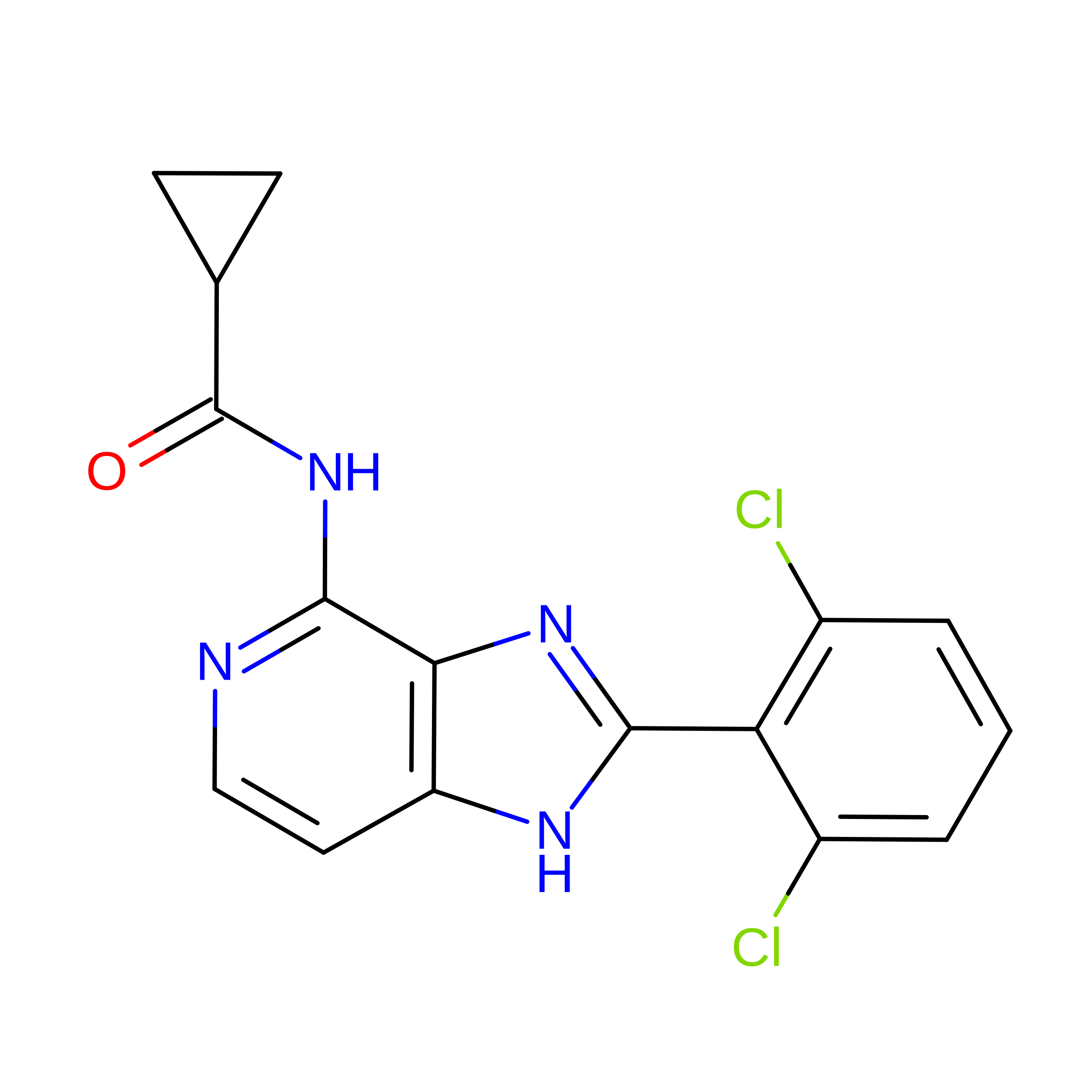
9ZS

Query on 9ZS


Download:Ideal Coordinates CCD File
B [auth A]N-[2-(2,6-dichlorophenyl)-1H-imidazo[4,5-c]pyridin-4-yl]cyclopropanecarboxamide
C16 H12 Cl2 N4 O
OFPQQEBBZKPLFE-UHFFFAOYSA-N
Modified Residues  1 Unique
IDChains TypeFormula2D DiagramParent
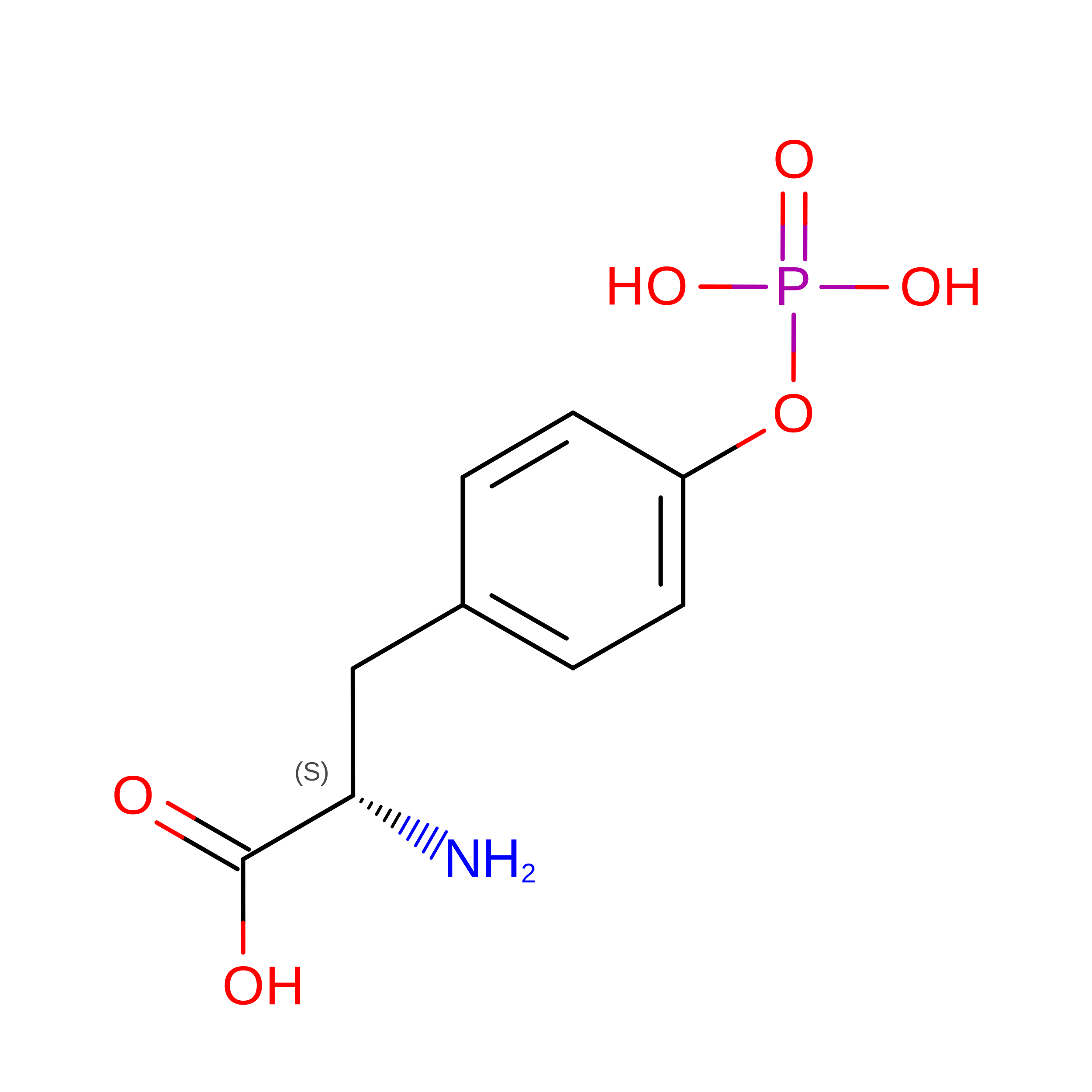
PTR
Query on PTR
A
L-PEPTIDE LINKINGC9 H12 N O6 PTYR

Experimental Data & Validation

Experimental Data

  • Method: X-RAY DIFFRACTION
  • Resolution: 1.85 Å
  • R-Value Free:  0.194 (Depositor), 0.196 (DCC) 
  • R-Value Work:  0.166 (Depositor), 0.167 (DCC) 
  • R-Value Observed: 0.167 (Depositor) 
Space Group: C 1 2 1
Unit Cell:
Length ( Å )Angle ( ˚ )
a = 107.653α = 90
b = 69.542β = 98.93
c = 50.629γ = 90
Software Package:
Software NamePurpose
REFMACrefinement
HKL-2000data reduction
SCALEPACKdata scaling
PHASERphasing

Structure Validation

View Full Validation Report


Ligand Structure Quality Assessment 


Entry History 

Deposition Data

Revision History  (Full details and data files)

  • Version 1.0: 2017-09-06
    Type: Initial release
  • Version 1.1: 2017-09-20
    Changes: Database references
  • Version 1.2: 2023-10-04
    Changes: Data collection, Database references, Refinement description
  • Version 1.3: 2023-11-15
    Changes: Data collection
  • Version 1.4: 2024-11-13
    Changes: Structure summary