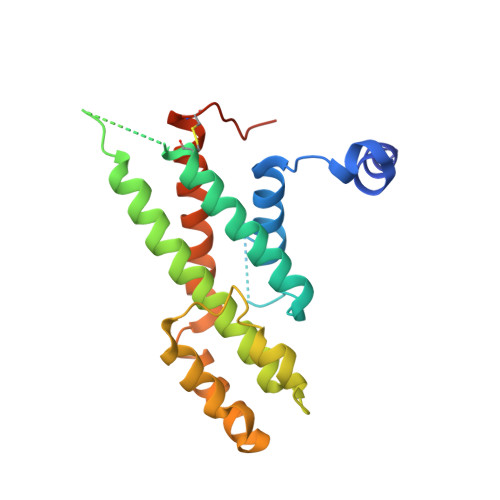
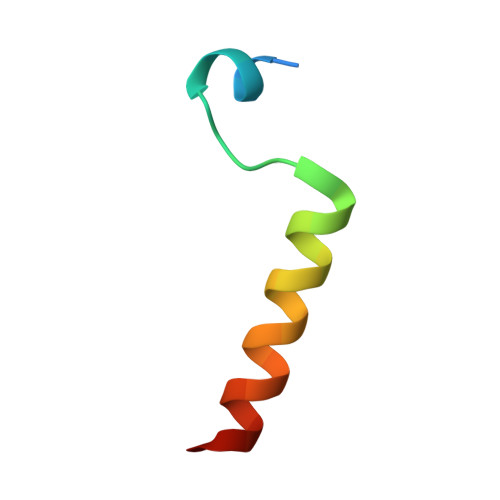
5WE1 | pdb_00005we1

Structural Basis for Shelterin Bridge Assembly


Experimental Data Snapshot

  • Method: X-RAY DIFFRACTION
  • Resolution: 3.20 Å
  • R-Value Free: 
    0.317 (Depositor), 0.317 (DCC) 
  • R-Value Work: 
    0.266 (Depositor), 0.282 (DCC) 
  • R-Value Observed: 
    0.269 (Depositor) 

Starting Model: experimental
View more details

wwPDB Validation 3D Report Full Report

Validation slider image for 5WE1

This is version 1.2 of the entry. See complete history

Literature

Structural Basis for Shelterin Bridge Assembly.

Kim, J.K.Liu, J.Hu, X.Yu, C.Roskamp, K.Sankaran, B.Huang, L.Komives, E.A.Qiao, F.

(2017) Mol Cell 68: 698-714.e5

  • DOI: https://doi.org/10.1016/j.molcel.2017.10.032
  • Primary Citation Related Structures: 
    5WE0, 5WE1, 5WE2

  • PubMed Abstract: 

    Telomere elongation through telomerase enables chromosome survival during cellular proliferation. The conserved multifunctional shelterin complex associates with telomeres to coordinate multiple telomere activities, including telomere elongation by telomerase. Similar to the human shelterin, fission yeast shelterin is composed of telomeric sequence-specific double- and single-stranded DNA-binding proteins, Taz1 and Pot1, respectively, bridged by Rap1, Poz1, and Tpz1. Here, we report the crystal structure of the fission yeast Tpz1 475-508 -Poz1-Rap1 467-496 complex that provides the structural basis for shelterin bridge assembly. Biochemical analyses reveal that shelterin bridge assembly is a hierarchical process in which Tpz1 binding to Poz1 elicits structural changes in Poz1, allosterically promoting Rap1 binding to Poz1. Perturbation of the cooperative Tpz1-Poz1-Rap1 assembly through mutation of the "conformational trigger" in Poz1 leads to unregulated telomere lengthening. Furthermore, we find that the human shelterin counterparts TPP1-TIN2-TRF2 also assemble hierarchically, indicating cooperativity as a conserved driving force for shelterin assembly.


  • Organizational Affiliation
    • Department of Biological Chemistry, School of Medicine, University of California, Irvine, Irvine, CA 92697-1700, USA.

Macromolecule Content 

  • Total Structure Weight: 58.69 kDa 
  • Atom Count: 3,513 
  • Modeled Residue Count: 417 
  • Deposited Residue Count: 494 
  • Unique protein chains: 2

Macromolecules

Find similar proteins by:|  3D Structure
Entity ID: 1
MoleculeChains  Sequence LengthOrganismDetailsImage
Protection of telomeres protein poz1,Protection of telomeres protein poz1
A, C
214Schizosaccharomyces pombe 972h-Mutation(s): 0 
Gene Names: poz1SPAC19G12.13c
UniProt
Find proteins for O13852 (Schizosaccharomyces pombe (strain 972 / ATCC 24843))
Explore O13852 
Go to UniProtKB:  O13852
Entity Groups
Sequence Clusters30% Identity50% Identity70% Identity90% Identity95% Identity100% Identity
UniProt GroupO13852
Sequence Annotations
Expand
Reference Sequence
Find similar proteins by:|  3D Structure
Entity ID: 2
MoleculeChains  Sequence LengthOrganismDetailsImage
Protection of telomeres protein tpz1
B, D
33Schizosaccharomyces pombe 972h-Mutation(s): 0 
Gene Names: tpz1mug169SPAC6F6.16cSPAC6F6.18c
UniProt
Find proteins for O14246 (Schizosaccharomyces pombe (strain 972 / ATCC 24843))
Explore O14246 
Go to UniProtKB:  O14246
Entity Groups
Sequence Clusters30% Identity50% Identity70% Identity90% Identity95% Identity100% Identity
UniProt GroupO14246
Sequence Annotations
Expand
Reference Sequence

Experimental Data & Validation

Experimental Data

  • Method: X-RAY DIFFRACTION
  • Resolution: 3.20 Å
  • R-Value Free:  0.317 (Depositor), 0.317 (DCC) 
  • R-Value Work:  0.266 (Depositor), 0.282 (DCC) 
  • R-Value Observed: 0.269 (Depositor) 
Space Group: P 31
Unit Cell:
Length ( Å )Angle ( ˚ )
a = 66.11α = 90
b = 66.11β = 90
c = 123.16γ = 120
Software Package:
Software NamePurpose
PHENIXrefinement
Cootmodel building
PHENIXphasing
MOSFLMdata processing
MOSFLMdata reduction
SCALAdata scaling

Structure Validation

View Full Validation Report


Entry History 

Deposition Data

Revision History  (Full details and data files)

  • Version 1.0: 2017-12-20
    Type: Initial release
  • Version 1.1: 2023-10-04
    Changes: Data collection, Database references, Derived calculations, Refinement description
  • Version 1.2: 2024-11-20
    Changes: Structure summary