Download Mendeley
The Phe-Ile Zipper: A Specific Interaction Motif Drives Antiparallel Coiled-Coil Hexamer Formation.
Spencer, R.K., Hochbaum, A.I.(2017) Biochemistry 56: 5300-5308
- PubMed: 28876052 Search on PubMed
- DOI: https://doi.org/10.1021/acs.biochem.7b00756
- Primary Citation Related Structures:
5VTE, 5W0J - PubMed Abstract:
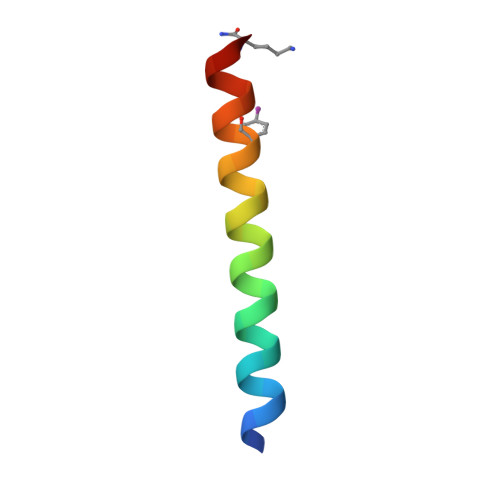
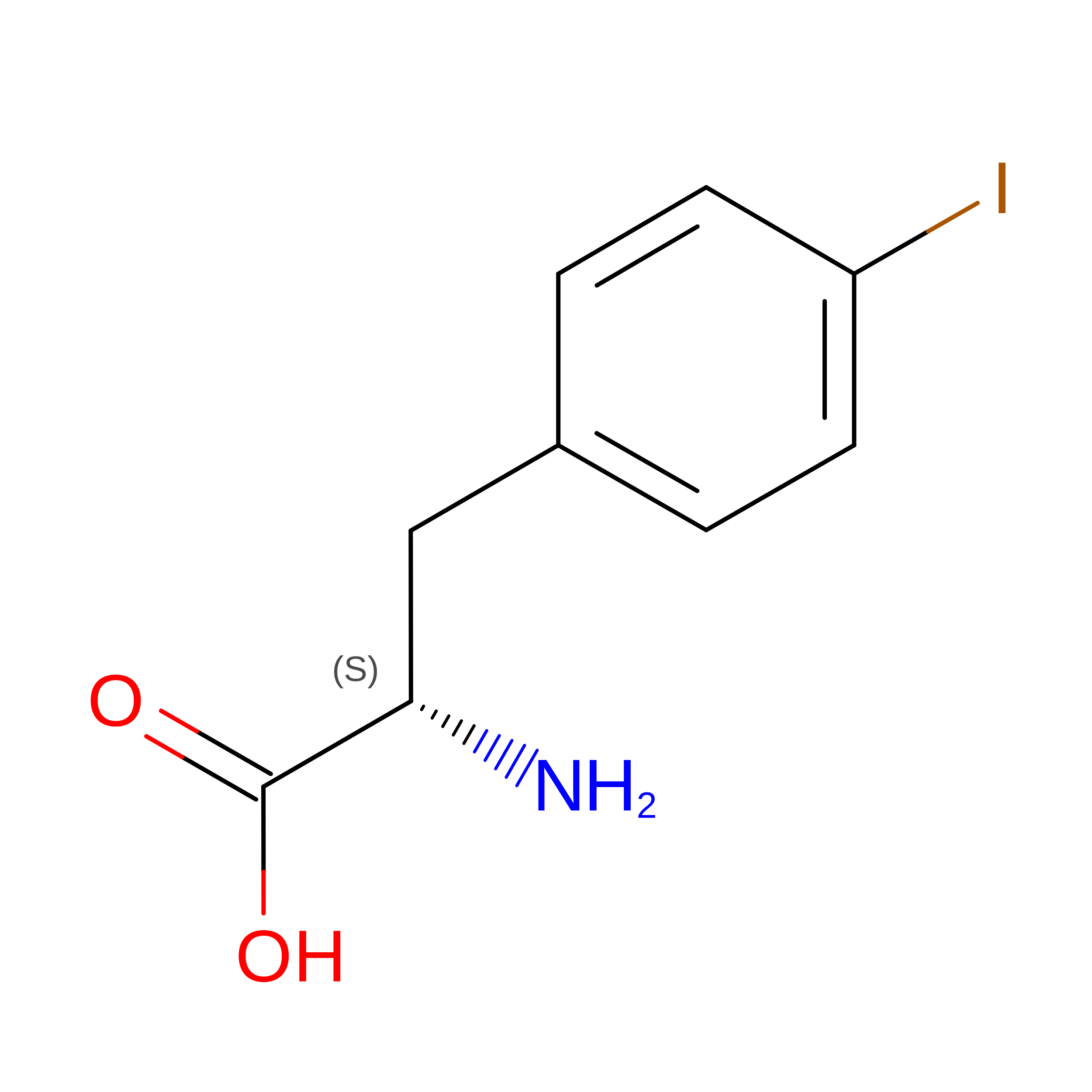
Coiled coils are a robust motif for exploring amino acid interactions, generating unique supramolecular structures, and expanding the functional properties of biological materials. A recently discovered antiparallel coiled-coil hexamer (ACC-Hex, peptide 1) exhibits a unique interaction in which Phe and Ile residues from adjacent α-helices interact to form a Phe-Ile zipper within the hydrophobic core. Analysis of the X-ray crystallographic structure of ACC-Hex suggests that the stability of the six-helix bundle relies on specific interactions between the Phe and Ile residues. The Phe-Ile zipper is unprecedented and represents a powerful tool for utilizing the Phe-Ile interactions to direct supramolecular assembly. To further probe and understand the limits of the Phe-Ile zipper, we designed peptide sequences with natural and unnatural amino acids placed at the Phe and Ile residue positions. Using size exclusion chromatography and small-angle X-ray scattering, we found that the proper assembly of ACC-Hex from monomers is sensitive to subtle changes in side chain steric bulk and hydrophobicity introduced by mutations at the Phe and Ile residue positions. Of the sequence variants that formed ACC-Hex, mutations in the hydrophobic core significantly affected the stability of the hexamer, from a ΔG u w of 2-8 kcal mol -1 . Additional sequences were designed to further probe and enhance the stability of the ACC-Hex system by maximizing salt bridging between the solvent-exposed residues. Finally, we expanded on the generality of the Phe-Ile zipper, creating a unique sequence that forms an antiparallel hexamer that is topologically similar to ACC-Hex but atomistically unique.
- Department of Chemistry and Department of Chemical Engineering & Materials Science, University of California, Irvine , Irvine, California 92697-2575, United States.
Organizational Affiliation: