5V72 | pdb_00005v72

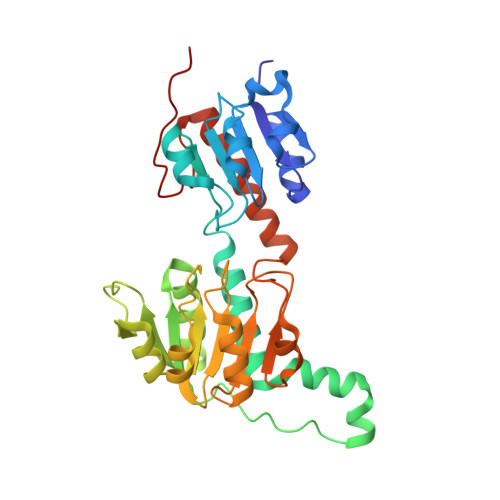
Crystal structure of NADPH-dependent glyoxylate/hydroxypyruvate reductase SMc04462 (SmGhrB) from Sinorhizobium meliloti in complex with citrate


Experimental Data Snapshot

  • Method: X-RAY DIFFRACTION
  • Resolution: 2.10 Å
  • R-Value Free: 
    0.204 (Depositor), 0.203 (DCC) 
  • R-Value Work: 
    0.164 (Depositor) 
  • R-Value Observed: 
    0.166 (Depositor) 

Starting Model: experimental
View more details

wwPDB Validation 3D Report Full Report

Validation slider image for 5V72

This is version 1.4 of the entry. See complete history

Literature

Structural, Biochemical, and Evolutionary Characterizations of Glyoxylate/Hydroxypyruvate Reductases Show Their Division into Two Distinct Subfamilies.

Kutner, J.Shabalin, I.G.Matelska, D.Handing, K.B.Gasiorowska, O.Sroka, P.Gorna, M.W.Ginalski, K.Wozniak, K.Minor, W.

(2018) Biochemistry 57: 963-977

  • DOI: https://doi.org/10.1021/acs.biochem.7b01137
  • Primary Citation Related Structures: 
    4WEQ, 4Z0P, 5J23, 5UNN, 5UOG, 5V6Q, 5V72, 5V7G, 5V7N

  • PubMed Abstract: 

    The d-2-hydroxyacid dehydrogenase (2HADH) family illustrates a complex evolutionary history with multiple lateral gene transfers and gene duplications and losses. As a result, the exact functional annotation of individual members can be extrapolated to a very limited extent. Here, we revise the previous simplified view on the classification of the 2HADH family; specifically, we show that the previously delineated glyoxylate/hydroxypyruvate reductase (GHPR) subfamily consists of two evolutionary separated GHRA and GHRB subfamilies. We compare two representatives of these subfamilies from Sinorhizobium meliloti (SmGhrA and SmGhrB), employing a combination of biochemical, structural, and bioinformatics approaches. Our kinetic results show that both enzymes reduce several 2-ketocarboxylic acids with overlapping, but not equivalent, substrate preferences. SmGhrA and SmGhrB show highest activity with glyoxylate and hydroxypyruvate, respectively; in addition, only SmGhrB reduces 2-keto-d-gluconate, and only SmGhrA reduces pyruvate (with low efficiency). We present nine crystal structures of both enzymes in apo forms and in complexes with cofactors and substrates/substrate analogues. In particular, we determined a crystal structure of SmGhrB with 2-keto-d-gluconate, which is the biggest substrate cocrystallized with a 2HADH member. The structures reveal significant differences between SmGhrA and SmGhrB, both in the overall structure and within the substrate-binding pocket, offering insight into the molecular basis for the observed substrate preferences and subfamily differences. In addition, we provide an overview of all GHRA and GHRB structures complexed with a ligand in the active site.


  • Organizational Affiliation
    • Department of Molecular Physiology and Biological Physics, University of Virginia , 1340 Jefferson Park Avenue, Charlottesville, Virginia 22908, United States.

Macromolecule Content 

  • Total Structure Weight: 137.63 kDa 
  • Atom Count: 10,506 
  • Modeled Residue Count: 1,264 
  • Deposited Residue Count: 1,288 
  • Unique protein chains: 1

Macromolecules

Find similar proteins by:|  3D Structure
Entity ID: 1
MoleculeChains  Sequence LengthOrganismDetailsImage
NADPH-dependent glyoxylate/hydroxypyruvate reductase
A, B, C, D
322Sinorhizobium meliloti 1021Mutation(s): 0 
Gene Names: SMc04462
EC: 1.1.1.81
UniProt
Find proteins for Q92LZ4 (Rhizobium meliloti (strain 1021))
Explore Q92LZ4 
Go to UniProtKB:  Q92LZ4
Entity Groups
Sequence Clusters30% Identity50% Identity70% Identity90% Identity95% Identity100% Identity
UniProt GroupQ92LZ4
Sequence Annotations
Expand
Reference Sequence

Small Molecules

Ligands 4 Unique
IDChains Name / Formula / InChI Key2D Diagram3D Interactions
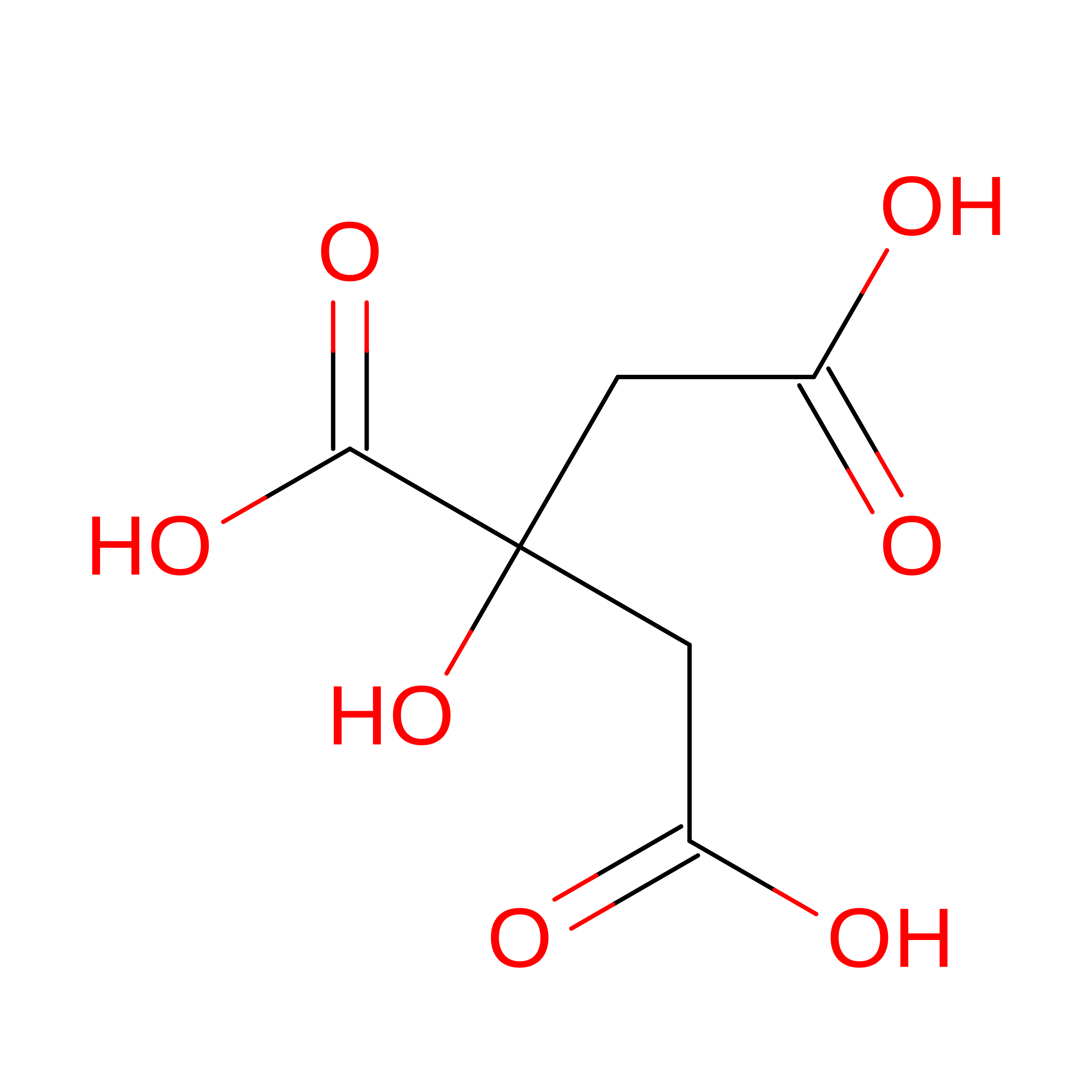
CIT

Query on CIT


Download:Ideal Coordinates CCD File
L [auth C]CITRIC ACID
C6 H8 O7
KRKNYBCHXYNGOX-UHFFFAOYSA-N
GOL

Query on GOL


Download:Ideal Coordinates CCD File
G [auth A]GLYCEROL
C3 H8 O3
PEDCQBHIVMGVHV-UHFFFAOYSA-N
CL

Query on CL


Download:Ideal Coordinates CCD File
F [auth A],
I [auth B],
M [auth C],
O [auth D]
CHLORIDE ION
Cl
VEXZGXHMUGYJMC-UHFFFAOYSA-M
NA

Query on NA


Download:Ideal Coordinates CCD File
E [auth A],
H [auth B],
J [auth C],
K [auth C],
N [auth D]
SODIUM ION
Na
FKNQFGJONOIPTF-UHFFFAOYSA-N

Experimental Data & Validation

Experimental Data

  • Method: X-RAY DIFFRACTION
  • Resolution: 2.10 Å
  • R-Value Free:  0.204 (Depositor), 0.203 (DCC) 
  • R-Value Work:  0.164 (Depositor) 
  • R-Value Observed: 0.166 (Depositor) 
Space Group: P 1 21 1
Unit Cell:
Length ( Å )Angle ( ˚ )
a = 63.188α = 90
b = 157.926β = 110.74
c = 64.719γ = 90
Software Package:
Software NamePurpose
MD2data collection
HKL-3000data reduction
HKL-3000data scaling
MOLREPphasing
REFMACrefinement
DENZOdata reduction
SCALEPACKdata scaling

Structure Validation

View Full Validation Report


Entry History 

& Funding Information

Deposition Data


Funding OrganizationLocationGrant Number
National Institutes of Health/National Institute of General Medical Sciences (NIH/NIGMS)United StatesGM094662
National Institutes of Health/National Institute of General Medical Sciences (NIH/NIGMS)United StatesGM117080
National Institutes of Health/National Human Genome Research Institute (NIH/NHGRI)United StatesHG008424

Revision History  (Full details and data files)

  • Version 1.0: 2017-03-29
    Type: Initial release
  • Version 1.1: 2017-09-13
    Changes: Author supporting evidence, Refinement description
  • Version 1.2: 2018-05-16
    Changes: Data collection, Database references, Structure summary
  • Version 1.3: 2019-11-27
    Changes: Author supporting evidence
  • Version 1.4: 2023-10-04
    Changes: Data collection, Database references, Derived calculations, Refinement description