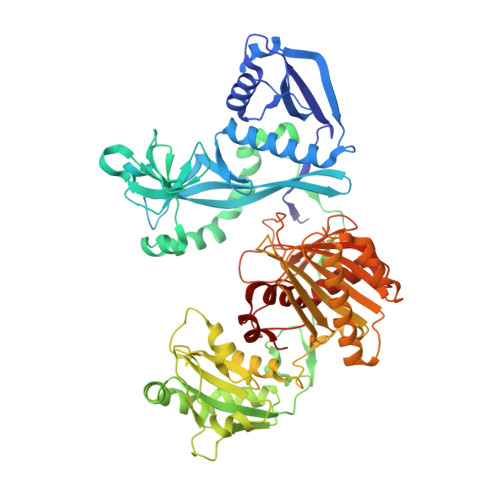
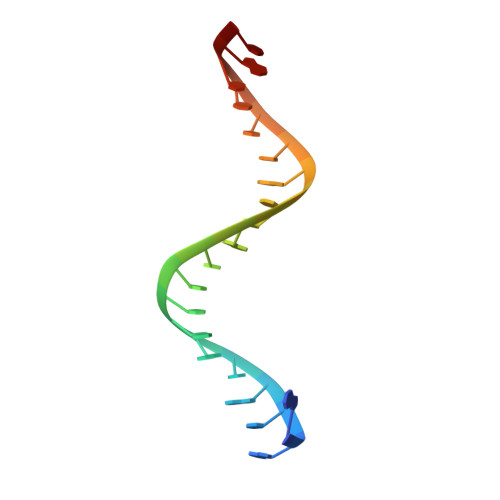
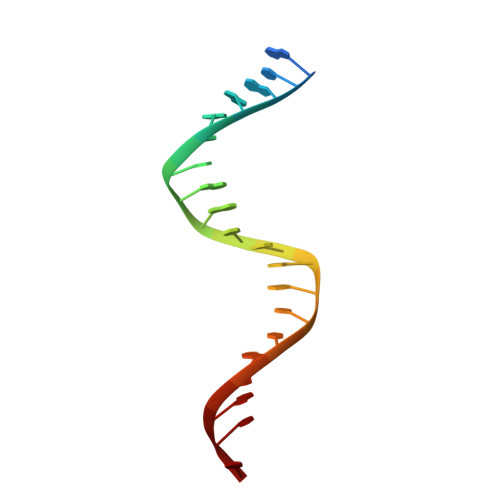
5UX0 | pdb_00005ux0

X-ray crystal structure of Marinitoga piezophila Argonaute in complex with 5' OH guide RNA and target DNA


Experimental Data Snapshot

  • Method: X-RAY DIFFRACTION
  • Resolution: 3.20 Å
  • R-Value Free: 
    0.259 (Depositor), 0.256 (DCC) 
  • R-Value Work: 
    0.215 (Depositor), 0.215 (DCC) 
  • R-Value Observed: 
    0.218 (Depositor) 

Starting Model: experimental
View more details

wwPDB Validation 3D Report Full Report

Validation slider image for 5UX0

This is version 1.3 of the entry. See complete history

Literature

DNA recognition by an RNA-guided bacterial Argonaute.

Doxzen, K.W.Doudna, J.A.

(2017) PLoS One 12: e0177097-e0177097

  • DOI: https://doi.org/10.1371/journal.pone.0177097
  • Primary Citation Related Structures: 
    5UX0

  • PubMed Abstract: 

    Argonaute (Ago) proteins are widespread in prokaryotes and eukaryotes and share a four-domain architecture capable of RNA- or DNA-guided nucleic acid recognition. Previous studies identified a prokaryotic Argonaute protein from the eubacterium Marinitoga piezophila (MpAgo), which binds preferentially to 5'-hydroxylated guide RNAs and cleaves single-stranded RNA (ssRNA) and DNA (ssDNA) targets. Here we present a 3.2 Å resolution crystal structure of MpAgo bound to a 21-nucleotide RNA guide and a complementary 21-nucleotide ssDNA substrate. Comparison of this ternary complex to other target-bound Argonaute structures reveals a unique orientation of the N-terminal domain, resulting in a straight helical axis of the entire RNA-DNA heteroduplex through the central cleft of the protein. Additionally, mismatches introduced into the heteroduplex reduce MpAgo cleavage efficiency with a symmetric profile centered around the middle of the helix. This pattern differs from the canonical mismatch tolerance of other Argonautes, which display decreased cleavage efficiency for substrates bearing sequence mismatches to the 5' region of the guide strand. This structural analysis of MpAgo bound to a hybrid helix advances our understanding of the diversity of target recognition mechanisms by Argonaute proteins.


  • Organizational Affiliation
    • Biophysics Graduate Group, University of California, Berkeley, California, United States of America.

Macromolecule Content 

  • Total Structure Weight: 178.56 kDa 
  • Atom Count: 12,237 
  • Modeled Residue Count: 1,345 
  • Deposited Residue Count: 1,368 
  • Unique protein chains: 1
  • Unique nucleic acid chains: 2

Macromolecules


Find similar proteins by:|  3D Structure
Entity ID: 1
MoleculeChains  Sequence LengthOrganismDetailsImage
Argonaute protein
A, D
642Marinitoga piezophilaMutation(s): 1 
EC: 3.1.24
UniProt
Find proteins for H2J4R4 (Marinitoga piezophila (strain DSM 14283 / JCM 11233 / KA3))
Explore H2J4R4 
Go to UniProtKB:  H2J4R4
Entity Groups
Sequence Clusters30% Identity50% Identity70% Identity90% Identity95% Identity100% Identity
UniProt GroupH2J4R4
Sequence Annotations
Expand
Reference Sequence
Find similar nucleic acids by:  Sequence
Entity ID: 2
MoleculeChains LengthOrganismImage
RNA (5'-R(*G*GP*UP*AP*CP*AP*AP*CP*CP*UP*AP*CP*UP*AP*CP*CP*UP*CP*AP*U)-3')
B, E
21synthetic construct
Sequence Annotations
Expand
Reference Sequence
Find similar nucleic acids by:  Sequence
Entity ID: 3
MoleculeChains LengthOrganismImage
DNA (5'-D(P*AP*TP*GP*AP*GP*GP*TP*AP*GP*TP*AP*GP*GP*TP*TP*GP*TP*AP*CP*C)-3')
C, F
21synthetic construct
Sequence Annotations
Expand
Reference Sequence

Experimental Data & Validation

Experimental Data

  • Method: X-RAY DIFFRACTION
  • Resolution: 3.20 Å
  • R-Value Free:  0.259 (Depositor), 0.256 (DCC) 
  • R-Value Work:  0.215 (Depositor), 0.215 (DCC) 
  • R-Value Observed: 0.218 (Depositor) 
Space Group: P 21 21 21
Unit Cell:
Length ( Å )Angle ( ˚ )
a = 85.003α = 90
b = 130.993β = 90
c = 171.468γ = 90
Software Package:
Software NamePurpose
Aimlessdata scaling
PHASERphasing
PHENIXrefinement
PDB_EXTRACTdata extraction
XDSdata reduction

Structure Validation

View Full Validation Report


Entry History 

Deposition Data

Revision History  (Full details and data files)

  • Version 1.0: 2017-05-03
    Type: Initial release
  • Version 1.1: 2017-06-07
    Changes: Database references
  • Version 1.2: 2023-10-04
    Changes: Data collection, Database references, Refinement description
  • Version 1.3: 2024-12-25
    Changes: Advisory, Derived calculations, Structure summary