5USJ | pdb_00005usj

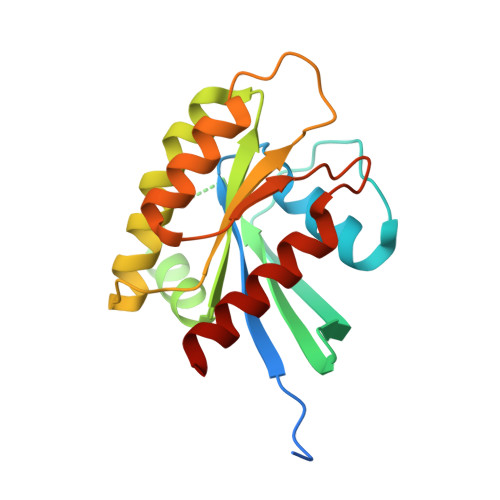
Crystal Structure of human KRAS G12D mutant in complex with GDPNP


Experimental Data Snapshot

  • Method: X-RAY DIFFRACTION
  • Resolution: 1.94 Å
  • R-Value Free: 
    0.238 (Depositor), 0.242 (DCC) 
  • R-Value Work: 
    0.177 (Depositor), 0.186 (DCC) 
  • R-Value Observed: 
    0.180 (Depositor) 

wwPDB Validation 3D Report Full Report

Validation slider image for 5USJ

Ligand Structure Quality Assessment 


This is version 1.2 of the entry. See complete history

Literature

Multivalent Small-Molecule Pan-RAS Inhibitors.

Welsch, M.E.Kaplan, A.Chambers, J.M.Stokes, M.E.Bos, P.H.Zask, A.Zhang, Y.Sanchez-Martin, M.Badgley, M.A.Huang, C.S.Tran, T.H.Akkiraju, H.Brown, L.M.Nandakumar, R.Cremers, S.Yang, W.S.Tong, L.Olive, K.P.Ferrando, A.Stockwell, B.R.

(2017) Cell 168: 878-889.e29

  • DOI: https://doi.org/10.1016/j.cell.2017.02.006
  • Primary Citation Related Structures: 
    5UQW, 5US4, 5USJ

  • PubMed Abstract: 

    Design of small molecules that disrupt protein-protein interactions, including the interaction of RAS proteins and their effectors, may provide chemical probes and therapeutic agents. We describe here the synthesis and testing of potential small-molecule pan-RAS ligands, which were designed to interact with adjacent sites on the surface of oncogenic KRAS. One compound, termed 3144, was found to bind to RAS proteins using microscale thermophoresis, nuclear magnetic resonance spectroscopy, and isothermal titration calorimetry and to exhibit lethality in cells partially dependent on expression of RAS proteins. This compound was metabolically stable in liver microsomes and displayed anti-tumor activity in xenograft mouse cancer models. These findings suggest that pan-RAS inhibition may be an effective therapeutic strategy for some cancers and that structure-based design of small molecules targeting multiple adjacent sites to create multivalent inhibitors may be effective for some proteins.


  • Organizational Affiliation
    • Department of Chemistry, Columbia University, New York, NY 10027, USA.

Macromolecule Content 

  • Total Structure Weight: 132.29 kDa 
  • Atom Count: 8,956 
  • Modeled Residue Count: 1,010 
  • Deposited Residue Count: 1,134 
  • Unique protein chains: 1

Macromolecules

Find similar proteins by:|  3D Structure
Entity ID: 1
MoleculeChains  Sequence LengthOrganismDetailsImage
GTPase KRas
A, B, C, D, E
A, B, C, D, E, F
189Homo sapiensMutation(s): 1 
Gene Names: KRASKRAS2RASK2
EC: 3.6.5.2
UniProt & NIH Common Fund Data Resources
Find proteins for P01116 (Homo sapiens)
Explore P01116 
Go to UniProtKB:  P01116
PHAROS:  P01116
GTEx:  ENSG00000133703 
Entity Groups
Sequence Clusters30% Identity50% Identity70% Identity90% Identity95% Identity100% Identity
UniProt GroupP01116
Sequence Annotations
Expand
Reference Sequence

Small Molecules

Ligands 2 Unique
IDChains Name / Formula / InChI Key2D Diagram3D Interactions
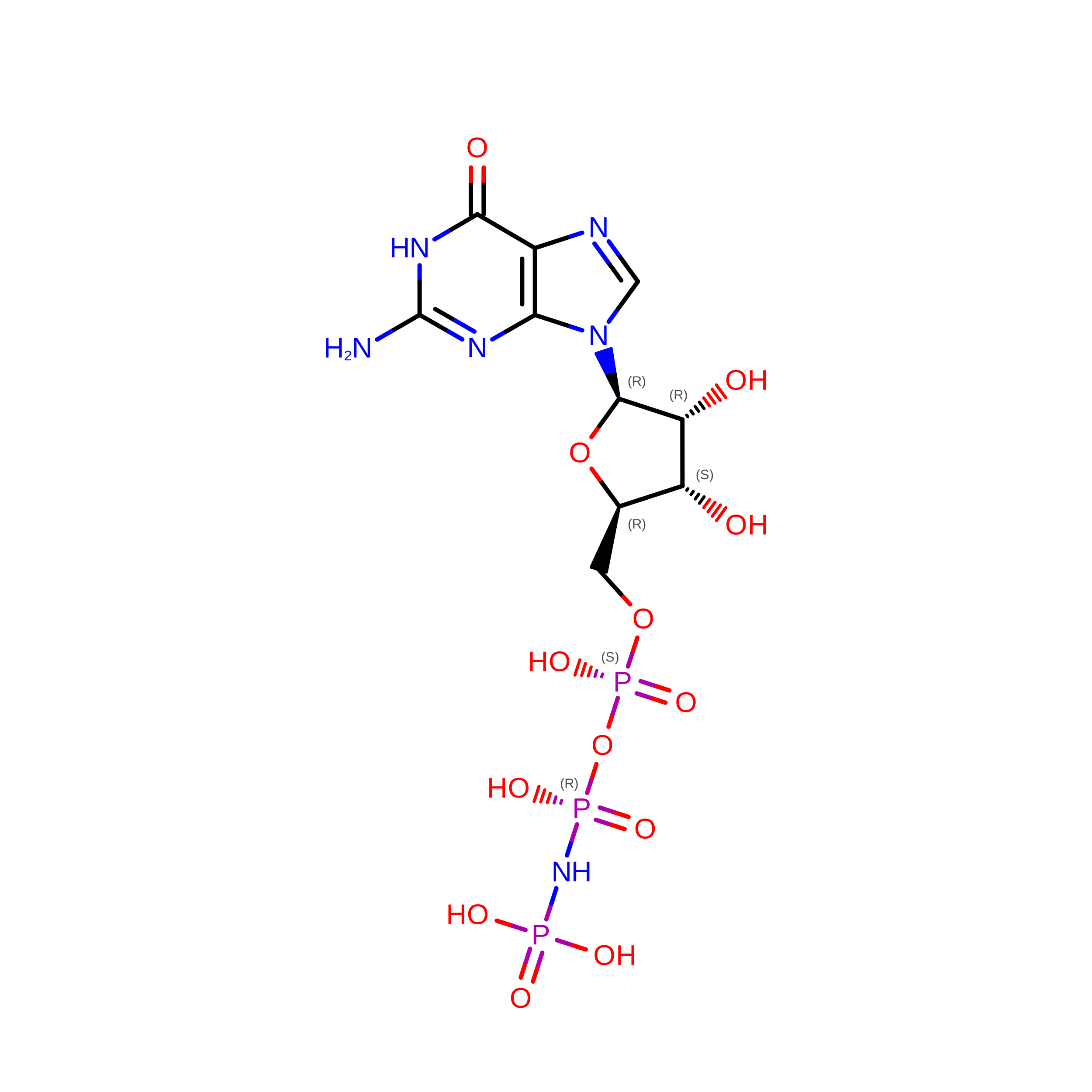
GNP

Query on GNP


Download:Ideal Coordinates CCD File
H [auth A]
J [auth B]
L [auth C]
N [auth D]
P [auth E]
H [auth A],
J [auth B],
L [auth C],
N [auth D],
P [auth E],
R [auth F]
PHOSPHOAMINOPHOSPHONIC ACID-GUANYLATE ESTER
C10 H17 N6 O13 P3
UQABYHGXWYXDTK-UUOKFMHZSA-N
MG

Query on MG


Download:Ideal Coordinates CCD File
G [auth A]
I [auth B]
K [auth C]
M [auth D]
O [auth E]
G [auth A],
I [auth B],
K [auth C],
M [auth D],
O [auth E],
Q [auth F]
MAGNESIUM ION
Mg
JLVVSXFLKOJNIY-UHFFFAOYSA-N

Experimental Data & Validation

Experimental Data

  • Method: X-RAY DIFFRACTION
  • Resolution: 1.94 Å
  • R-Value Free:  0.238 (Depositor), 0.242 (DCC) 
  • R-Value Work:  0.177 (Depositor), 0.186 (DCC) 
  • R-Value Observed: 0.180 (Depositor) 
Space Group: P 1
Unit Cell:
Length ( Å )Angle ( ˚ )
a = 63.423α = 91.51
b = 63.491β = 112.63
c = 81.991γ = 115.44
Software Package:
Software NamePurpose
REFMACrefinement
DENZOdata reduction
SCALEPACKdata scaling
PHASERphasing

Structure Validation

View Full Validation Report


Ligand Structure Quality Assessment 


Entry History 

Deposition Data

Revision History  (Full details and data files)

  • Version 1.0: 2017-03-22
    Type: Initial release
  • Version 1.1: 2017-09-27
    Changes: Author supporting evidence
  • Version 1.2: 2024-03-06
    Changes: Data collection, Database references, Derived calculations