5UFC | pdb_00005ufc

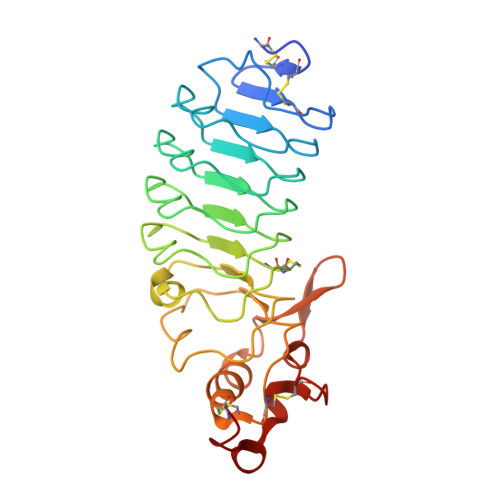
Crystal Structure of Variable Lymphocyte Receptor (VLR) Tn4-22 with H-trisaccharide bound


Experimental Data Snapshot

  • Method: X-RAY DIFFRACTION
  • Resolution: 1.89 Å
  • R-Value Free: 
    0.231 (Depositor), 0.231 (DCC) 
  • R-Value Work: 
    0.198 (Depositor) 
  • R-Value Observed: 
    0.199 (Depositor) 

Starting Model: experimental
View more details

wwPDB Validation 3D Report Full Report

Validation slider image for 5UFC

This is version 2.2 of the entry. See complete history

Literature

Structural Insights into VLR Fine Specificity for Blood Group Carbohydrates.

Collins, B.C.Gunn, R.J.McKitrick, T.R.Cummings, R.D.Cooper, M.D.Herrin, B.R.Wilson, I.A.

(2017) Structure 25: 1667-1678.e4

  • DOI: https://doi.org/10.1016/j.str.2017.09.003
  • Primary Citation Related Structures: 
    5UEI, 5UF1, 5UF4, 5UFB, 5UFC, 5UFD, 5UFF

  • PubMed Abstract: 

    High-quality reagents to study and detect glycans with high specificity for research and clinical applications are severely lacking. Here, we structurally and functionally characterize several variable lymphocyte receptor (VLR)-based antibodies from lampreys immunized with O erythrocytes that specifically recognize the blood group H-trisaccharide type II antigen. Glycan microarray analysis and biophysical data reveal that these VLRs exhibit greater specificity for H-trisaccharide compared with the plant lectin UEA-1, which is widely used in blood typing. Among these antibodies, O13 exhibits superior specificity for H-trisaccharide, the basis for which is revealed by comparative analysis of high-resolution VLR:glycan crystal structures. Using a structure-guided approach, we designed an O13 mutant with further enhanced specificity for H-trisaccharide. These insights into glycan recognition by VLRs suggest that lampreys can produce highly specific glycan antibodies, and are a valuable resource for the production of next-generation glycan reagents for biological and biomedical research and as diagnostics and therapeutics.


  • Organizational Affiliation
    • Department of Integrative Structural and Computational Biology and the Skaggs Institute for Chemical Biology, The Scripps Research Institute, La Jolla, CA 92037, USA.

Macromolecule Content 

  • Total Structure Weight: 84.74 kDa 
  • Atom Count: 5,934 
  • Modeled Residue Count: 720 
  • Deposited Residue Count: 744 
  • Unique protein chains: 1

Macromolecules

Find similar proteins by:|  3D Structure
Entity ID: 1
MoleculeChains  Sequence LengthOrganismDetailsImage
Tn4-22
A, B, C
248Petromyzon marinusMutation(s): 0 

Oligosaccharides

Help  
Entity ID: 2
MoleculeChains Length2D Diagram GlycosylationD Interactions
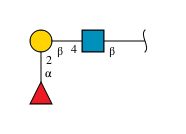
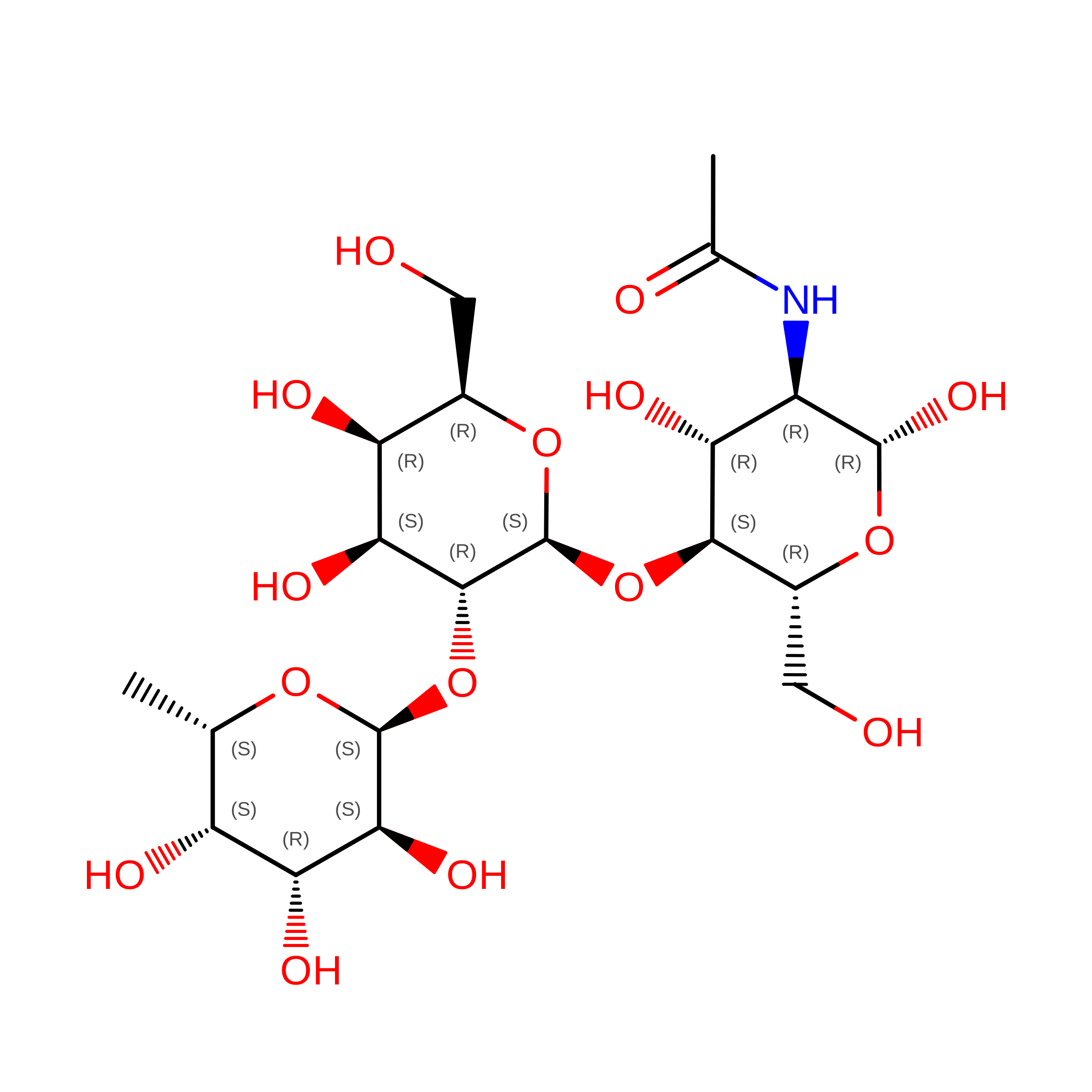
alpha-L-fucopyranose-(1-2)-beta-D-galactopyranose-(1-4)-2-acetamido-2-deoxy-beta-D-glucopyranose
D, E, F
3N/A
Glycosylation Resources
GlyTouCan: G61459JW
GlyCosmos: G61459JW
GlyGen: G61459JW

Biologically Interesting Molecules (External Reference) 

1 Unique

Experimental Data & Validation

Experimental Data

  • Method: X-RAY DIFFRACTION
  • Resolution: 1.89 Å
  • R-Value Free:  0.231 (Depositor), 0.231 (DCC) 
  • R-Value Work:  0.198 (Depositor) 
  • R-Value Observed: 0.199 (Depositor) 
Space Group: P 31 2 1
Unit Cell:
Length ( Å )Angle ( ˚ )
a = 98.916α = 90
b = 98.916β = 90
c = 162.875γ = 120
Software Package:
Software NamePurpose
PHENIXrefinement
PDB_EXTRACTdata extraction
XDSdata reduction
XDSdata scaling
PHASERphasing

Structure Validation

View Full Validation Report


Entry History 

& Funding Information

Deposition Data


Funding OrganizationLocationGrant Number
National Institutes of Health/National Institute Of Allergy and Infectious Diseases (NIH/NIAID)United States--

Revision History  (Full details and data files)

  • Version 1.0: 2017-10-18
    Type: Initial release
  • Version 1.1: 2017-11-22
    Changes: Database references
  • Version 1.2: 2019-12-11
    Changes: Author supporting evidence
  • Version 2.0: 2020-07-29
    Type: Remediation
    Reason: Carbohydrate remediation
    Changes: Atomic model, Data collection, Derived calculations, Non-polymer description, Structure summary
  • Version 2.1: 2023-10-04
    Changes: Data collection, Database references, Refinement description, Structure summary
  • Version 2.2: 2024-10-23
    Changes: Structure summary