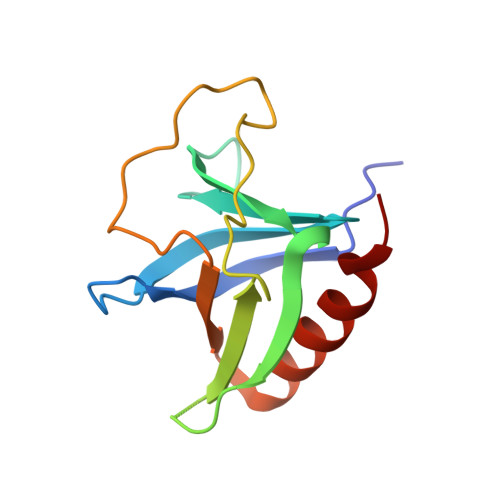
5U78 | pdb_00005u78

Crystal structure of ORP8 PH domain in P1211 space group


Experimental Data Snapshot

  • Method: X-RAY DIFFRACTION
  • Resolution: 1.98 Å
  • R-Value Free: 
    0.258 (Depositor), 0.258 (DCC) 
  • R-Value Work: 
    0.223 (Depositor), 0.228 (DCC) 
  • R-Value Observed: 
    0.224 (Depositor) 

Starting Model: experimental
View more details

wwPDB Validation 3D Report Full Report

Validation slider image for 5U78

This is version 1.4 of the entry. See complete history

Literature

ORP5 and ORP8 bind phosphatidylinositol-4, 5-biphosphate (PtdIns(4,5)P 2) and regulate its level at the plasma membrane.

Ghai, R.Du, X.Wang, H.Dong, J.Ferguson, C.Brown, A.J.Parton, R.G.Wu, J.W.Yang, H.

(2017) Nat Commun 8: 757-757

  • DOI: https://doi.org/10.1038/s41467-017-00861-5
  • Primary Citation Related Structures: 
    5U77, 5U78

  • PubMed Abstract: 

    ORP5 and ORP8, members of the oxysterol-binding protein (OSBP)-related proteins (ORP) family, are endoplasmic reticulum membrane proteins implicated in lipid trafficking. ORP5 and ORP8 are reported to localize to endoplasmic reticulum-plasma membrane junctions via binding to phosphatidylinositol-4-phosphate (PtdIns(4)P), and act as a PtdIns(4)P/phosphatidylserine counter exchanger between the endoplasmic reticulum and plasma membrane. Here we provide evidence that the pleckstrin homology domain of ORP5/8 via PtdIns(4,5)P 2 , and not PtdIns(4)P binding mediates the recruitment of ORP5/8 to endoplasmic reticulum-plasma membrane contact sites. The OSBP-related domain of ORP8 can extract and transport multiple phosphoinositides in vitro, and knocking down both ORP5 and ORP8 in cells increases the plasma membrane level of PtdIns(4,5)P 2 with little effect on PtdIns(4)P. Overall, our data show, for the first time, that phosphoinositides other than PtdIns(4)P can also serve as co-exchangers for the transport of cargo lipids by ORPs.ORP5/8 are endoplasmic reticulum (ER) membrane proteins implicated in lipid trafficking that localize to ER-plasma membrane (PM) contacts and maintain membrane homeostasis. Here the authors show that PtdIns(4,5)P 2 plays a critical role in the targeting and function of ORP5/8 at the PM.


  • Organizational Affiliation
    • School of Biotechnology and Biomolecular Sciences, The University of New South Wales, Sydney, NSW, 2052, Australia.

Macromolecule Content 

  • Total Structure Weight: 54.44 kDa 
  • Atom Count: 3,935 
  • Modeled Residue Count: 479 
  • Deposited Residue Count: 492 
  • Unique protein chains: 1

Macromolecules

Find similar proteins by:|  3D Structure
Entity ID: 1
MoleculeChains  Sequence LengthOrganismDetailsImage
Oxysterol-binding protein-related protein 8
A, B, C, D
123Homo sapiensMutation(s): 0 
Gene Names: OSBPL8KIAA1451ORP8OSBP10
Membrane Entity: Yes 
UniProt & NIH Common Fund Data Resources
Find proteins for Q9BZF1 (Homo sapiens)
Explore Q9BZF1 
Go to UniProtKB:  Q9BZF1
PHAROS:  Q9BZF1
GTEx:  ENSG00000091039 
Entity Groups
Sequence Clusters30% Identity50% Identity70% Identity90% Identity95% Identity100% Identity
UniProt GroupQ9BZF1
Sequence Annotations
Expand
Reference Sequence

Experimental Data & Validation

Experimental Data

  • Method: X-RAY DIFFRACTION
  • Resolution: 1.98 Å
  • R-Value Free:  0.258 (Depositor), 0.258 (DCC) 
  • R-Value Work:  0.223 (Depositor), 0.228 (DCC) 
  • R-Value Observed: 0.224 (Depositor) 
Space Group: P 1 21 1
Unit Cell:
Length ( Å )Angle ( ˚ )
a = 52.17α = 90
b = 66.35β = 94.67
c = 79.549γ = 90
Software Package:
Software NamePurpose
PHENIXrefinement
iMOSFLMdata reduction
Aimlessdata scaling
PHASERphasing

Structure Validation

View Full Validation Report


Entry History 

& Funding Information

Deposition Data


Funding OrganizationLocationGrant Number
National Health and Medical Research Council (NHMRC, Australia)Australia1097185
National Health and Medical Research Council (NHMRC, Australia)Australia1041301
Australian Research Council (ARC)AustraliaDP130100457

Revision History  (Full details and data files)

  • Version 1.0: 2017-10-18
    Type: Initial release
  • Version 1.1: 2018-01-17
    Changes: Author supporting evidence
  • Version 1.2: 2020-01-01
    Changes: Author supporting evidence
  • Version 1.3: 2023-10-04
    Changes: Data collection, Database references, Refinement description
  • Version 1.4: 2024-10-23
    Changes: Structure summary