5TS4 | pdb_00005ts4

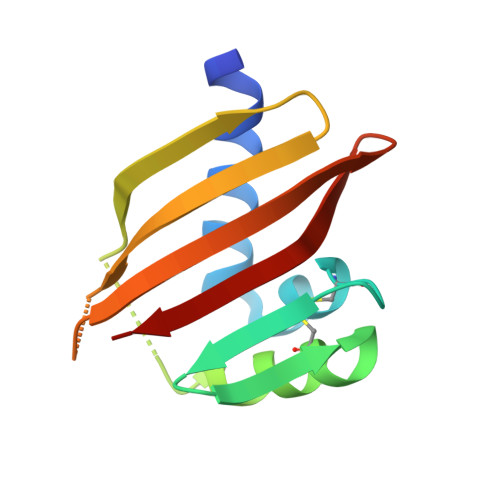
Crystal structure of a de novo designed protein with curved beta-sheet


Experimental Data Snapshot

  • Method: X-RAY DIFFRACTION
  • Resolution: 3.00 Å
  • R-Value Free: 
    0.316 (Depositor), 0.327 (DCC) 
  • R-Value Work: 
    0.274 (Depositor), 0.292 (DCC) 
  • R-Value Observed: 
    0.278 (Depositor) 

wwPDB Validation 3D Report Full Report

Validation slider image for 5TS4

This is version 1.4 of the entry. See complete history

Literature

Principles for designing proteins with cavities formed by curved beta sheets.

Marcos, E.Basanta, B.Chidyausiku, T.M.Tang, Y.Oberdorfer, G.Liu, G.Swapna, G.V.Guan, R.Silva, D.A.Dou, J.Pereira, J.H.Xiao, R.Sankaran, B.Zwart, P.H.Montelione, G.T.Baker, D.

(2017) Science 355: 201-206

  • DOI: https://doi.org/10.1126/science.aah7389
  • Primary Citation Related Structures: 
    5KPE, 5KPH, 5L33, 5TPH, 5TPJ, 5TRV, 5TS4, 5U35

  • PubMed Abstract: 

    Active sites and ligand-binding cavities in native proteins are often formed by curved β sheets, and the ability to control β-sheet curvature would allow design of binding proteins with cavities customized to specific ligands. Toward this end, we investigated the mechanisms controlling β-sheet curvature by studying the geometry of β sheets in naturally occurring protein structures and folding simulations. The principles emerging from this analysis were used to design, de novo, a series of proteins with curved β sheets topped with α helices. Nuclear magnetic resonance and crystal structures of the designs closely match the computational models, showing that β-sheet curvature can be controlled with atomic-level accuracy. Our approach enables the design of proteins with cavities and provides a route to custom design ligand-binding and catalytic sites.


  • Organizational Affiliation
    • Department of Biochemistry, University of Washington, Seattle, WA 98195, USA.

Macromolecule Content 

  • Total Structure Weight: 53.22 kDa 
  • Atom Count: 2,844 
  • Modeled Residue Count: 401 
  • Deposited Residue Count: 440 
  • Unique protein chains: 1

Macromolecules

Find similar proteins by:|  3D Structure
Entity ID: 1
MoleculeChains  Sequence LengthOrganismDetailsImage
denovo NTF2
A, B, C, D
110synthetic constructMutation(s): 0 

Small Molecules

Ligands 1 Unique
IDChains Name / Formula / InChI Key2D Diagram3D Interactions
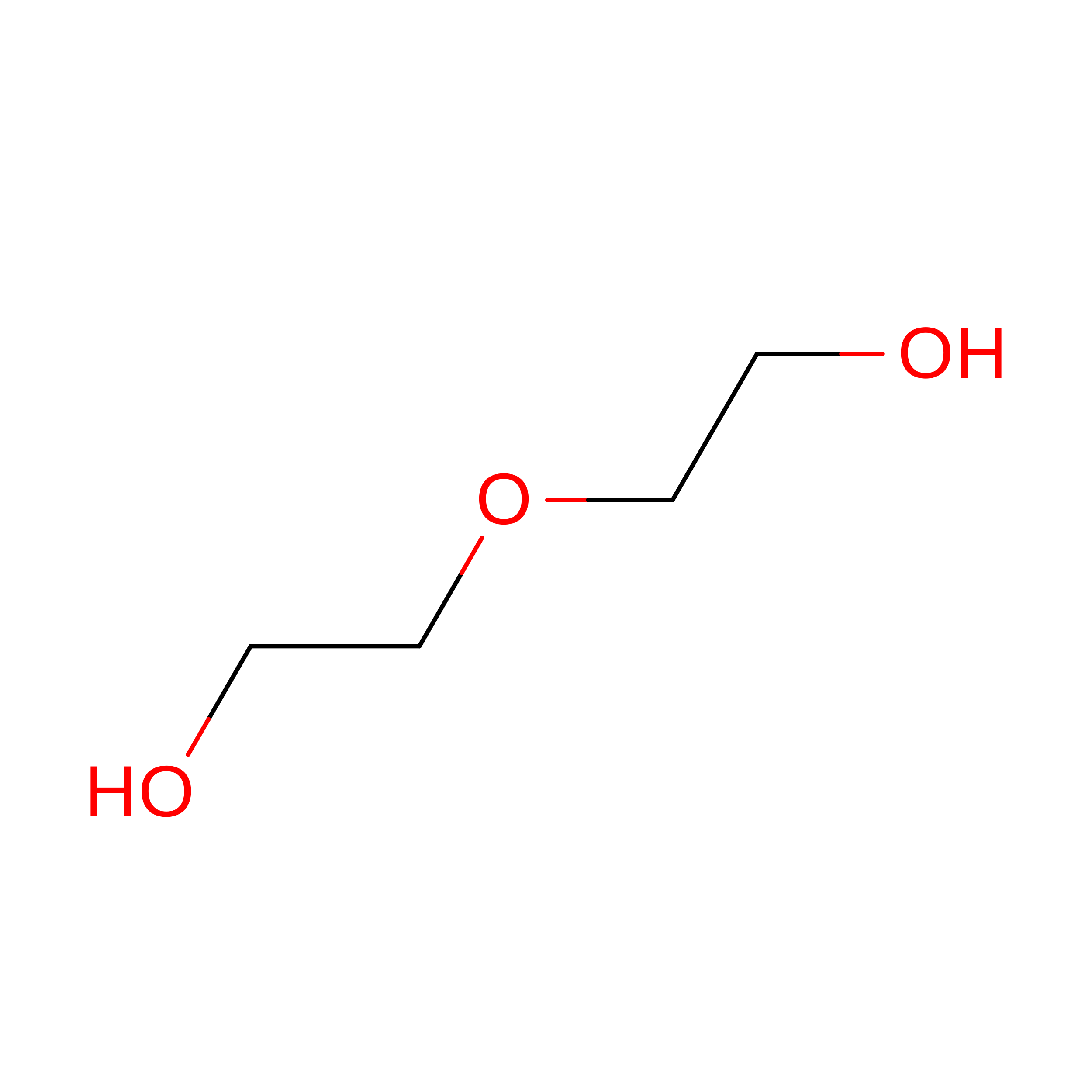
PEG

Query on PEG


Download:Ideal Coordinates CCD File
E [auth B]DI(HYDROXYETHYL)ETHER
C4 H10 O3
MTHSVFCYNBDYFN-UHFFFAOYSA-N

Experimental Data & Validation

Experimental Data

  • Method: X-RAY DIFFRACTION
  • Resolution: 3.00 Å
  • R-Value Free:  0.316 (Depositor), 0.327 (DCC) 
  • R-Value Work:  0.274 (Depositor), 0.292 (DCC) 
  • R-Value Observed: 0.278 (Depositor) 
Space Group: C 2 2 21
Unit Cell:
Length ( Å )Angle ( ˚ )
a = 81.307α = 90
b = 101.538β = 90
c = 101.584γ = 90
Software Package:
Software NamePurpose
PHENIXrefinement
HKL-2000data reduction
HKL-2000data scaling
PHASERphasing

Structure Validation

View Full Validation Report


Entry History 

& Funding Information

Deposition Data


Funding OrganizationLocationGrant Number
Defense Threat Reduction Agency (DTRA)United StatesHDTRA 1-11-1-0041
European CommissionSpainFP7-PEOPLE-2011-IOF 298976
European CommissionAustria332094 ASR-CompEnzDes FP7-PEOPLE-2012-IOF).
Department of Energy (DOE, United States)United StatesDE-AC02-05CH11231

Revision History  (Full details and data files)

  • Version 1.0: 2017-01-25
    Type: Initial release
  • Version 1.1: 2017-02-01
    Changes: Database references
  • Version 1.2: 2017-09-20
    Changes: Author supporting evidence
  • Version 1.3: 2019-12-04
    Changes: Author supporting evidence
  • Version 1.4: 2024-11-20
    Changes: Data collection, Database references, Structure summary