5TR2 | pdb_00005tr2

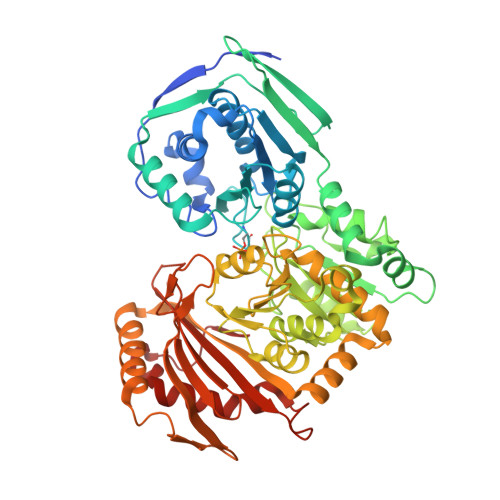
Crystal structure of the D263G missense variant of human PGM1


Experimental Data Snapshot

  • Method: X-RAY DIFFRACTION
  • Resolution: 2.50 Å
  • R-Value Free: 
    0.292 (Depositor), 0.299 (DCC) 
  • R-Value Work: 
    0.220 (Depositor), 0.225 (DCC) 
  • R-Value Observed: 
    0.224 (Depositor) 

Starting Model: experimental
View more details

wwPDB Validation 3D Report Full Report

Validation slider image for 5TR2

This is version 1.5 of the entry. See complete history

Literature

Asp263 missense variants perturb the active site of human phosphoglucomutase 1.

Stiers, K.M.Graham, A.C.Kain, B.N.Beamer, L.J.

(2017) FEBS J 284: 937-947

  • DOI: https://doi.org/10.1111/febs.14025
  • Primary Citation Related Structures: 
    5JN5, 5TR2

  • PubMed Abstract: 

    The enzyme phosphoglucomutase 1 (PGM1) plays a central role in glucose homeostasis. Clinical studies have identified mutations in human PGM1 as the cause of PGM1 deficiency, an inherited metabolic disease. One residue, Asp263, has two known variants associated with disease: D263G and D263Y. Biochemical studies have shown that these mutants are soluble and well folded, but have significant catalytic impairment. To better understand this catalytic defect, we determined crystal structures of these two missense variants, both of which reveal a similar and indirect structural change due to the loss of a conserved salt bridge between Asp263 and Arg293. The arginine reorients into the active site, making interactions with residues responsible for substrate binding. Biochemical studies also show that the catalytic phosphoserine of the missense variants is more stable to hydrolysis relative to wild-type enzyme. The structural perturbation resulting from mutation of this single amino acid reveals the molecular mechanism underlying PGM1 deficiency in these missense variants. Structural data are available in the PDB under the accession numbers 5JN5 and 5TR2.


  • Organizational Affiliation
    • Biochemistry Department, University of Missouri, Columbia, MO, USA.

Macromolecule Content 

  • Total Structure Weight: 128.98 kDa 
  • Atom Count: 8,233 
  • Modeled Residue Count: 1,113 
  • Deposited Residue Count: 1,170 
  • Unique protein chains: 1

Macromolecules

Find similar proteins by:|  3D Structure
Entity ID: 1
MoleculeChains  Sequence LengthOrganismDetailsImage
Phosphoglucomutase-1
A, B
585Homo sapiensMutation(s): 0 
Gene Names: PGM1
EC: 5.4.2.2
UniProt & NIH Common Fund Data Resources
Find proteins for P36871 (Homo sapiens)
Explore P36871 
Go to UniProtKB:  P36871
PHAROS:  P36871
GTEx:  ENSG00000079739 
Entity Groups
Sequence Clusters30% Identity50% Identity70% Identity90% Identity95% Identity100% Identity
UniProt GroupP36871
Sequence Annotations
Expand
Reference Sequence

Small Molecules

Ligands 3 Unique
IDChains Name / Formula / InChI Key2D Diagram3D Interactions
SO4

Query on SO4


Download:Ideal Coordinates CCD File
C [auth A],
D [auth A],
E [auth A],
H [auth B]
SULFATE ION
O4 S
QAOWNCQODCNURD-UHFFFAOYSA-L
GOL

Query on GOL


Download:Ideal Coordinates CCD File
G [auth A]GLYCEROL
C3 H8 O3
PEDCQBHIVMGVHV-UHFFFAOYSA-N
CA

Query on CA


Download:Ideal Coordinates CCD File
F [auth A],
I [auth B]
CALCIUM ION
Ca
BHPQYMZQTOCNFJ-UHFFFAOYSA-N
Modified Residues  1 Unique
IDChains TypeFormula2D DiagramParent
SEP
Query on SEP
A, B
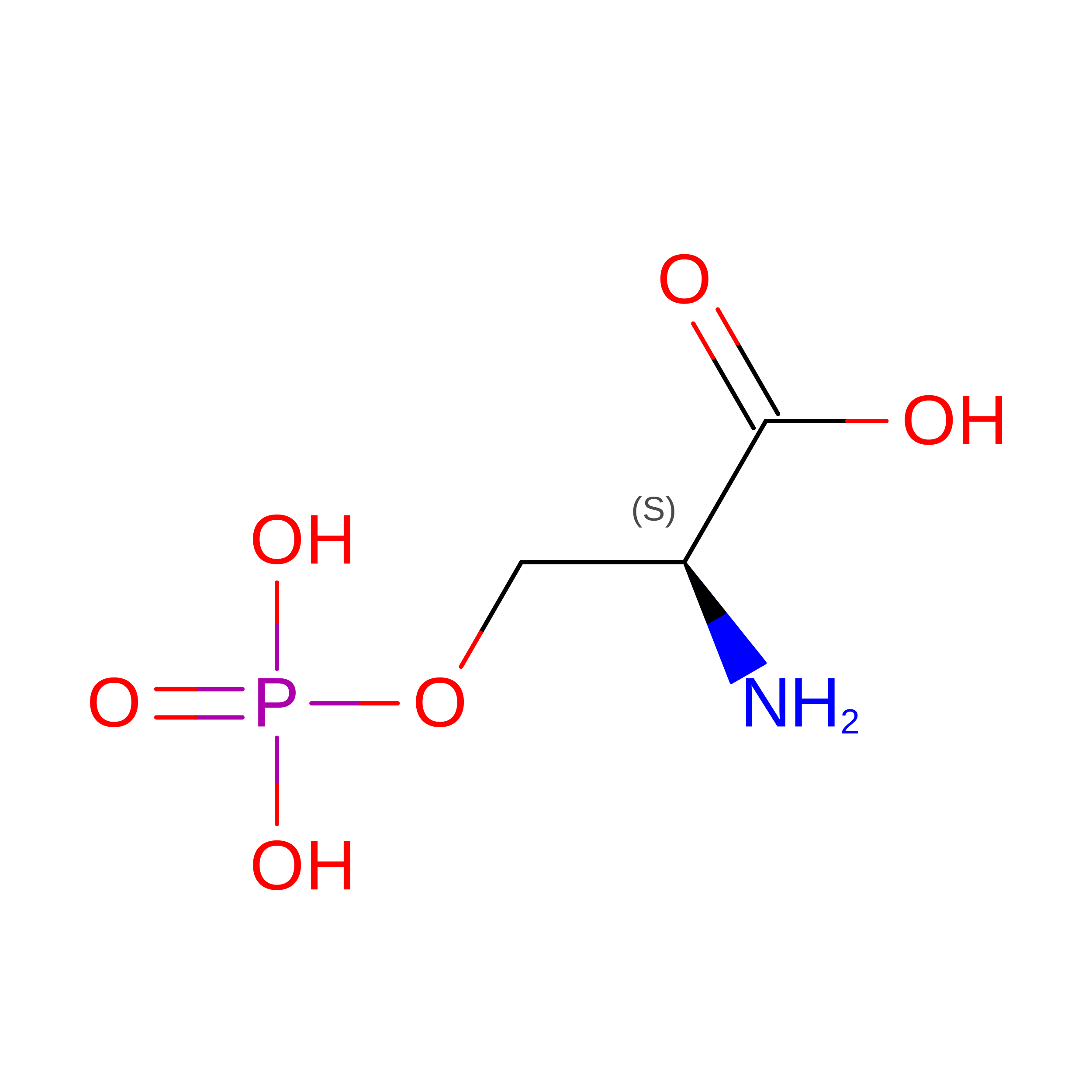
L-PEPTIDE LINKINGC3 H8 N O6 PSER

Experimental Data & Validation

Experimental Data

  • Method: X-RAY DIFFRACTION
  • Resolution: 2.50 Å
  • R-Value Free:  0.292 (Depositor), 0.299 (DCC) 
  • R-Value Work:  0.220 (Depositor), 0.225 (DCC) 
  • R-Value Observed: 0.224 (Depositor) 
Space Group: P 41 21 2
Unit Cell:
Length ( Å )Angle ( ˚ )
a = 172.124α = 90
b = 172.124β = 90
c = 99.005γ = 90
Software Package:
Software NamePurpose
PHENIXrefinement
XDSdata reduction
PHASERphasing
XDSdata scaling

Structure Validation

View Full Validation Report


Entry History 

Deposition Data

Revision History  (Full details and data files)

  • Version 1.0: 2017-02-08
    Type: Initial release
  • Version 1.1: 2017-02-22
    Changes: Database references
  • Version 1.2: 2017-03-29
    Changes: Database references
  • Version 1.3: 2017-11-01
    Changes: Author supporting evidence
  • Version 1.4: 2023-10-04
    Changes: Data collection, Database references, Derived calculations, Refinement description
  • Version 1.5: 2024-11-13
    Changes: Structure summary