Download Mendeley
Influence of nucleotide modifications at the C2' position on the Hoogsteen base-paired parallel-stranded duplex of poly(A) RNA.
Copp, W., Denisov, A.Y., Xie, J., Noronha, A.M., Liczner, C., Safaee, N., Wilds, C.J., Gehring, K.(2017) Nucleic Acids Res 45: 10321-10331
- PubMed: 28973475 Search on PubMedSearch on PubMed Central
- DOI: https://doi.org/10.1093/nar/gkx713
- Primary Citation Related Structures:
5TGG, 5VXQ - PubMed Abstract:
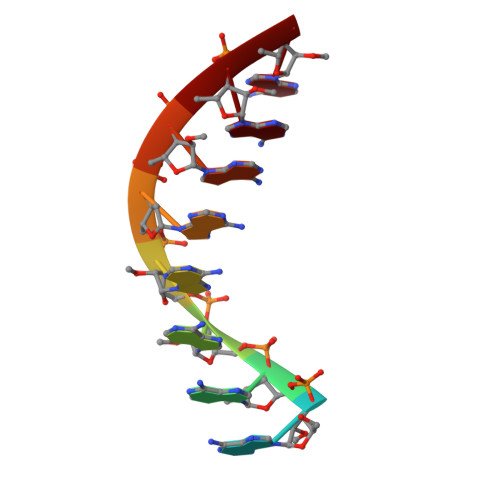
Polyadenylate (poly(A)) has the ability to form a parallel duplex with Hoogsteen adenine:adenine base pairs at low pH or in the presence of ammonium ions. In order to evaluate the potential of this structural motif for nucleic acid-based nanodevices, we characterized the effects on duplex stability of substitutions of the ribose sugar with 2'-deoxyribose, 2'-O-methyl-ribose, 2'-deoxy-2'-fluoro-ribose, arabinose and 2'-deoxy-2'-fluoro-arabinose. Deoxyribose substitutions destabilized the poly(A) duplex both at low pH and in the presence of ammonium ions: no duplex formation could be detected with poly(A) DNA oligomers. Other sugar C2' modifications gave a variety of effects. Arabinose and 2'-deoxy-2'-fluoro-arabinose nucleotides strongly destabilized poly(A) duplex formation. In contrast, 2'-O-methyl and 2'-deoxy-2'-fluoro-ribo modifications were stabilizing either at pH 4 or in the presence of ammonium ions. The differential effect suggests they could be used to design molecules selectively responsive to pH or ammonium ions. To understand the destabilization by deoxyribose, we determined the structures of poly(A) duplexes with a single DNA residue by nuclear magnetic resonance spectroscopy and X-ray crystallography. The structures revealed minor structural perturbations suggesting that the combination of sugar pucker propensity, hydrogen bonding, pKa shifts and changes in hydration determine duplex stability.
- Department of Chemistry and Biochemistry, Concordia University, Montréal, Québec H4B 1R6, Canada.
Organizational Affiliation: