5TBN | pdb_00005tbn

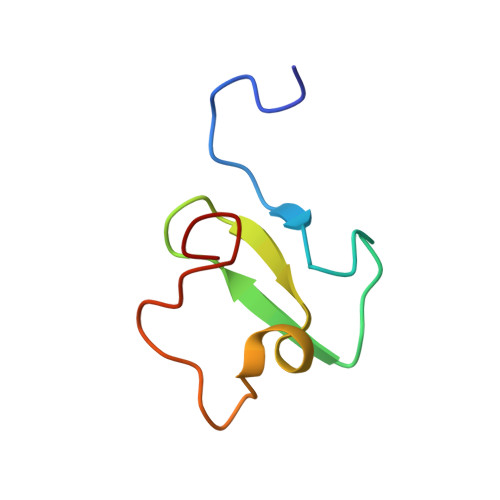
Solution NMR structure of PHF20 PHD domain in complex with a histone H3K4me2 peptide


Experimental Data Snapshot

  • Method: SOLUTION NMR
  • Conformers Calculated: 100 
  • Conformers Submitted: 20 
  • Selection Criteria: structures with the lowest energy 

wwPDB Validation 3D Report Full Report

Validation slider image for 5TBN

This is version 1.4 of the entry. See complete history

Literature

PHF20 Readers Link Methylation of Histone H3K4 and p53 with H4K16 Acetylation.

Klein, B.J.Wang, X.Cui, G.Yuan, C.Botuyan, M.V.Lin, K.Lu, Y.Wang, X.Zhao, Y.Bruns, C.J.Mer, G.Shi, X.Kutateladze, T.G.

(2016) Cell Rep 17: 1158-1170

  • DOI: https://doi.org/10.1016/j.celrep.2016.09.056
  • Primary Citation Related Structures: 
    5TAB, 5TBN

  • PubMed Abstract: 

    PHF20 is a core component of the lysine acetyltransferase complex MOF (male absent on the first)-NSL (non-specific lethal) that generates the major epigenetic mark H4K16ac and is necessary for transcriptional regulation and DNA repair. The role of PHF20 in the complex remains elusive. Here, we report on functional coupling between methylation readers in PHF20. We show that the plant homeodomain (PHD) finger of PHF20 recognizes dimethylated lysine 4 of histone H3 (H3K4me2) and represents an example of a native reader that selects for this modification. Biochemical and structural analyses help to explain this selectivity and the preference of Tudor2, another reader in PHF20, for dimethylated p53. Binding of the PHD finger to H3K4me2 is required for histone acetylation, accumulation of PHF20 at target genes, and transcriptional activation. Together, our findings establish a unique PHF20-mediated link between MOF histone acetyltransferase (HAT), p53, and H3K4me2, and suggest a model for rapid spreading of H4K16ac-enriched open chromatin.


  • Organizational Affiliation
    • Department of Pharmacology, University of Colorado School of Medicine, Aurora, CO 80045, USA.

Macromolecule Content 

  • Total Structure Weight: 8.24 kDa 
  • Atom Count: 561 
  • Modeled Residue Count: 69 
  • Deposited Residue Count: 69 
  • Unique protein chains: 2

Macromolecules

Find similar proteins by:|  3D Structure
Entity ID: 1
MoleculeChains  Sequence LengthOrganismDetailsImage
PHD finger protein 2057Homo sapiensMutation(s): 0 
Gene Names: PHF20C20orf104GLEA2HCA58NZFTZP
UniProt & NIH Common Fund Data Resources
Find proteins for Q9BVI0 (Homo sapiens)
Explore Q9BVI0 
Go to UniProtKB:  Q9BVI0
PHAROS:  Q9BVI0
GTEx:  ENSG00000025293 
Entity Groups
Sequence Clusters30% Identity50% Identity70% Identity90% Identity95% Identity100% Identity
UniProt GroupQ9BVI0
Sequence Annotations
Expand
Reference Sequence
Find similar proteins by:  Sequence   |   3D Structure  
Entity ID: 2
MoleculeChains  Sequence LengthOrganismDetailsImage
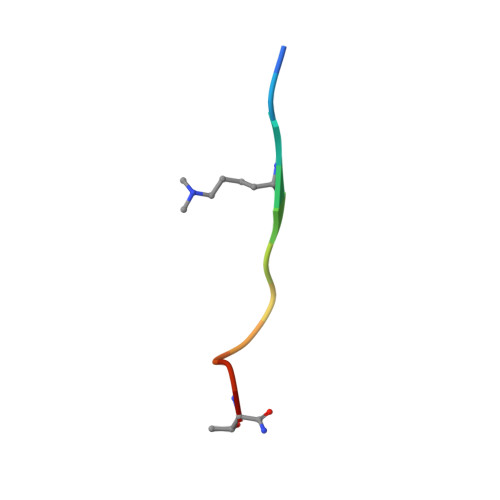
Histone H3.1B [auth C]12Homo sapiensMutation(s): 1 
UniProt & NIH Common Fund Data Resources
Find proteins for P68431 (Homo sapiens)
Explore P68431 
Go to UniProtKB:  P68431
Entity Groups
Sequence Clusters30% Identity50% Identity70% Identity90% Identity95% Identity100% Identity
UniProt GroupP68431
Sequence Annotations
Expand
Reference Sequence

Small Molecules

Modified Residues  1 Unique
IDChains TypeFormula2D DiagramParent
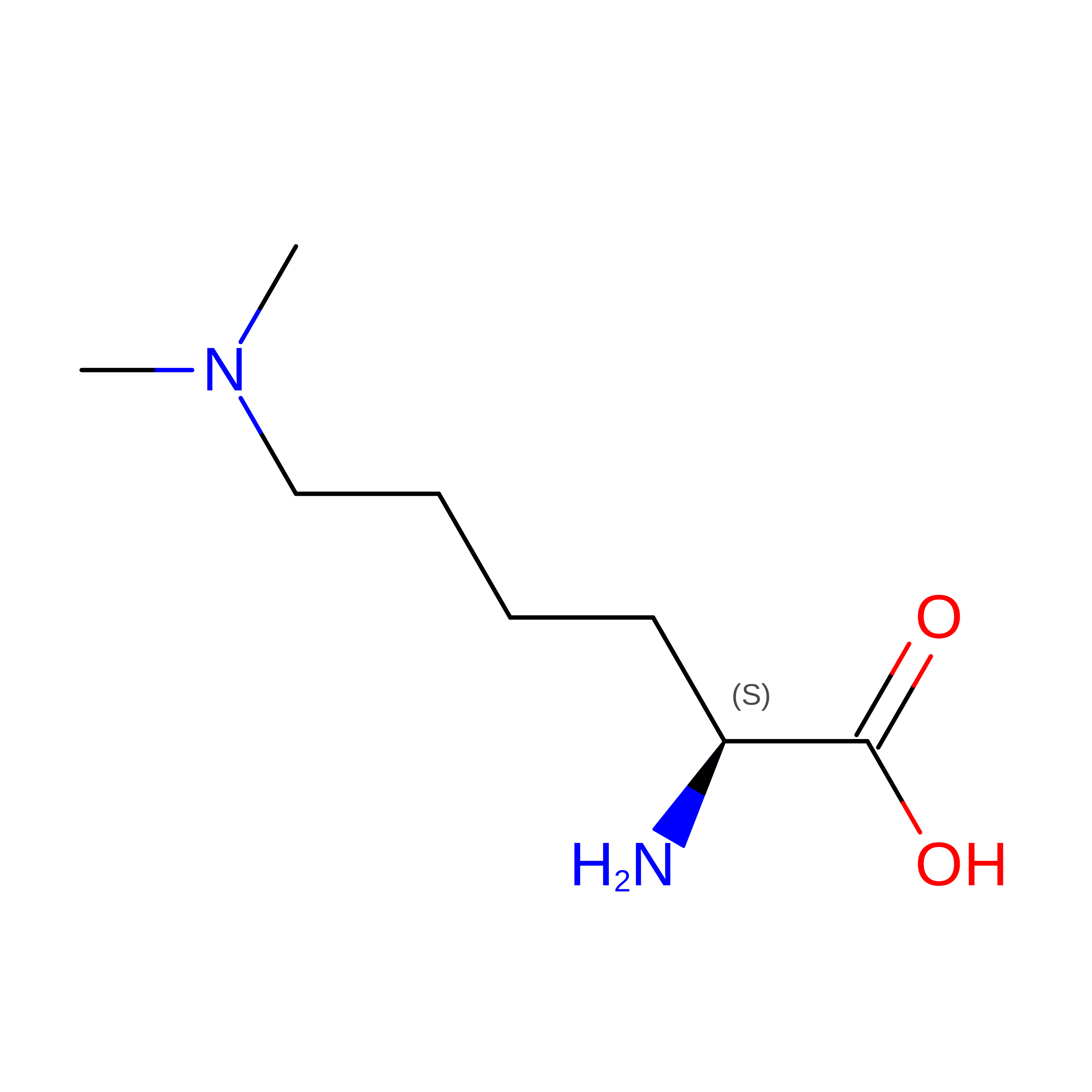
MLY
Query on MLY
B [auth C]L-PEPTIDE LINKINGC8 H18 N2 O2LYS

Experimental Data & Validation

Experimental Data

  • Method: SOLUTION NMR
  • Conformers Calculated: 100 
  • Conformers Submitted: 20 
  • Selection Criteria: structures with the lowest energy 

Structure Validation

View Full Validation Report


Entry History 

& Funding Information

Deposition Data


Funding OrganizationLocationGrant Number
National Institutes of Health/National Cancer Institute (NIH/NCI)United StatesCA132878

Revision History  (Full details and data files)

  • Version 1.0: 2016-10-12
    Type: Initial release
  • Version 1.1: 2016-11-02
    Changes: Database references
  • Version 1.2: 2017-09-20
    Changes: Author supporting evidence, Structure summary
  • Version 1.3: 2019-12-04
    Changes: Author supporting evidence, Data collection
  • Version 1.4: 2025-04-02
    Changes: Data collection, Database references, Derived calculations, Structure summary