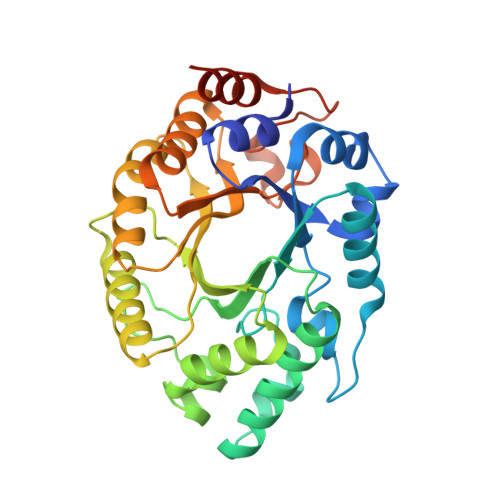
5RG7 | pdb_00005rg7

Crystal Structure of Kemp Eliminase HG3.14 in unbound state, 277K


Experimental Data Snapshot

  • Method: X-RAY DIFFRACTION
  • Resolution: 1.47 Å
  • R-Value Free: 
    0.148 (Depositor), 0.152 (DCC) 
  • R-Value Work: 
    0.132 (Depositor), 0.138 (DCC) 

wwPDB Validation 3D Report Full Report

Validation slider image for 5RG7

This is version 1.3 of the entry. See complete history

Literature

Ensemble-based enzyme design can recapitulate the effects of laboratory directed evolution in silico.

Broom, A.Rakotoharisoa, R.V.Thompson, M.C.Zarifi, N.Nguyen, E.Mukhametzhanov, N.Liu, L.Fraser, J.S.Chica, R.A.

(2020) Nat Commun 11: 4808-4808

  • DOI: https://doi.org/10.1038/s41467-020-18619-x
  • Primary Citation Related Structures: 
    5RG4, 5RG5, 5RG6, 5RG7, 5RG8, 5RG9, 5RGA, 5RGB, 5RGC, 5RGD, 5RGE, 5RGF

  • PubMed Abstract: 

    The creation of artificial enzymes is a key objective of computational protein design. Although de novo enzymes have been successfully designed, these exhibit low catalytic efficiencies, requiring directed evolution to improve activity. Here, we use room-temperature X-ray crystallography to study changes in the conformational ensemble during evolution of the designed Kemp eliminase HG3 (k cat /K M 146 M -1 s -1 ). We observe that catalytic residues are increasingly rigidified, the active site becomes better pre-organized, and its entrance is widened. Based on these observations, we engineer HG4, an efficient biocatalyst (k cat /K M 103,000 M -1 s -1 ) containing key first and second-shell mutations found during evolution. HG4 structures reveal that its active site is pre-organized and rigidified for efficient catalysis. Our results show how directed evolution circumvents challenges inherent to enzyme design by shifting conformational ensembles to favor catalytically-productive sub-states, and suggest improvements to the design methodology that incorporate ensemble modeling of crystallographic data.


  • Organizational Affiliation
    • Department of Chemistry and Biomolecular Sciences, University of Ottawa, 10 Marie Curie, Ottawa, ON, K1N 6N5, Canada.

Macromolecule Content 

  • Total Structure Weight: 69.42 kDa 
  • Atom Count: 5,933 
  • Modeled Residue Count: 600 
  • Deposited Residue Count: 636 
  • Unique protein chains: 1

Macromolecules

Find similar proteins by:|  3D Structure
Entity ID: 1
MoleculeChains  Sequence LengthOrganismDetailsImage
Kemp Eliminase HG3
A, B
318Thermoascus aurantiacusMutation(s): 22 
EC: 3.2.1.8
UniProt
Find proteins for P23360 (Thermoascus aurantiacus)
Explore P23360 
Go to UniProtKB:  P23360
Entity Groups
Sequence Clusters30% Identity50% Identity70% Identity90% Identity95% Identity100% Identity
UniProt GroupP23360
Sequence Annotations
Expand
Reference Sequence

Experimental Data & Validation

Experimental Data

  • Method: X-RAY DIFFRACTION
  • Resolution: 1.47 Å
  • R-Value Free:  0.148 (Depositor), 0.152 (DCC) 
  • R-Value Work:  0.132 (Depositor), 0.138 (DCC) 
Space Group: P 21 21 21
Unit Cell:
Length ( Å )Angle ( ˚ )
a = 76.31α = 90
b = 79.83β = 90
c = 99.11γ = 90
Software Package:
Software NamePurpose
PHENIXrefinement
xia2data scaling
XDSdata reduction
PHASERphasing
PDB_EXTRACTdata extraction

Structure Validation

View Full Validation Report


Entry History 

& Funding Information

Deposition Data


Funding OrganizationLocationGrant Number
Natural Sciences and Engineering Research Council of CanadaCanada--

Revision History  (Full details and data files)

  • Version 1.0: 2020-07-22
    Type: Initial release
  • Version 1.1: 2020-12-02
    Changes: Database references
  • Version 1.2: 2021-05-12
    Changes: Structure summary
  • Version 1.3: 2024-03-06
    Changes: Data collection, Database references