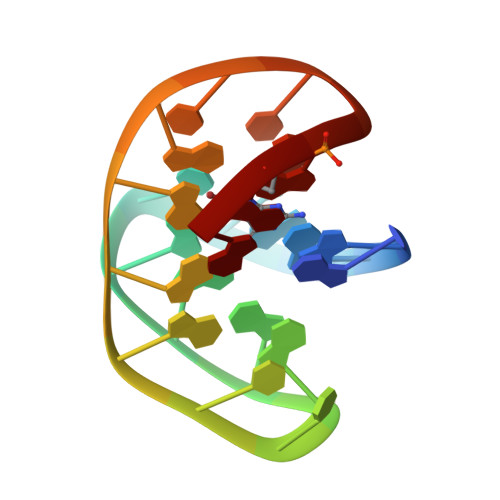
5OPH | pdb_00005oph

G-quadruplex structure of DNA oligonucleotide containing GGGGCC repeats linked to ALS and FTD

  • Classification: DNA
  • Organism(s): Homo sapiens
  • Mutation(s): No 

  • Deposited: 2017-08-09 Released: 2018-08-29 
  • Deposition Author(s): Brcic, J., Plavec, J.
  • Funding Organization(s): Slovenian Research Agency

Experimental Data Snapshot

  • Method: SOLUTION NMR
  • Conformers Calculated: 100 
  • Conformers Submitted: 10 
  • Selection Criteria: structures with the least restraint violations 

wwPDB Validation 3D Report Full Report

Validation slider image for 5OPH

This is version 1.5 of the entry. See complete history

Literature

NMR structure of a G-quadruplex formed by four d(G4C2) repeats: insights into structural polymorphism.

Brcic, J.Plavec, J.

(2018) Nucleic Acids Res 46: 11605-11617

  • DOI: https://doi.org/10.1093/nar/gky886
  • Primary Citation Related Structures: 
    5OPH

  • PubMed Abstract: 

    Most frequent genetic cause of amyotrophic lateral sclerosis (ALS) and frontotemporal dementia (FTD), is a largely increased number of d(G4C2)n•(G2C4)n repeats located in the non-coding region of C9orf72 gene. Non-canonical structures, including G-quadruplexes, formed within expanded repeats have been proposed to drive repeat expansion and pathogenesis of ALS and FTD. Oligonucleotide d[(G4C2)3G4], which represents the shortest oligonucleotide model of d(G4C2) repeats with the ability to form a unimolecular G-quadruplex, forms two major G-quadruplex structures in addition to several minor species which coexist in solution with K+ ions. Herein, we used solution-state NMR to determine the high-resolution structure of one of the major G-quadruplex species adopted by d[(G4C2)3G4]. Structural characterization of the G-quadruplex named AQU was facilitated by a single substitution of dG with 8Br-dG at position 21 and revealed an antiparallel fold composed of four G-quartets and three lateral C-C loops. The G-quadruplex exhibits high thermal stability and is favored kinetically and under slightly acidic conditions. An unusual structural element distinct from a C-quartet is observed in the structure. Two C•C base pairs are stacked on the nearby G-quartet and are involved in a dynamic equilibrium between symmetric N3-amino and carbonyl-amino geometries and protonated C+•C state.


  • Organizational Affiliation
    • Slovenian NMR Center, National Institute of Chemistry, Ljubljana SI-1000, Slovenia.

Macromolecule Content 

  • Total Structure Weight: 7.04 kDa 
  • Atom Count: 464 
  • Modeled Residue Count: 22 
  • Deposited Residue Count: 22 
  • Unique nucleic acid chains: 1

Macromolecules

Find similar nucleic acids by:  Sequence
Entity ID: 1
MoleculeChains LengthOrganismImage
DNA (5'-D(*GP*GP*GP*GP*CP*CP*GP*GP*GP*GP*CP*CP*GP*GP*GP*GP*CP*CP*GP*GP*(BGM)P*G)-3')22Homo sapiens
Sequence Annotations
Expand
Reference Sequence

Experimental Data & Validation

Experimental Data

  • Method: SOLUTION NMR
  • Conformers Calculated: 100 
  • Conformers Submitted: 10 
  • Selection Criteria: structures with the least restraint violations 

Structure Validation

View Full Validation Report


Entry History 

& Funding Information

Deposition Data


Funding OrganizationLocationGrant Number
Slovenian Research AgencySloveniaP1-0242

Revision History  (Full details and data files)

  • Version 1.0: 2018-08-29
    Type: Initial release
  • Version 1.1: 2018-10-24
    Changes: Data collection, Database references
  • Version 1.2: 2018-12-19
    Changes: Data collection, Database references
  • Version 1.3: 2019-05-08
    Changes: Data collection
  • Version 1.4: 2019-06-19
    Changes: Data collection
  • Version 1.5: 2024-05-15
    Changes: Data collection, Database references, Derived calculations