5OER | pdb_00005oer

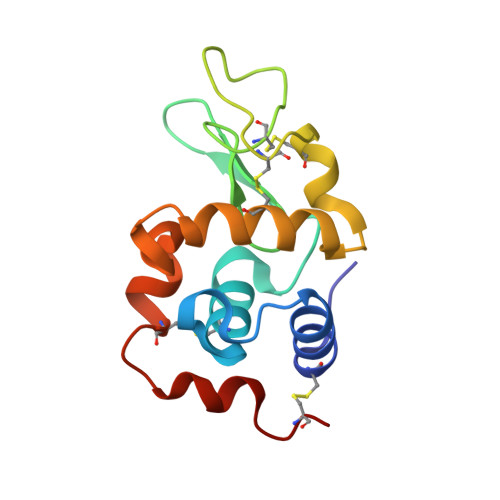
Hen egg-white lysozyme refined against 5000 9 keV diffraction patterns


Experimental Data Snapshot

  • Method: X-RAY DIFFRACTION
  • Resolution: 1.90 Å
  • R-Value Free: 
    0.214 (Depositor), 0.225 (DCC) 
  • R-Value Work: 
    0.186 (Depositor), 0.192 (DCC) 
  • R-Value Observed: 
    0.187 (Depositor) 

wwPDB Validation 3D Report Full Report

Validation slider image for 5OER

Ligand Structure Quality Assessment 


This is version 1.6 of the entry. See complete history

Literature

Multi-wavelength anomalous diffraction de novo phasing using a two-colour X-ray free-electron laser with wide tunability.

Gorel, A.Motomura, K.Fukuzawa, H.Doak, R.B.Grunbein, M.L.Hilpert, M.Inoue, I.Kloos, M.Kovacsova, G.Nango, E.Nass, K.Roome, C.M.Shoeman, R.L.Tanaka, R.Tono, K.Joti, Y.Yabashi, M.Iwata, S.Foucar, L.Ueda, K.Barends, T.R.M.Schlichting, I.

(2017) Nat Commun 8: 1170-1170

  • DOI: https://doi.org/10.1038/s41467-017-00754-7
  • Primary Citation Related Structures: 
    5OER

  • PubMed Abstract: 

    Serial femtosecond crystallography at X-ray free-electron lasers (XFELs) offers unprecedented possibilities for macromolecular structure determination of systems prone to radiation damage. However, de novo structure determination, i.e., without prior structural knowledge, is complicated by the inherent inaccuracy of serial femtosecond crystallography data. By its very nature, serial femtosecond crystallography data collection entails shot-to-shot fluctuations in X-ray wavelength and intensity as well as variations in crystal size and quality that must be averaged out. Hence, to obtain accurate diffraction intensities for de novo phasing, large numbers of diffraction patterns are required, and, concomitantly large volumes of sample and long X-ray free-electron laser beamtimes. Here we show that serial femtosecond crystallography data collected using simultaneous two-colour X-ray free-electron laser pulses can be used for multiple wavelength anomalous dispersion phasing. The phase angle determination is significantly more accurate than for single-colour phasing. We anticipate that two-colour multiple wavelength anomalous dispersion phasing will enhance structure determination of difficult-to-phase proteins at X-ray free-electron lasers.


  • Organizational Affiliation
    • Max-Planck-Institut für medizinische Forschung, Jahnstrasse 29, Heidelberg, 69120, Germany.

Macromolecule Content 

  • Total Structure Weight: 15.48 kDa 
  • Atom Count: 1,138 
  • Modeled Residue Count: 128 
  • Deposited Residue Count: 129 
  • Unique protein chains: 1

Macromolecules

Find similar proteins by:|  3D Structure
Entity ID: 1
MoleculeChains  Sequence LengthOrganismDetailsImage
Lysozyme C129Gallus gallusMutation(s): 0 
EC: 3.2.1.17
UniProt
Find proteins for P00698 (Gallus gallus)
Explore P00698 
Go to UniProtKB:  P00698
Entity Groups
Sequence Clusters30% Identity50% Identity70% Identity90% Identity95% Identity100% Identity
UniProt GroupP00698
Sequence Annotations
Expand
Reference Sequence

Experimental Data & Validation

Experimental Data

  • Method: X-RAY DIFFRACTION
  • Resolution: 1.90 Å
  • R-Value Free:  0.214 (Depositor), 0.225 (DCC) 
  • R-Value Work:  0.186 (Depositor), 0.192 (DCC) 
  • R-Value Observed: 0.187 (Depositor) 
Space Group: P 43 21 2
Unit Cell:
Length ( Å )Angle ( ˚ )
a = 79.1α = 90
b = 79.1β = 90
c = 39.2γ = 90
Software Package:
Software NamePurpose
REFMACrefinement
autoSHARPphasing

Structure Validation

View Full Validation Report


Ligand Structure Quality Assessment 


Entry History 

Deposition Data

Revision History  (Full details and data files)

  • Version 1.0: 2017-10-25
    Type: Initial release
  • Version 1.1: 2017-11-01
    Changes: Database references
  • Version 1.2: 2017-11-08
    Changes: Database references
  • Version 1.3: 2018-01-24
    Changes: Data collection
  • Version 1.4: 2018-11-14
    Changes: Data collection
  • Version 1.5: 2023-12-13
    Changes: Data collection, Database references
  • Version 1.6: 2024-10-23
    Changes: Structure summary