Download Mendeley
Mutations in the U11/U12-65K protein associated with isolated growth hormone deficiency lead to structural destabilization and impaired binding of U12 snRNA.
Norppa, A.J., Kauppala, T.M., Heikkinen, H.A., Verma, B., Iwai, H., Frilander, M.J.(2018) RNA 24: 396-409
- PubMed: 29255062 Search on PubMedSearch on PubMed Central
- DOI: https://doi.org/10.1261/rna.062844.117
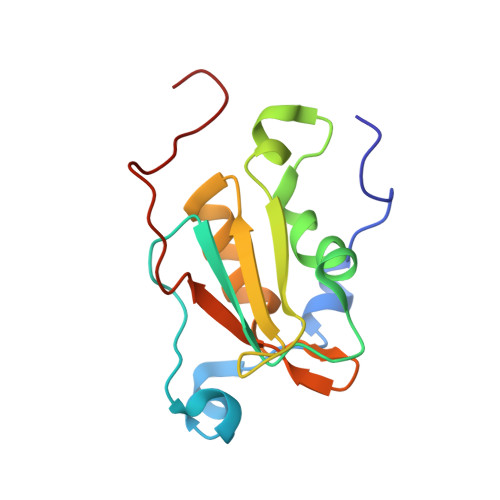
- Primary Citation Related Structures:
5OBN - PubMed Abstract:
Mutations in the components of the minor spliceosome underlie several human diseases. A subset of patients with isolated growth hormone deficiency (IGHD) harbors mutations in the RNPC3 gene, which encodes the minor spliceosome-specific U11/U12-65K protein. Although a previous study showed that IGHD patient cells have defects in U12-type intron recognition, the biochemical effects of these mutations on the 65K protein have not been characterized. Here, we show that a proline-to-threonine missense mutation (P474T) and a nonsense mutation (R502X) in the C-terminal RNA recognition motif (C-RRM) of the 65K protein impair the binding of 65K to U12 and U6atac snRNAs. We further show that the nonsense allele is targeted to the nonsense-mediated decay (NMD) pathway, but in an isoform-specific manner, with the nuclear-retained 65K long-3'UTR isoform escaping the NMD pathway. In contrast, the missense P474T mutation leads, in addition to the RNA-binding defect, to a partial defect in the folding of the C-RRM and reduced stability of the full-length protein, thus reducing the formation of U11/U12 di-snRNP complexes. We propose that both the C-RRM folding defect and NMD-mediated decrease in the levels of the U11/U12-65K protein reduce formation of the U12-type intron recognition complex and missplicing of a subset of minor introns leading to pituitary hypoplasia and a subsequent defect in growth hormone secretion.
- Institute of Biotechnology, FI-00014 University of Helsinki, Finland.
Organizational Affiliation: