Download Mendeley
Allostery, Recognition of Nascent Peptidoglycan, and Cross-linking of the Cell Wall by the Essential Penicillin-Binding Protein 2x of Streptococcus pneumoniae.
Bernardo-Garcia, N., Mahasenan, K.V., Batuecas, M.T., Lee, M., Hesek, D., Petrackova, D., Doubravova, L., Branny, P., Mobashery, S., Hermoso, J.A.(2018) ACS Chem Biol 13: 694-702
- PubMed: 29357220 Search on PubMed
- DOI: https://doi.org/10.1021/acschembio.7b00817
- Primary Citation Related Structures:
5OAU, 5OIZ, 5OJ0, 5OJ1 - PubMed Abstract:
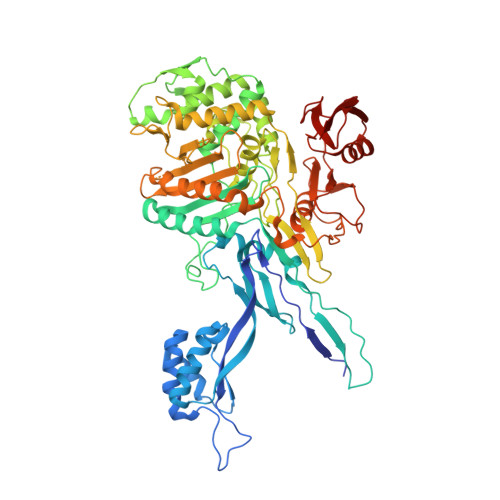
Transpeptidases, members of the penicillin-binding protein (PBP) families, catalyze cross-linking of the bacterial cell wall. This transformation is critical for the survival of bacteria, and it is the target of inhibition by β-lactam antibiotics. We report herein our structural insights into catalysis by the essential PBP2x of Streptococcus pneumoniae by disclosing a total of four X-ray structures, two computational models based on the crystal structures, and molecular-dynamics simulations. The X-ray structures are for the apo PBP2x, the enzyme modified covalently in the active site by oxacillin (a penicillin antibiotic), the enzyme modified by oxacillin in the presence of a synthetic tetrasaccharide surrogate for the cell-wall peptidoglycan, and a noncovalent complex of cefepime (a cephalosporin antibiotic) bound to the active site. A prerequisite for catalysis by transpeptidases, including PBP2x, is the molecular recognition of nascent peptidoglycan strands, which harbor pentapeptide stems. We disclose that the recognition of nascent peptidoglycan by PBP2x takes place by complexation of one pentapeptide stem at an allosteric site located in the PASTA domains of this enzyme. This binding predisposes the third pentapeptide stem in the same nascent peptidoglycan strand to penetration into the active site for the turnover events. The complexation of the two pentapeptide stems in the same peptidoglycan strand is a recognition motif for the nascent peptidoglycan, critical for the cell-wall cross-linking reaction.
- Department of Crystallography and Structural Biology , Institute of Physical Chemistry "Rocasolano," CSIC , 28006 Madrid , Spain.
Organizational Affiliation: