Download Mendeley
Molecular basis for asymmetry sensing of siRNAs by the Drosophila Loqs-PD/Dcr-2 complex in RNA interference.
Tants, J.N., Fesser, S., Kern, T., Stehle, R., Geerlof, A., Wunderlich, C., Juen, M., Hartlmuller, C., Bottcher, R., Kunzelmann, S., Lange, O., Kreutz, C., Forstemann, K., Sattler, M.(2017) Nucleic Acids Res 45: 12536-12550
- PubMed: 29040648 Search on PubMedSearch on PubMed Central
- DOI: https://doi.org/10.1093/nar/gkx886
- Primary Citation Related Structures:
5NPA, 5NPG - PubMed Abstract:
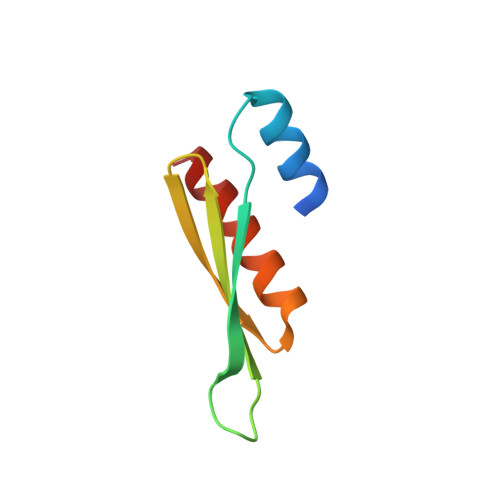
RNA interference defends against RNA viruses and retro-elements within an organism's genome. It is triggered by duplex siRNAs, of which one strand is selected to confer sequence-specificity to the RNA induced silencing complex (RISC). In Drosophila, Dicer-2 (Dcr-2) and the double-stranded RNA binding domain (dsRBD) protein R2D2 form the RISC loading complex (RLC) and select one strand of exogenous siRNAs according to the relative thermodynamic stability of base-pairing at either end. Through genome editing we demonstrate that Loqs-PD, the Drosophila homolog of human TAR RNA binding protein (TRBP) and a paralog of R2D2, forms an alternative RLC with Dcr-2 that is required for strand choice of endogenous siRNAs in S2 cells. Two canonical dsRBDs in Loqs-PD bind to siRNAs with enhanced affinity compared to miRNA/miRNA* duplexes. Structural analysis, NMR and biophysical experiments indicate that the Loqs-PD dsRBDs can slide along the RNA duplex to the ends of the siRNA. A moderate but notable binding preference for the thermodynamically more stable siRNA end by Loqs-PD alone is greatly amplified in complex with Dcr-2 to initiate strand discrimination by asymmetry sensing in the RLC.
- Institute of Structural Biology, Helmholtz Zentrum München, 85764 Neuherberg, Germany.
Organizational Affiliation: