Download Mendeley
The CO dehydrogenase accessory protein CooT is a novel nickel-binding protein.
Timm, J., Brochier-Armanet, C., Perard, J., Zambelli, B., Ollagnier-de-Choudens, S., Ciurli, S., Cavazza, C.(2017) Metallomics 9: 575-583
- PubMed: 28447092 Search on PubMed
- DOI: https://doi.org/10.1039/c7mt00063d
- Primary Citation Related Structures:
5N76 - PubMed Abstract:
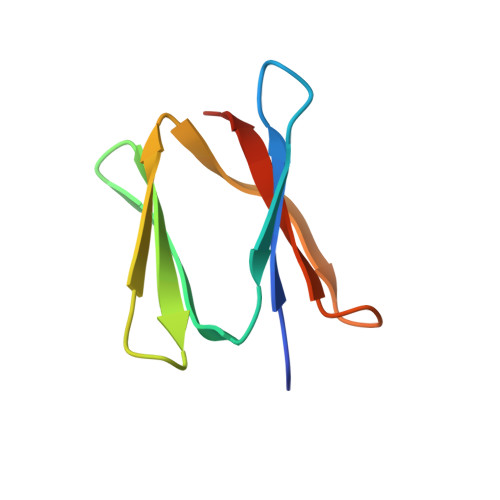
In Rhodospirillum rubrum, maturation of Carbon Monoxide Dehydrogenase (CODH) requires three accessory proteins, CooC, CooT and CooJ, dedicated to nickel insertion into the active site, which is constituted by a distorted [NiFe 3 S 4 ] cubane coordinated with a mononuclear Fe site. CooC is an ATPase proposed to provide the energy required for the maturation process, while CooJ is described as a metallochaperone with 16 histidines and 2 cysteines at the C-terminus, likely involved in metal binding and/or storage. Prior to the present study, no information was available on CooT at the molecular level. Here, the X-ray structure of RrCooT was obtained, which revealed that this protein is a homodimer featuring a fold that resembles an Sm-like domain, suggesting a role in RNA metabolism that was however not supported by experimental observations. Biochemical and biophysical evidence based on circular dichroism spectroscopy, light scattering, isothermal titration calorimetry and site-directed mutagenesis showed that RrCooT specifically binds a single Ni(ii) per dimer, with a dissociation constant of 9 nM, through the pair of Cys2, highly conserved residues, located at the dimer interface. Despite its role in the activation of RrCODH in vivo, CooT was thought to be a unique protein, found only in R. rubrum, with an unclear function. In this study, we extended the biological impact of CooT, establishing that this protein is a member of a novel Ni(ii)-binding protein family with 111 homologues, linked to anaerobic metabolism in bacteria and archaea, and in most cases to the presence of CODH.
- Université Grenoble Alpes, Laboratoire de Chimie et Biologie des Métaux, BioCat, F-Grenoble, France.
Organizational Affiliation: