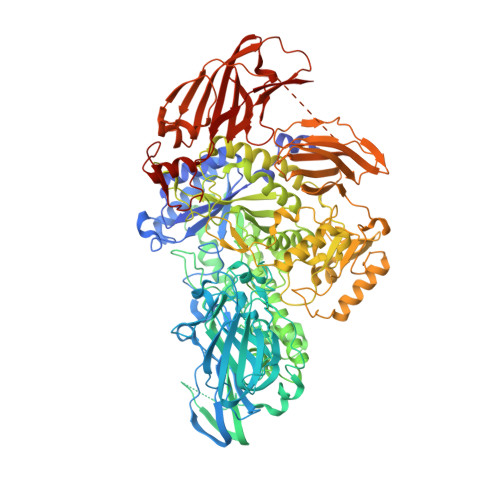
5MWK | pdb_00005mwk

Glycoside hydrolase BT_0986


Experimental Data Snapshot

  • Method: X-RAY DIFFRACTION
  • Resolution: 2.00 Å
  • R-Value Free: 
    0.239 (Depositor), 0.228 (DCC) 
  • R-Value Work: 
    0.199 (Depositor) 
  • R-Value Observed: 
    0.201 (Depositor) 

Starting Model: experimental
View more details

wwPDB Validation 3D Report Full Report

Validation slider image for 5MWK

This is version 2.1 of the entry. See complete history

Literature

Complex pectin metabolism by gut bacteria reveals novel catalytic functions.

Ndeh, D.Rogowski, A.Cartmell, A.Luis, A.S.Basle, A.Gray, J.Venditto, I.Briggs, J.Zhang, X.Labourel, A.Terrapon, N.Buffetto, F.Nepogodiev, S.Xiao, Y.Field, R.A.Zhu, Y.O'Neill, M.A.Urbanowicz, B.R.York, W.S.Davies, G.J.Abbott, D.W.Ralet, M.C.Martens, E.C.Henrissat, B.Gilbert, H.J.

(2017) Nature 544: 65-70

  • DOI: https://doi.org/10.1038/nature21725
  • Primary Citation Related Structures: 
    5MQM, 5MQN, 5MQO, 5MQR, 5MQS, 5MSX, 5MSY, 5MT2, 5MUI, 5MUJ, 5MWK

  • PubMed Abstract: 

    The metabolism of carbohydrate polymers drives microbial diversity in the human gut microbiota. It is unclear, however, whether bacterial consortia or single organisms are required to depolymerize highly complex glycans. Here we show that the gut bacterium Bacteroides thetaiotaomicron uses the most structurally complex glycan known: the plant pectic polysaccharide rhamnogalacturonan-II, cleaving all but 1 of its 21 distinct glycosidic linkages. The deconstruction of rhamnogalacturonan-II side chains and backbone are coordinated to overcome steric constraints, and the degradation involves previously undiscovered enzyme families and catalytic activities. The degradation system informs revision of the current structural model of rhamnogalacturonan-II and highlights how individual gut bacteria orchestrate manifold enzymes to metabolize the most challenging glycan in the human diet.


  • Organizational Affiliation
    • Institute for Cell and Molecular Biosciences, Newcastle University, Newcastle upon Tyne NE2 4HH, U.K.

Macromolecule Content 

  • Total Structure Weight: 126.43 kDa 
  • Atom Count: 8,765 
  • Modeled Residue Count: 1,040 
  • Deposited Residue Count: 1,105 
  • Unique protein chains: 1

Macromolecules

Find similar proteins by:|  3D Structure
Entity ID: 1
MoleculeChains  Sequence LengthOrganismDetailsImage
Glycoside hydrolase family 2, sugar binding protein1,105Bacteroides thetaiotaomicronMutation(s): 0 
Gene Names: BT_0986
UniProt
Find proteins for Q8A931 (Bacteroides thetaiotaomicron (strain ATCC 29148 / DSM 2079 / JCM 5827 / CCUG 10774 / NCTC 10582 / VPI-5482 / E50))
Explore Q8A931 
Go to UniProtKB:  Q8A931
Entity Groups
Sequence Clusters30% Identity50% Identity70% Identity90% Identity95% Identity100% Identity
UniProt GroupQ8A931
Sequence Annotations
Expand
Reference Sequence

Oligosaccharides

Help  
Entity ID: 2
MoleculeChains Length2D Diagram GlycosylationD Interactions
alpha-L-rhamnopyranose-(1-2)-alpha-L-arabinopyranose-(1-4)-[4-O-[(1R)-1-hydroxyethyl]-2-O-methyl-alpha-L-fucopyranose-(1-2)]beta-D-galactopyranose-(1-2)-alpha-D-aceric acid-(1-3)-alpha-L-rhamnopyranose
B
6N/AN/A

Experimental Data & Validation

Experimental Data

  • Method: X-RAY DIFFRACTION
  • Resolution: 2.00 Å
  • R-Value Free:  0.239 (Depositor), 0.228 (DCC) 
  • R-Value Work:  0.199 (Depositor) 
  • R-Value Observed: 0.201 (Depositor) 
Space Group: P 1 21 1
Unit Cell:
Length ( Å )Angle ( ˚ )
a = 65.254α = 90
b = 86.216β = 99.38
c = 123.2γ = 90
Software Package:
Software NamePurpose
XDSdata reduction
Aimlessdata scaling
MOLREPphasing
Cootmodel building
REFMACrefinement

Structure Validation

View Full Validation Report


Entry History 

Deposition Data

Revision History  (Full details and data files)

  • Version 1.0: 2017-03-22
    Type: Initial release
  • Version 1.1: 2017-04-05
    Changes: Database references
  • Version 1.2: 2017-04-12
    Changes: Database references
  • Version 2.0: 2020-07-29
    Type: Remediation
    Reason: Carbohydrate remediation
    Changes: Advisory, Atomic model, Data collection, Derived calculations, Structure summary
  • Version 2.1: 2024-01-17
    Changes: Data collection, Database references, Derived calculations, Refinement description, Structure summary