5MNG | pdb_00005mng

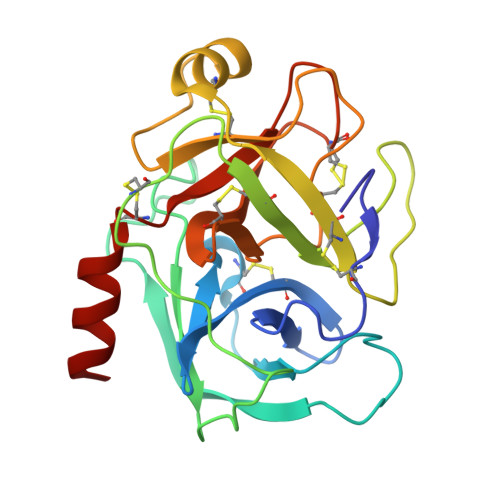
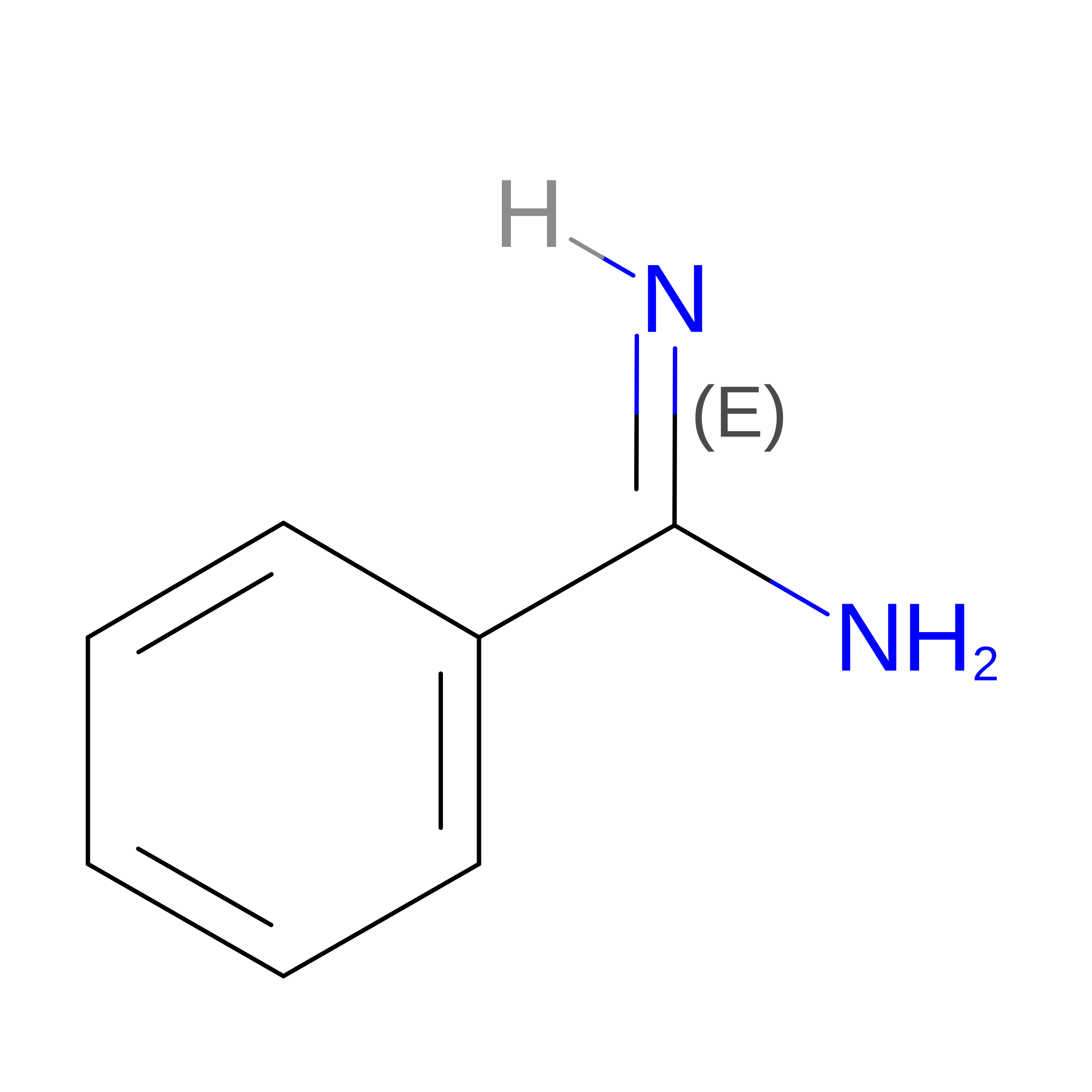
Cationic trypsin in complex with benzamidine (deuterated sample at 100 K)


Experimental Data Snapshot

  • Method: X-RAY DIFFRACTION
  • Resolution: 0.86 Å
  • R-Value Free: 
    0.109 (Depositor), 0.110 (DCC) 
  • R-Value Work: 
    0.099 (Depositor), 0.099 (DCC) 
  • R-Value Observed: 
    0.100 (Depositor) 

Starting Model: experimental
View more details

wwPDB Validation 3D Report Full Report

Validation slider image for 5MNG

This is version 2.2 of the entry. See complete history

Literature

Intriguing role of water in protein-ligand binding studied by neutron crystallography on trypsin complexes.

Schiebel, J.Gaspari, R.Wulsdorf, T.Ngo, K.Sohn, C.Schrader, T.E.Cavalli, A.Ostermann, A.Heine, A.Klebe, G.

(2018) Nat Commun 9: 3559-3559

  • DOI: https://doi.org/10.1038/s41467-018-05769-2
  • Primary Citation Related Structures: 
    5MNE, 5MNF, 5MNG, 5MNH, 5MNN, 5MNO, 5MNQ, 5MNZ, 5MO0, 5MO2, 5MOP, 5MOQ, 5MOS

  • PubMed Abstract: 

    Hydrogen bonds are key interactions determining protein-ligand binding affinity and therefore fundamental to any biological process. Unfortunately, explicit structural information about hydrogen positions and thus H-bonds in protein-ligand complexes is extremely rare and similarly the important role of water during binding remains poorly understood. Here, we report on neutron structures of trypsin determined at very high resolutions ≤1.5 Å in uncomplexed and inhibited state complemented by X-ray and thermodynamic data and computer simulations. Our structures show the precise geometry of H-bonds between protein and the inhibitors N-amidinopiperidine and benzamidine along with the dynamics of the residual solvation pattern. Prior to binding, the ligand-free binding pocket is occupied by water molecules characterized by a paucity of H-bonds and high mobility resulting in an imperfect hydration of the critical residue Asp189. This phenomenon likely constitutes a key factor fueling ligand binding via water displacement and helps improving our current view on water influencing protein-ligand recognition.


  • Organizational Affiliation
    • Institut für Pharmazeutische Chemie, Philipps-Universität Marburg, Marbacher Weg 6, 35032, Marburg, Germany.

Macromolecule Content 

  • Total Structure Weight: 23.87 kDa 
  • Atom Count: 2,351 
  • Modeled Residue Count: 223 
  • Deposited Residue Count: 223 
  • Unique protein chains: 1

Macromolecules

Find similar proteins by:|  3D Structure
Entity ID: 1
MoleculeChains  Sequence LengthOrganismDetailsImage
Cationic trypsin223Bos taurusMutation(s): 0 
EC: 3.4.21.4
UniProt
Find proteins for P00760 (Bos taurus)
Explore P00760 
Go to UniProtKB:  P00760
Entity Groups
Sequence Clusters30% Identity50% Identity70% Identity90% Identity95% Identity100% Identity
UniProt GroupP00760
Sequence Annotations
Expand
Reference Sequence

Experimental Data & Validation

Experimental Data

  • Method: X-RAY DIFFRACTION
  • Resolution: 0.86 Å
  • R-Value Free:  0.109 (Depositor), 0.110 (DCC) 
  • R-Value Work:  0.099 (Depositor), 0.099 (DCC) 
  • R-Value Observed: 0.100 (Depositor) 
Space Group: P 21 21 21
Unit Cell:
Length ( Å )Angle ( ˚ )
a = 54.486α = 90
b = 58.177β = 90
c = 66.833γ = 90
Software Package:
Software NamePurpose
PHENIXrefinement
XDSdata reduction
XDSdata scaling
PHASERphasing
Cootmodel building

Structure Validation

View Full Validation Report


Entry History 

& Funding Information

Deposition Data


Funding OrganizationLocationGrant Number
European Research Council268145-DrugProfilBind

Revision History  (Full details and data files)

  • Version 1.0: 2018-01-17
    Type: Initial release
  • Version 1.1: 2018-09-12
    Changes: Data collection, Database references
  • Version 2.0: 2021-08-04
    Changes: Atomic model, Data collection, Derived calculations, Non-polymer description, Structure summary
  • Version 2.1: 2024-01-17
    Changes: Data collection, Database references, Refinement description
  • Version 2.2: 2024-11-13
    Changes: Structure summary