5MHJ | pdb_00005mhj

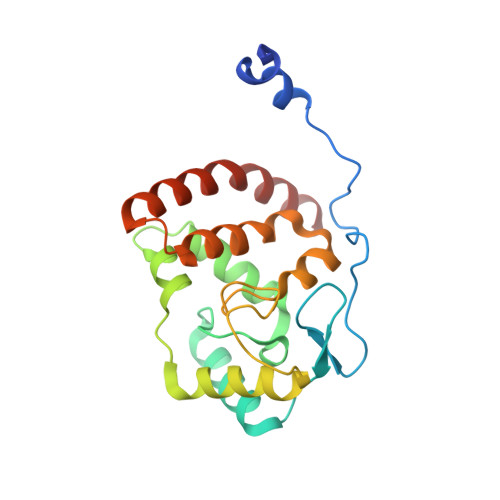
ICP4 DNA-binding domain, lacking intrinsically disordered region, in complex with 12mer DNA duplex from its own promoter


Experimental Data Snapshot

  • Method: X-RAY DIFFRACTION
  • Resolution: 2.12 Å
  • R-Value Free: 
    0.235 (Depositor), 0.237 (DCC) 
  • R-Value Work: 
    0.197 (Depositor), 0.199 (DCC) 
  • R-Value Observed: 
    0.199 (Depositor) 

Starting Model: other
View more details

wwPDB Validation 3D Report Full Report

Validation slider image for 5MHJ

This is version 1.3 of the entry. See complete history

Literature

The herpes viral transcription factor ICP4 forms a novel DNA recognition complex.

Tunnicliffe, R.B.Lockhart-Cairns, M.P.Levy, C.Mould, A.P.Jowitt, T.A.Sito, H.Baldock, C.Sandri-Goldin, R.M.Golovanov, A.P.

(2017) Nucleic Acids Res 45: 8064-8078

  • DOI: https://doi.org/10.1093/nar/gkx419
  • Primary Citation Related Structures: 
    5MHJ, 5MHK

  • PubMed Abstract: 

    The transcription factor ICP4 from herpes simplex virus has a central role in regulating the gene expression cascade which controls viral infection. Here we present the crystal structure of the functionally essential ICP4 DNA binding domain in complex with a segment from its own promoter, revealing a novel homo-dimeric fold. We also studied the complex in solution by small angle X-Ray scattering, nuclear magnetic resonance and surface-plasmon resonance which indicated that, in addition to the globular domain, a flanking intrinsically disordered region also recognizes DNA. Together the data provides a rationale for the bi-partite nature of the ICP4 DNA recognition consensus sequence as the globular and disordered regions bind synergistically to adjacent DNA motifs. Therefore in common with its eukaryotic host, the viral transcription factor ICP4 utilizes disordered regions to enhance the affinity and tune the specificity of DNA interactions in tandem with a globular domain.


  • Organizational Affiliation
    • Manchester Institute of Biotechnology, School of Chemistry, Faculty of Science and Engineering, The University of Manchester, Manchester M1 7DN, UK.

Macromolecule Content 

  • Total Structure Weight: 50.11 kDa 
  • Atom Count: 3,476 
  • Modeled Residue Count: 399 
  • Deposited Residue Count: 426 
  • Unique protein chains: 1
  • Unique nucleic acid chains: 2

Macromolecules


Find similar proteins by:|  3D Structure
Entity ID: 1
MoleculeChains  Sequence LengthOrganismDetailsImage
Major viral transcription factor ICP4
A, B
201Human alphaherpesvirus 1 strain 17Mutation(s): 0 
Gene Names: ICP4IE175RS1
UniProt
Find proteins for P08392 (Human herpesvirus 1 (strain 17))
Explore P08392 
Go to UniProtKB:  P08392
Entity Groups
Sequence Clusters30% Identity50% Identity70% Identity90% Identity95% Identity100% Identity
UniProt GroupP08392
Sequence Annotations
Expand
Reference Sequence
Find similar nucleic acids by:  Sequence
Entity ID: 2
MoleculeChains LengthOrganismImage
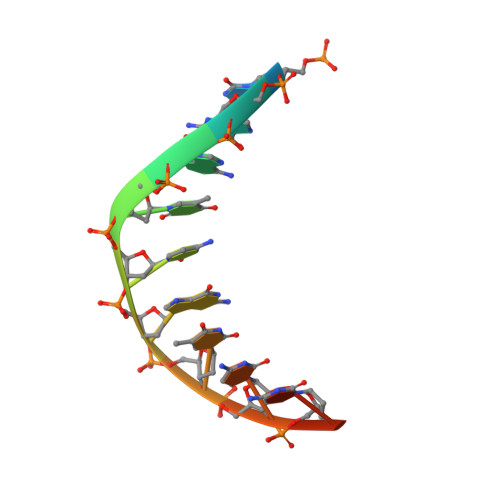
DNA (5'-D(P*CP*GP*AP*TP*CP*GP*TP*CP*C)-3')C [auth E]12Human alphaherpesvirus 1
Sequence Annotations
Expand
Reference Sequence
Find similar nucleic acids by:  Sequence
Entity ID: 3
MoleculeChains LengthOrganismImage
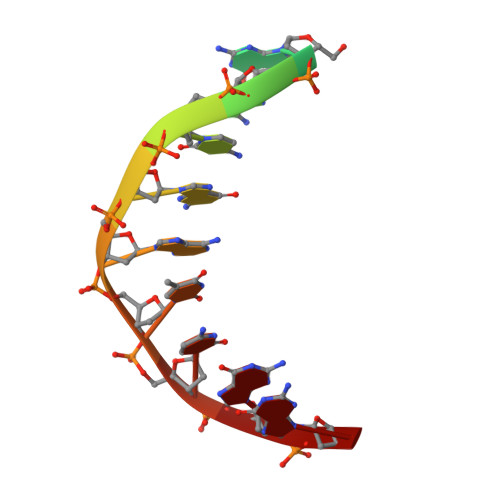
DNA (5'-D(P*CP*GP*AP*TP*CP*GP*TP*CP*C)-3')D [auth F]12Human alphaherpesvirus 1
Sequence Annotations
Expand
Reference Sequence

Experimental Data & Validation

Experimental Data

  • Method: X-RAY DIFFRACTION
  • Resolution: 2.12 Å
  • R-Value Free:  0.235 (Depositor), 0.237 (DCC) 
  • R-Value Work:  0.197 (Depositor), 0.199 (DCC) 
  • R-Value Observed: 0.199 (Depositor) 
Space Group: P 21 21 21
Unit Cell:
Length ( Å )Angle ( ˚ )
a = 127.254α = 90
b = 39.084β = 90
c = 90.443γ = 90
Software Package:
Software NamePurpose
PHENIXrefinement
xia2data reduction
xia2data scaling
PHENIXphasing

Structure Validation

View Full Validation Report


Entry History 

& Funding Information

Deposition Data


Funding OrganizationLocationGrant Number
National Institutes of HealthUnited StatesAI107803

Revision History  (Full details and data files)

  • Version 1.0: 2017-05-24
    Type: Initial release
  • Version 1.1: 2017-09-06
    Changes: Database references
  • Version 1.2: 2019-04-10
    Changes: Data collection, Source and taxonomy
  • Version 1.3: 2024-05-01
    Changes: Data collection, Database references, Refinement description