5LY3 | pdb_00005ly3

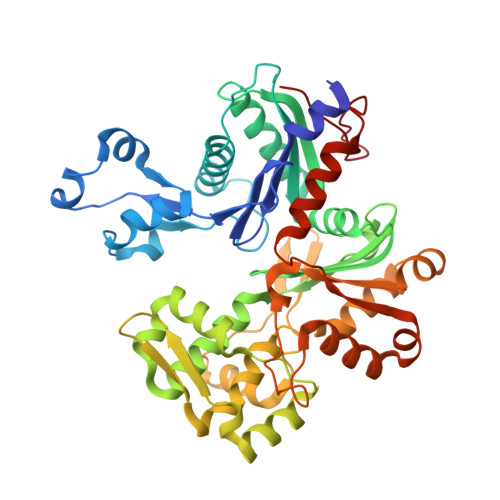
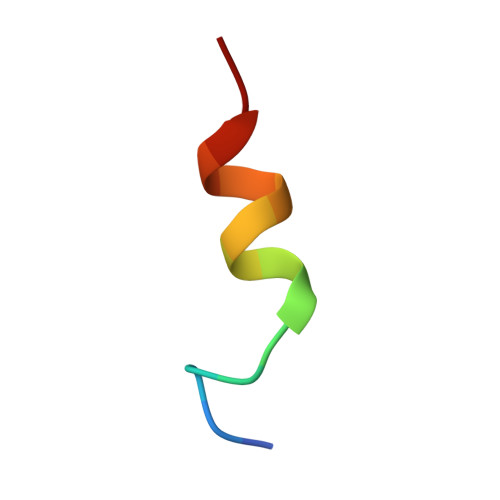
P. calidifontis crenactin in complex with arcadin-2 C-terminal peptide


Experimental Data Snapshot

  • Method: X-RAY DIFFRACTION
  • Resolution: 1.60 Å
  • R-Value Free: 
    0.200 (Depositor), 0.213 (DCC) 
  • R-Value Work: 
    0.175 (Depositor), 0.189 (DCC) 
  • R-Value Observed: 
    0.176 (Depositor) 

Starting Model: experimental
View more details

wwPDB Validation 3D Report Full Report

Validation slider image for 5LY3

Ligand Structure Quality Assessment 


This is version 1.1 of the entry. See complete history

Literature

Crenactin forms actin-like double helical filaments regulated by arcadin-2.

Izore, T.Kureisaite-Ciziene, D.McLaughlin, S.H.Lowe, J.

(2016) Elife 5

  • DOI: https://doi.org/10.7554/eLife.21600
  • Primary Citation Related Structures: 
    5LY3, 5LY5, 5MW1

  • PubMed Abstract: 

    The similarity of eukaryotic actin to crenactin, a filament-forming protein from the crenarchaeon Pyrobaculum calidifontis supports the theory of a common origin of Crenarchaea and Eukaryotes. Monomeric structures of crenactin and actin are similar, although their filament architectures were suggested to be different. Here we report that crenactin forms bona fide double helical filaments that show exceptional similarity to eukaryotic F-actin. With cryo-electron microscopy and helical reconstruction we solved the structure of the crenactin filament to 3.8 Å resolution. When forming double filaments, the 'hydrophobic plug' loop in crenactin rearranges. Arcadin-2, also encoded by the arcade gene cluster, binds tightly with its C-terminus to the hydrophobic groove of crenactin. Binding is reminiscent of eukaryotic actin modulators such as cofilin and thymosin β4 and arcadin-2 is a depolymeriser of crenactin filaments. Our work further supports the theory of shared ancestry of Eukaryotes and Crenarchaea.


  • Organizational Affiliation
    • MRC Laboratory of Molecular Biology, Francis Crick Avenue, Cambridge, United Kingdom.

Macromolecule Content 

  • Total Structure Weight: 50.7 kDa 
  • Atom Count: 3,867 
  • Modeled Residue Count: 443 
  • Deposited Residue Count: 448 
  • Unique protein chains: 2

Macromolecules

Find similar proteins by:|  3D Structure
Entity ID: 1
MoleculeChains  Sequence LengthOrganismDetailsImage
Actin/actin family protein432Pyrobaculum calidifontisMutation(s): 0 
Gene Names: Pcal_1635
EC: 3.6.4
UniProt
Find proteins for A3MWN5 (Pyrobaculum calidifontis (strain DSM 21063 / JCM 11548 / VA1))
Explore A3MWN5 
Go to UniProtKB:  A3MWN5
Entity Groups
Sequence Clusters30% Identity50% Identity70% Identity90% Identity95% Identity100% Identity
UniProt GroupA3MWN5
Sequence Annotations
Expand
Reference Sequence
Find similar proteins by:  Sequence   |   3D Structure  
Entity ID: 2
MoleculeChains  Sequence LengthOrganismDetailsImage
Actin-like protein16Pyrobaculum calidifontis JCM 11548Mutation(s): 0 
Gene Names: Pcal_1636
UniProt
Find proteins for A3MWN6 (Pyrobaculum calidifontis (strain DSM 21063 / JCM 11548 / VA1))
Explore A3MWN6 
Go to UniProtKB:  A3MWN6
Entity Groups
Sequence Clusters30% Identity50% Identity70% Identity90% Identity95% Identity100% Identity
UniProt GroupA3MWN6
Sequence Annotations
Expand
Reference Sequence

Small Molecules

Ligands 1 Unique
IDChains Name / Formula / InChI Key2D Diagram3D Interactions
ADP

Query on ADP


Download:Ideal Coordinates CCD File
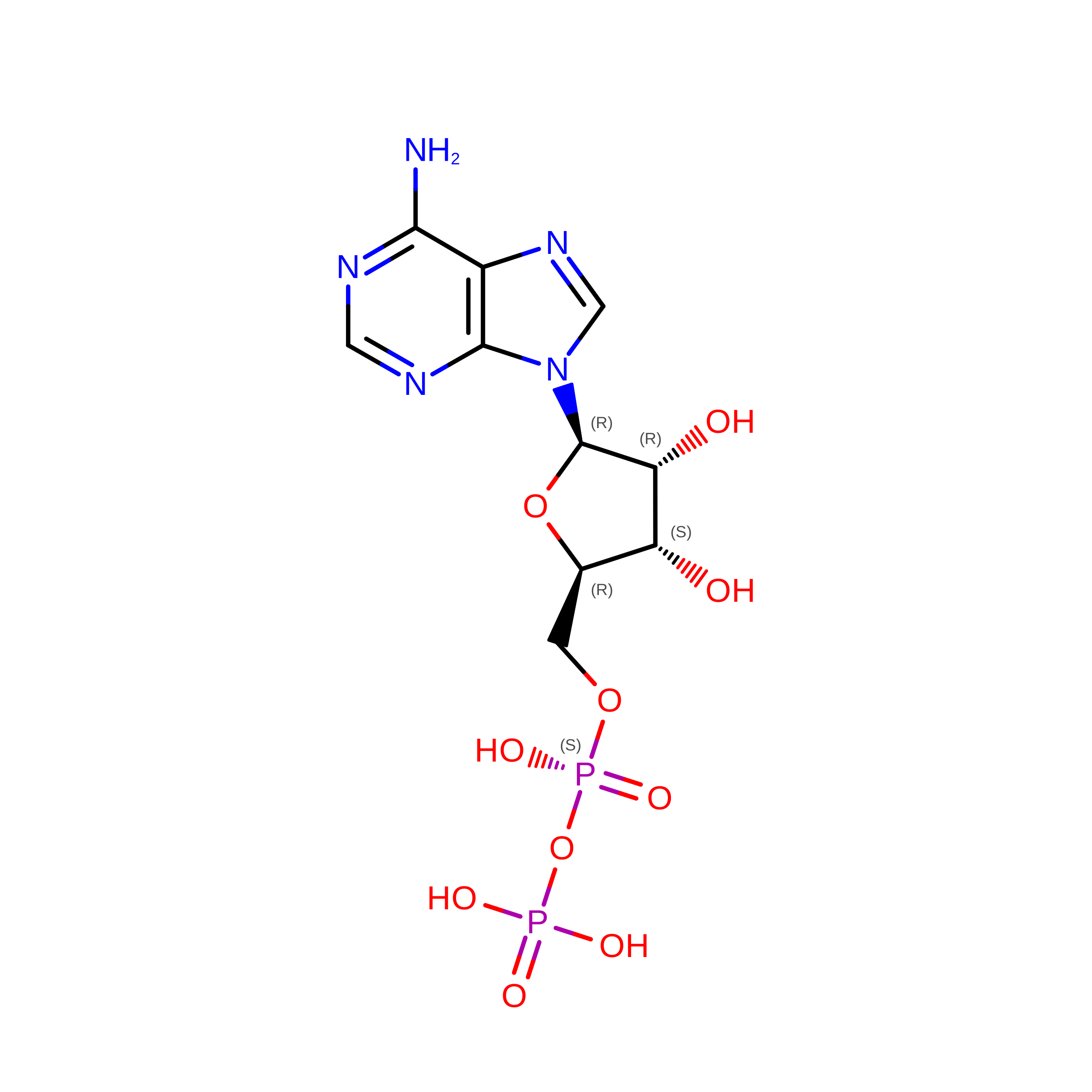
C [auth A]ADENOSINE-5'-DIPHOSPHATE
C10 H15 N5 O10 P2
XTWYTFMLZFPYCI-KQYNXXCUSA-N

Experimental Data & Validation

Experimental Data

  • Method: X-RAY DIFFRACTION
  • Resolution: 1.60 Å
  • R-Value Free:  0.200 (Depositor), 0.213 (DCC) 
  • R-Value Work:  0.175 (Depositor), 0.189 (DCC) 
  • R-Value Observed: 0.176 (Depositor) 
Space Group: P 1 21 1
Unit Cell:
Length ( Å )Angle ( ˚ )
a = 54.18α = 90
b = 70.909β = 104.21
c = 62.231γ = 90
Software Package:
Software NamePurpose
PHENIXrefinement
SCALAdata scaling
PHASERphasing

Structure Validation

View Full Validation Report


Ligand Structure Quality Assessment 


Entry History 

Deposition Data

Revision History  (Full details and data files)

  • Version 1.0: 2016-11-30
    Type: Initial release
  • Version 1.1: 2024-01-17
    Changes: Data collection, Database references, Refinement description