5LRE | pdb_00005lre

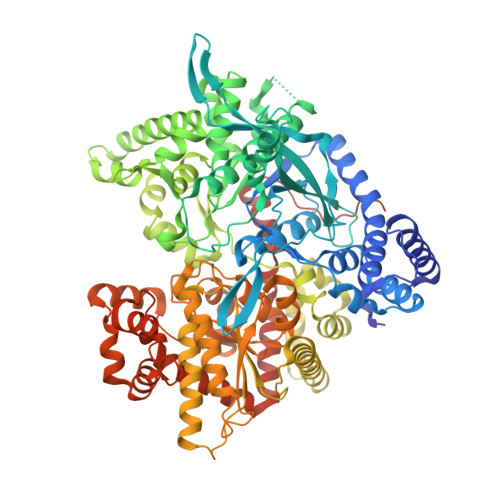
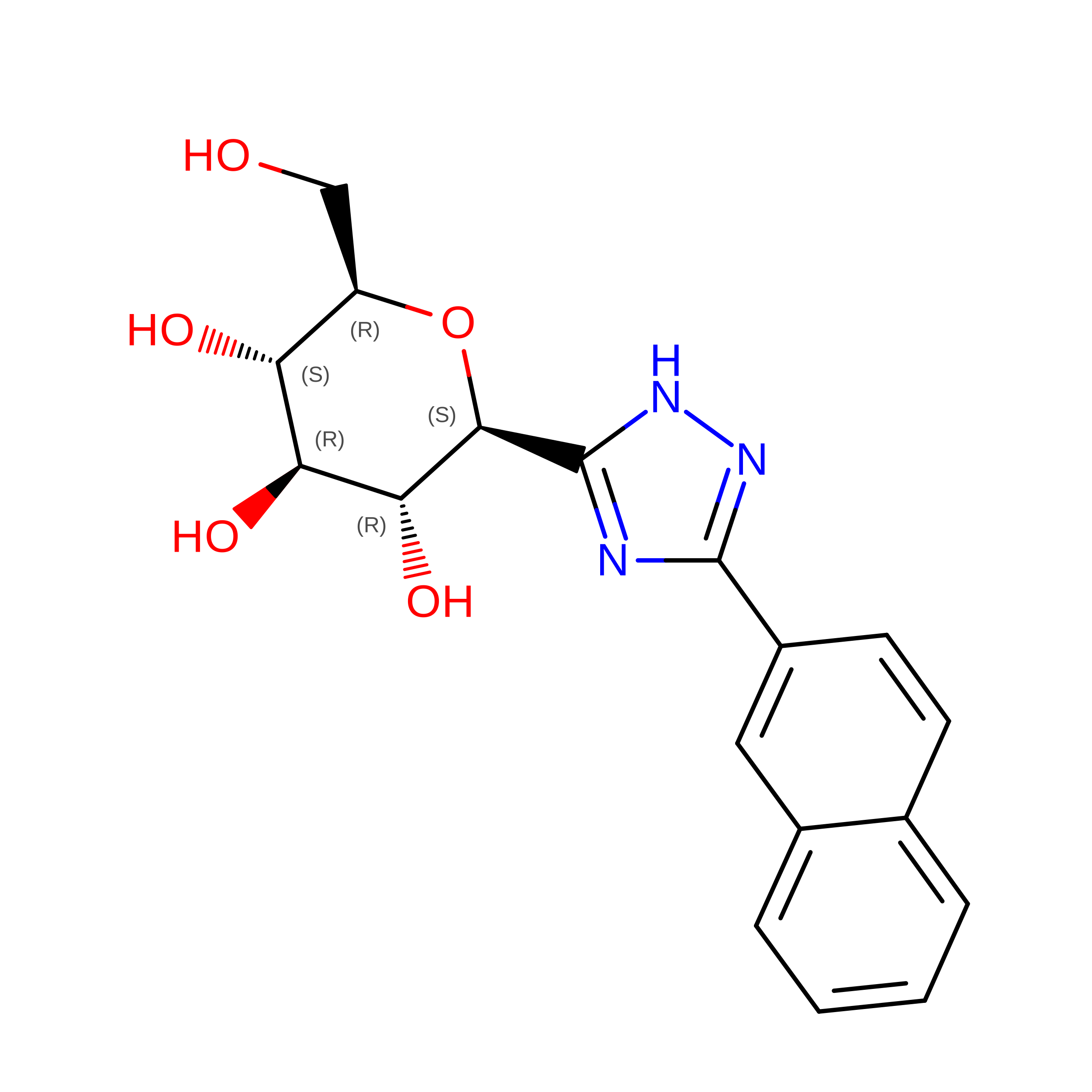
Crystal structure of Glycogen Phosphorylase b in complex with KS382


Experimental Data Snapshot

  • Method: X-RAY DIFFRACTION
  • Resolution: 1.80 Å
  • R-Value Free: 
    0.186 (Depositor), 0.194 (DCC) 
  • R-Value Work: 
    0.161 (Depositor), 0.172 (DCC) 
  • R-Value Observed: 
    0.162 (Depositor) 

wwPDB Validation 3D Report Full Report

Validation slider image for 5LRE

Ligand Structure Quality Assessment 


This is version 1.2 of the entry. See complete history

Literature

Synthetic, enzyme kinetic, and protein crystallographic studies of C-beta-d-glucopyranosyl pyrroles and imidazoles reveal and explain low nanomolar inhibition of human liver glycogen phosphorylase.

Kantsadi, A.L.Bokor, E.Kun, S.Stravodimos, G.A.Chatzileontiadou, D.S.Leonidas, D.D.Juhasz-Toth, E.Szakacs, A.Batta, G.Docsa, T.Gergely, P.Somsak, L.

(2016) Eur J Med Chem 123: 737-745

  • DOI: https://doi.org/10.1016/j.ejmech.2016.06.049
  • Primary Citation Related Structures: 
    5JTT, 5JTU, 5LRE

  • PubMed Abstract: 

    C-β-d-Glucopyranosyl pyrrole derivatives were prepared in the reactions of pyrrole, 2-, and 3-aryl-pyrroles with O-peracetylated β-d-glucopyranosyl trichloroacetimidate, while 2-(β-d-glucopyranosyl) indole was obtained by a cross coupling of O-perbenzylated β-d-glucopyranosyl acetylene with N-tosyl-2-iodoaniline followed by spontaneous ring closure. An improved synthesis of O-perbenzoylated 2-(β-d-glucopyranosyl) imidazoles was achieved by reacting C-glucopyranosyl formimidates with α-aminoketones. The deprotected compounds were assayed with isoforms of glycogen phosphorylase (GP) to show no activity of the pyrroles against rabbit muscle GPb. The imidazoles proved to be the best known glucose derived inhibitors of not only the muscle enzymes (both a and b) but also of the pharmacologically relevant human liver GPa (Ki = 156 and 26 nM for the 4(5)-phenyl and -(2-naphthyl) derivatives, respectively). An X-ray crystallographic study of the rmGPb-imidazole complexes revealed structural features of the strong binding, and also allowed to explain the absence of inhibition for the pyrrole derivatives.


  • Organizational Affiliation
    • Department of Biochemistry and Biotechnology, University of Thessaly, 26 Ploutonos Str. 41221, Larissa, Greece.

Macromolecule Content 

  • Total Structure Weight: 98.41 kDa 
  • Atom Count: 7,001 
  • Modeled Residue Count: 810 
  • Deposited Residue Count: 842 
  • Unique protein chains: 1

Macromolecules

Find similar proteins by:|  3D Structure
Entity ID: 1
MoleculeChains  Sequence LengthOrganismDetailsImage
Glycogen phosphorylase, muscle form842Oryctolagus cuniculusMutation(s): 0 
EC: 2.4.1.1
UniProt
Find proteins for P00489 (Oryctolagus cuniculus)
Explore P00489 
Go to UniProtKB:  P00489
Entity Groups
Sequence Clusters30% Identity50% Identity70% Identity90% Identity95% Identity100% Identity
UniProt GroupP00489
Sequence Annotations
Expand
Reference Sequence

Experimental Data & Validation

Experimental Data

  • Method: X-RAY DIFFRACTION
  • Resolution: 1.80 Å
  • R-Value Free:  0.186 (Depositor), 0.194 (DCC) 
  • R-Value Work:  0.161 (Depositor), 0.172 (DCC) 
  • R-Value Observed: 0.162 (Depositor) 
Space Group: P 43 21 2
Unit Cell:
Length ( Å )Angle ( ˚ )
a = 128.57α = 90
b = 128.57β = 90
c = 116.36γ = 90
Software Package:
Software NamePurpose
REFMACrefinement
MOSFLMdata reduction
SCALAdata scaling

Structure Validation

View Full Validation Report


Ligand Structure Quality Assessment 


Entry History 

Deposition Data

Revision History  (Full details and data files)

  • Version 1.0: 2017-05-31
    Type: Initial release
  • Version 1.1: 2018-01-17
    Changes: Data collection
  • Version 1.2: 2025-04-09
    Changes: Advisory, Data collection, Database references, Structure summary