5LL7 | pdb_00005ll7

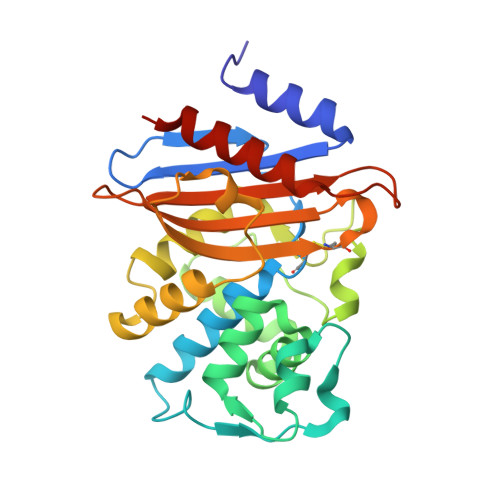
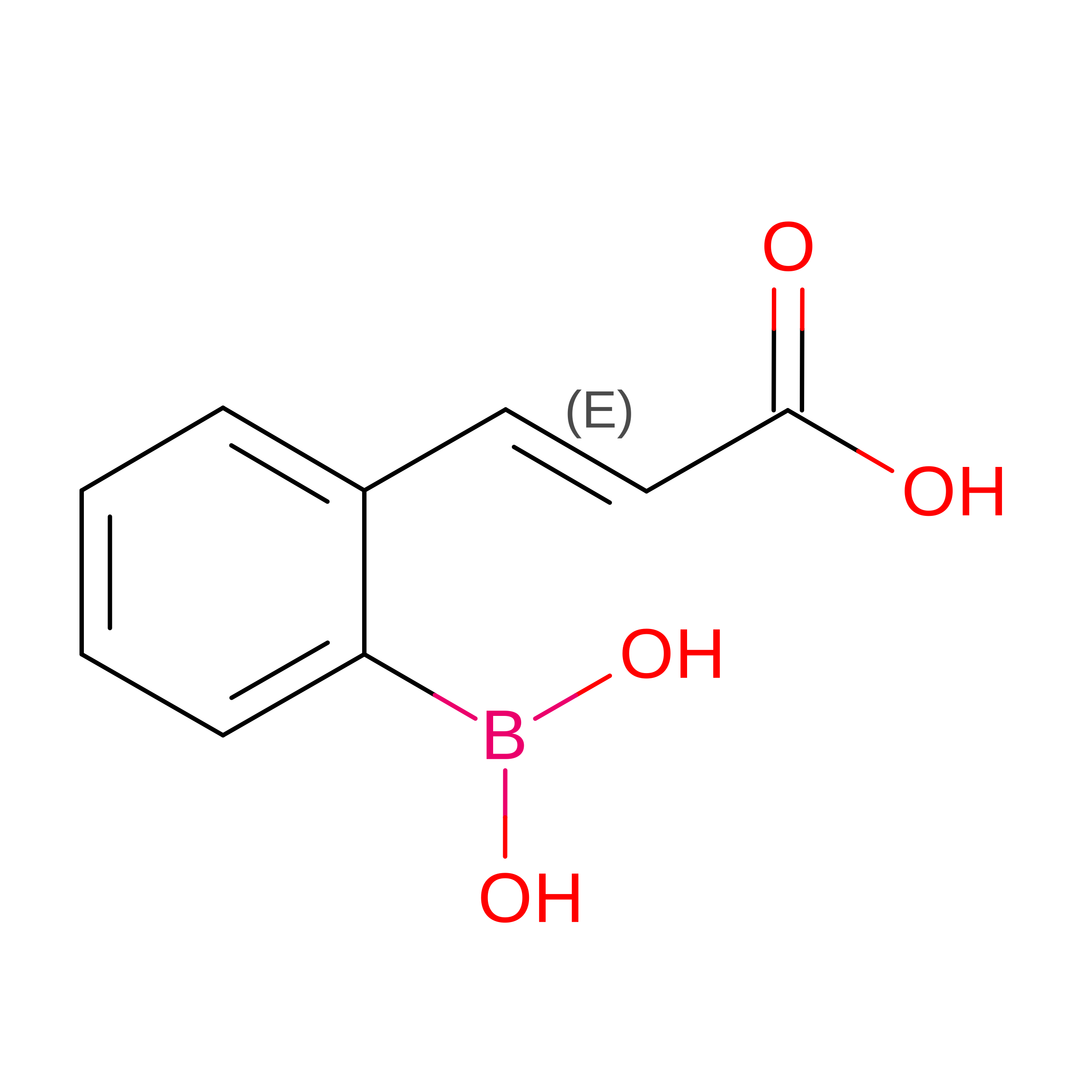
Crystal structure of KPC-2 carbapenemase in complex with a phenyl boronic inhibitor.


Experimental Data Snapshot

  • Method: X-RAY DIFFRACTION
  • Resolution: 1.40 Å
  • R-Value Free: 
    0.197 (DCC) 
  • R-Value Work: 
    0.183 (DCC) 

Starting Model: experimental
View more details

wwPDB Validation 3D Report Full Report

Validation slider image for 5LL7

Ligand Structure Quality Assessment 


This is version 1.3 of the entry. See complete history

Literature

Phenylboronic Acid Derivatives as Validated Leads Active in Clinical Strains Overexpressing KPC-2: A Step against Bacterial Resistance.

Celenza, G.Vicario, M.Bellio, P.Linciano, P.Perilli, M.Oliver, A.Blazquez, J.Cendron, L.Tondi, D.

(2018) ChemMedChem 13: 713-724

  • DOI: https://doi.org/10.1002/cmdc.201700788
  • Primary Citation Related Structures: 
    5LL7, 5MGI

  • PubMed Abstract: 

    The emergence and dissemination of multidrug resistant (MDR) pathogens resistant to nearly all available antibiotics poses a significant threat in clinical therapy. Among them, Klebsiella pneumoniae clinical isolates overexpressing KPC-2 carbapenemase are the most worrisome, extending bacterial resistance to last-resort carbapenems. In this study, we investigate the molecular recognition requirements in the KPC-2 active site by small phenylboronic acid derivatives. Four new phenylboronic acid derivatives were designed and tested against KPC-2. For the most active, despite their simple chemical structures, nanomolar affinity was achieved. The new derivatives restored susceptibility to meropenem in clinical strains overexpressing KPC-2. Moreover, no cytotoxicity was detected in cell-viability assays, which further validated the designed leads. Two crystallographic binary complexes of the best inhibitors binding KPC-2 were obtained at high resolution. Kinetic descriptions of slow binding, time-dependent inhibition, and interaction geometries in KPC-2 were fully investigated. This study will ultimately lead toward the optimization and development of more-effective KPC-2 inhibitors.


  • Organizational Affiliation
    • Dipartimento di Scienze Cliniche Applicate e Biotecnologie, Università dell'Aquila, Via Vetoio 1, 67100, L'Aquila, Italy.

Macromolecule Content 

  • Total Structure Weight: 28.77 kDa 
  • Atom Count: 2,177 
  • Modeled Residue Count: 264 
  • Deposited Residue Count: 268 
  • Unique protein chains: 1

Macromolecules

Find similar proteins by:|  3D Structure
Entity ID: 1
MoleculeChains  Sequence LengthOrganismDetailsImage
Beta-lactamase268Escherichia coliMutation(s): 0 
Gene Names: blaKPC-18
EC: 3.5.2.6
UniProt
Find proteins for A0A0H4IUK8 (Escherichia coli)
Explore A0A0H4IUK8 
Go to UniProtKB:  A0A0H4IUK8
Entity Groups
Sequence Clusters30% Identity50% Identity70% Identity90% Identity95% Identity100% Identity
UniProt GroupA0A0H4IUK8
Sequence Annotations
Expand
Reference Sequence

Experimental Data & Validation

Experimental Data

  • Method: X-RAY DIFFRACTION
  • Resolution: 1.40 Å
  • R-Value Free:  0.197 (DCC) 
  • R-Value Work:  0.183 (DCC) 
Space Group: P 21 21 21
Unit Cell:
Length ( Å )Angle ( ˚ )
a = 49.033α = 90
b = 65.764β = 90
c = 72.21γ = 90
Software Package:
Software NamePurpose
REFMACrefinement
XDSdata reduction
Aimlessdata scaling
PHENIXphasing

Structure Validation

View Full Validation Report


Ligand Structure Quality Assessment 


Entry History 

& Funding Information

Deposition Data


Funding OrganizationLocationGrant Number
Fondo Ateneo Ricerca University of Modena and Reggio EmiliaItaly--

Revision History  (Full details and data files)

  • Version 1.0: 2018-02-21
    Type: Initial release
  • Version 1.1: 2019-06-05
    Changes: Data collection, Database references
  • Version 1.2: 2024-01-10
    Changes: Data collection, Database references, Refinement description
  • Version 1.3: 2024-10-16
    Changes: Structure summary