5LKW | pdb_00005lkw

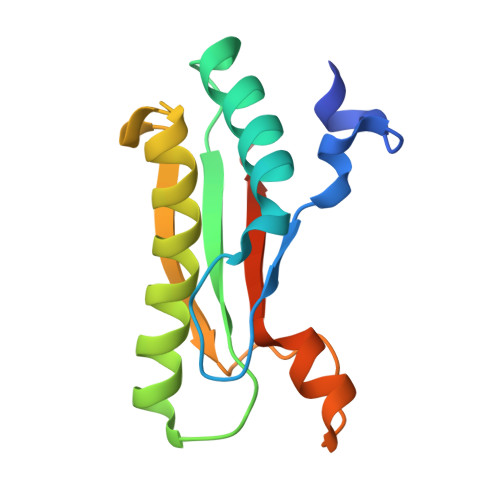
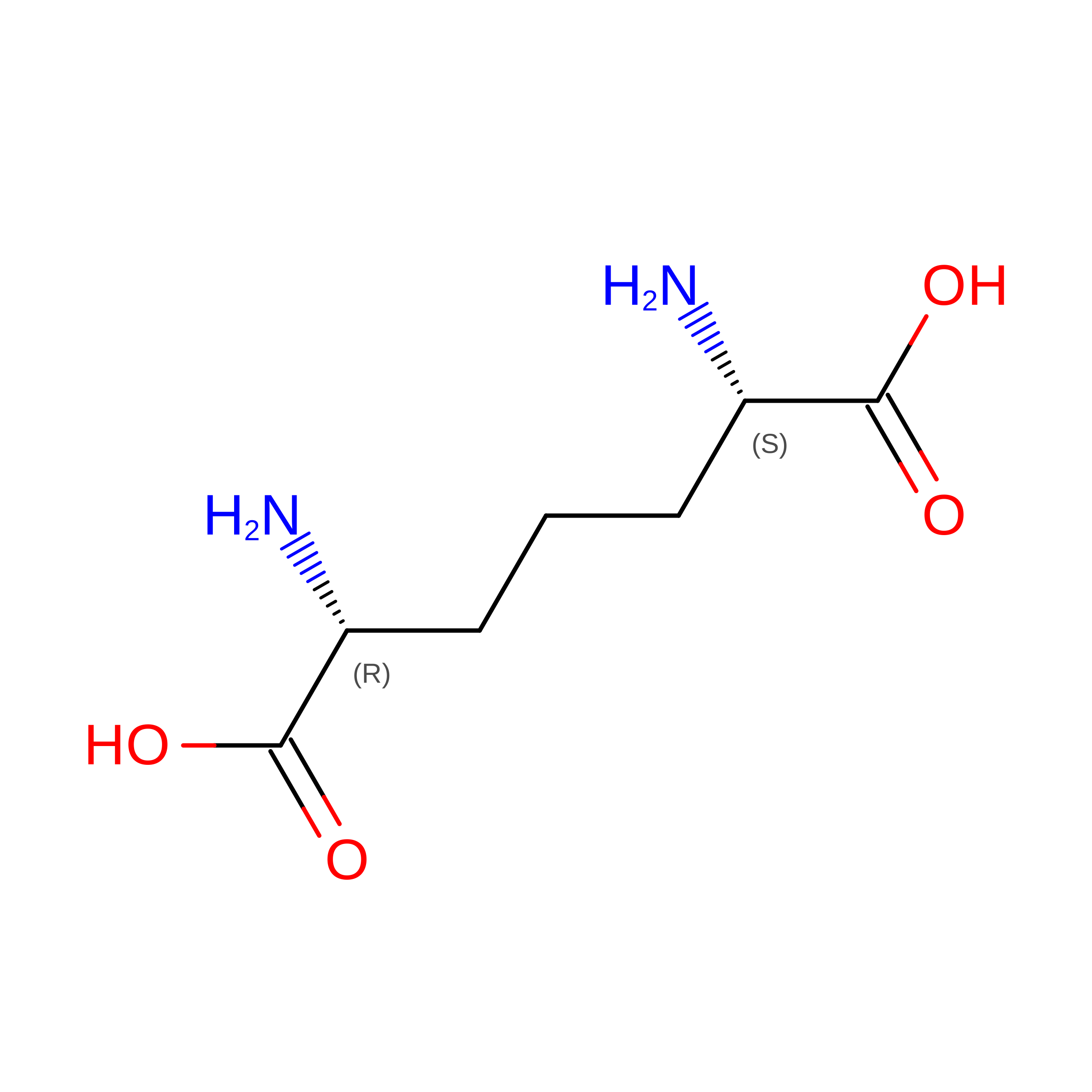
Crystal structure of the peptidoglycan-associated lipoprotein (Pal) from Burkholderia cepacia in complex with DAP


Experimental Data Snapshot

  • Method: X-RAY DIFFRACTION
  • Resolution: 2.00 Å
  • R-Value Free: 
    0.249 (Depositor), 0.249 (DCC) 
  • R-Value Work: 
    0.188 (Depositor), 0.191 (DCC) 
  • R-Value Observed: 
    0.191 (Depositor) 

Starting Model: experimental
View more details

wwPDB Validation 3D Report Full Report

Validation slider image for 5LKW

Ligand Structure Quality Assessment 


This is version 2.1 of the entry. See complete history

Literature

The Burkholderia cenocepacia peptidoglycan-associated lipoprotein is involved in epithelial cell attachment and elicitation of inflammation.

Dennehy, R.Romano, M.Ruggiero, A.Mohamed, Y.F.Dignam, S.L.Mujica Troncoso, C.Callaghan, M.Valvano, M.A.Berisio, R.McClean, S.

(2017) Cell Microbiol 19

  • DOI: https://doi.org/10.1111/cmi.12691
  • Primary Citation Related Structures: 
    5LKW

  • PubMed Abstract: 

    The Burkholderia cepacia complex (Bcc) is a group of Gram-negative opportunistic pathogens causing infections in people with cystic fibrosis (CF). Bcc is highly antibiotic resistant, making conventional antibiotic treatment problematic. The identification of novel targets for anti-virulence therapies should improve therapeutic options for infected CF patients. We previously identified that the peptidoglycan-associated lipoprotein (Pal) was immunogenic in Bcc infected CF patients; however, its role in Bcc pathogenesis is unknown. The virulence of a pal deletion mutant (Δpal) in Galleria mellonella was 88-fold reduced (p < .001) compared to wild type. The lipopolysaccharide profiles of wild type and Δpal were identical, indicating no involvement of Pal in O-antigen transport. However, Δpal was more susceptible to polymyxin B. Structural elucidation by X-ray crystallography and calorimetry demonstrated that Pal binds peptidoglycan fragments. Δpal showed a 1.5-fold reduced stimulation of IL-8 in CF epithelial cells relative to wild type (p < .001), demonstrating that Pal is a significant driver of inflammation. The Δpal mutant had reduced binding to CFBE41o - cells, but adhesion of Pal-expressing recombinant E. coli to CFBE41o - cells was enhanced compared to wild-type E. coli (p < .0001), confirming that Pal plays a direct role in host cell attachment. Overall, Bcc Pal mediates host cell attachment and stimulation of cytokine secretion, contributing to Bcc pathogenesis.


  • Organizational Affiliation
    • Centre of Microbial Host Interactions, Institute of Technology Tallaght, Dublin, Ireland.

Macromolecule Content 

  • Total Structure Weight: 30.2 kDa 
  • Atom Count: 2,084 
  • Modeled Residue Count: 238 
  • Deposited Residue Count: 260 
  • Unique protein chains: 1

Macromolecules

Find similar proteins by:|  3D Structure
Entity ID: 1
MoleculeChains  Sequence LengthOrganismDetailsImage
Putative OmpA family lipoprotein
A, B
130Burkholderia cenocepacia J2315Mutation(s): 0 
Gene Names: BCAL3204
UniProt
Find proteins for B4EDC1 (Burkholderia cenocepacia (strain ATCC BAA-245 / DSM 16553 / LMG 16656 / NCTC 13227 / J2315 / CF5610))
Explore B4EDC1 
Go to UniProtKB:  B4EDC1
Entity Groups
Sequence Clusters30% Identity50% Identity70% Identity90% Identity95% Identity100% Identity
UniProt GroupB4EDC1
Sequence Annotations
Expand
Reference Sequence

Experimental Data & Validation

Experimental Data

  • Method: X-RAY DIFFRACTION
  • Resolution: 2.00 Å
  • R-Value Free:  0.249 (Depositor), 0.249 (DCC) 
  • R-Value Work:  0.188 (Depositor), 0.191 (DCC) 
  • R-Value Observed: 0.191 (Depositor) 
Space Group: P 32
Unit Cell:
Length ( Å )Angle ( ˚ )
a = 77.706α = 90
b = 77.706β = 90
c = 38.606γ = 120
Software Package:
Software NamePurpose
REFMACrefinement
HKL-2000data reduction
HKL-2000data scaling
PHASERphasing

Structure Validation

View Full Validation Report


Ligand Structure Quality Assessment 


Entry History 

Deposition Data

Revision History  (Full details and data files)

  • Version 1.0: 2017-08-16
    Type: Initial release
  • Version 1.1: 2017-12-06
    Changes: Database references
  • Version 1.2: 2019-10-16
    Changes: Data collection
  • Version 2.0: 2023-11-15
    Changes: Atomic model, Data collection, Database references
  • Version 2.1: 2024-01-10
    Changes: Refinement description