5LHT | pdb_00005lht

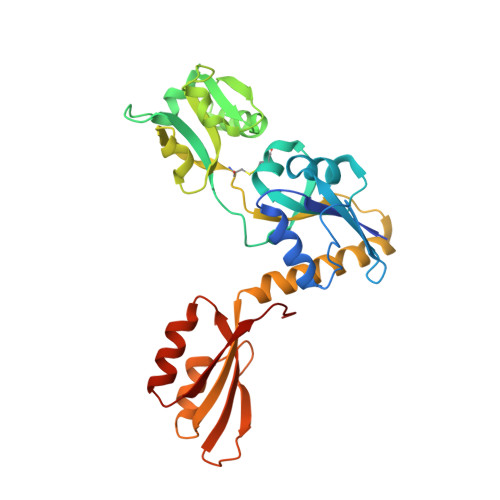
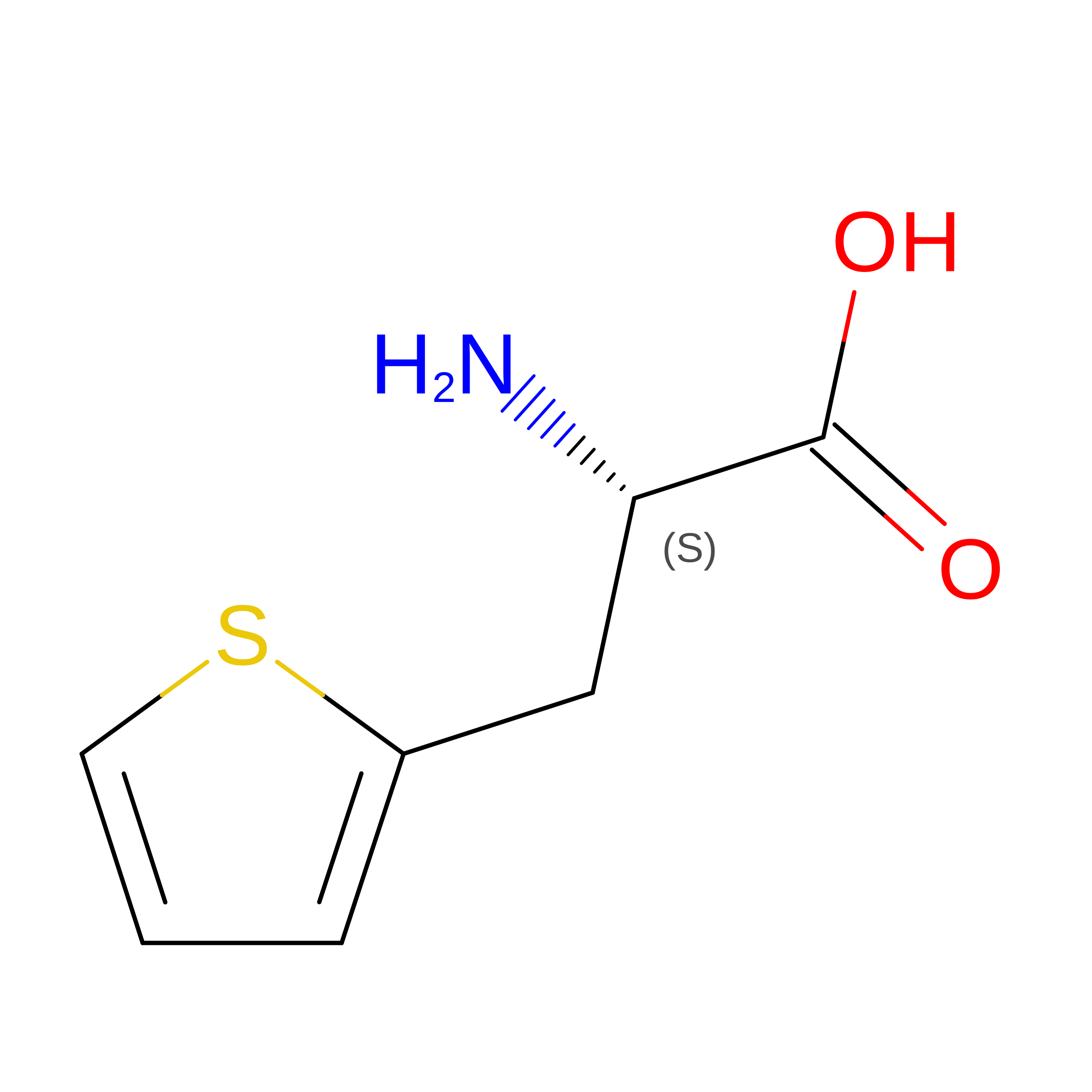
ATP Phosphoribosyltransferase from Mycobacterium tuberculosis in complex with the allosteric activator 3-(2-Thienyl)-L-alanine


Experimental Data Snapshot

  • Method: X-RAY DIFFRACTION
  • Resolution: 2.06 Å
  • R-Value Free: 
    0.229 (Depositor), 0.229 (DCC) 
  • R-Value Work: 
    0.193 (Depositor), 0.194 (DCC) 
  • R-Value Observed: 
    0.194 (Depositor) 

Starting Model: experimental
View more details

wwPDB Validation 3D Report Full Report

Validation slider image for 5LHT

Ligand Structure Quality Assessment 


This is version 1.3 of the entry. See complete history

Literature

Uncoupling conformational states from activity in an allosteric enzyme.

Pisco, J.P.Chiara, C.Pacholarz, K.J.Garza-Garcia, A.Ogrodowicz, R.W.Walker, P.A.Barran, P.E.Smerdon, S.J.Carvalho, L.P.S.

(2017) Nat Commun 8: 203-203

  • DOI: https://doi.org/10.1038/s41467-017-00224-0
  • Primary Citation Related Structures: 
    5LHT, 5LHU

  • PubMed Abstract: 

    ATP-phosphoribosyltransferase (ATP-PRT) is a hexameric enzyme in conformational equilibrium between an open and seemingly active state and a closed and presumably inhibited form. The structure-function relationship of allosteric regulation in this system is still not fully understood. Here, we develop a screening strategy for modulators of ATP-PRT and identify 3-(2-thienyl)-L-alanine (TIH) as an allosteric activator of this enzyme. Kinetic analysis reveals co-occupancy of the allosteric sites by TIH and L-histidine. Crystallographic and native ion-mobility mass spectrometry data show that the TIH-bound activated form of the enzyme closely resembles the inhibited L-histidine-bound closed conformation, revealing the uncoupling between ATP-PRT open and closed conformations and its functional state. These findings suggest that dynamic processes are responsible for ATP-PRT allosteric regulation and that similar mechanisms might also be found in other enzymes bearing a ferredoxin-like allosteric domain.Active and inactive state ATP-phosphoribosyltransferases (ATP-PRTs) are believed to have different conformations. Here the authors show that in both states, ATP-PRT has a similar structural arrangement, suggesting that dynamic alterations are involved in ATP-PRT regulation by allosteric modulators.


  • Organizational Affiliation
    • Mycobacterial Metabolism and Antibiotic Research Laboratory, The Francis Crick Institute, 1 Midland Road, London, NW1 1AT, UK.

Macromolecule Content 

  • Total Structure Weight: 32.33 kDa 
  • Atom Count: 2,274 
  • Modeled Residue Count: 284 
  • Deposited Residue Count: 294 
  • Unique protein chains: 1

Macromolecules

Find similar proteins by:|  3D Structure
Entity ID: 1
MoleculeChains  Sequence LengthOrganismDetailsImage
ATP phosphoribosyltransferase294Mycobacterium tuberculosis H37RvMutation(s): 0 
Gene Names: hisGRv2121cMTCY261.17c
EC: 2.4.2.17
UniProt
Find proteins for P9WMN1 (Mycobacterium tuberculosis (strain ATCC 25618 / H37Rv))
Explore P9WMN1 
Go to UniProtKB:  P9WMN1
Entity Groups
Sequence Clusters30% Identity50% Identity70% Identity90% Identity95% Identity100% Identity
UniProt GroupP9WMN1
Sequence Annotations
Expand
Reference Sequence

Experimental Data & Validation

Experimental Data

  • Method: X-RAY DIFFRACTION
  • Resolution: 2.06 Å
  • R-Value Free:  0.229 (Depositor), 0.229 (DCC) 
  • R-Value Work:  0.193 (Depositor), 0.194 (DCC) 
  • R-Value Observed: 0.194 (Depositor) 
Space Group: H 3 2
Unit Cell:
Length ( Å )Angle ( ˚ )
a = 117.512α = 90
b = 117.512β = 90
c = 127.356γ = 120
Software Package:
Software NamePurpose
PHENIXrefinement
XDSdata reduction
Aimlessdata scaling
PHASERphasing

Structure Validation

View Full Validation Report


Ligand Structure Quality Assessment 


Entry History 

Deposition Data

Revision History  (Full details and data files)

  • Version 1.0: 2017-07-05
    Type: Initial release
  • Version 1.1: 2017-09-13
    Changes: Database references
  • Version 1.2: 2024-01-10
    Changes: Data collection, Database references, Refinement description
  • Version 1.3: 2024-10-16
    Changes: Structure summary