5KIM | pdb_00005kim

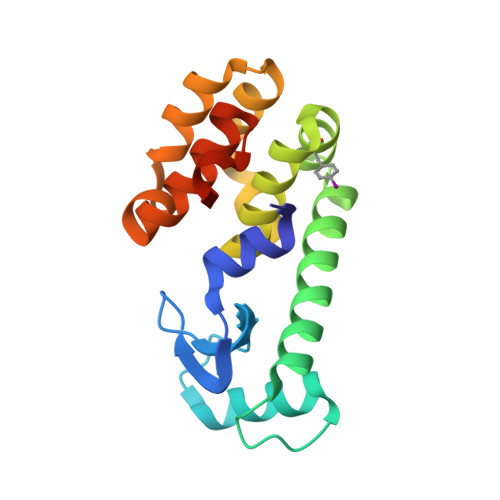
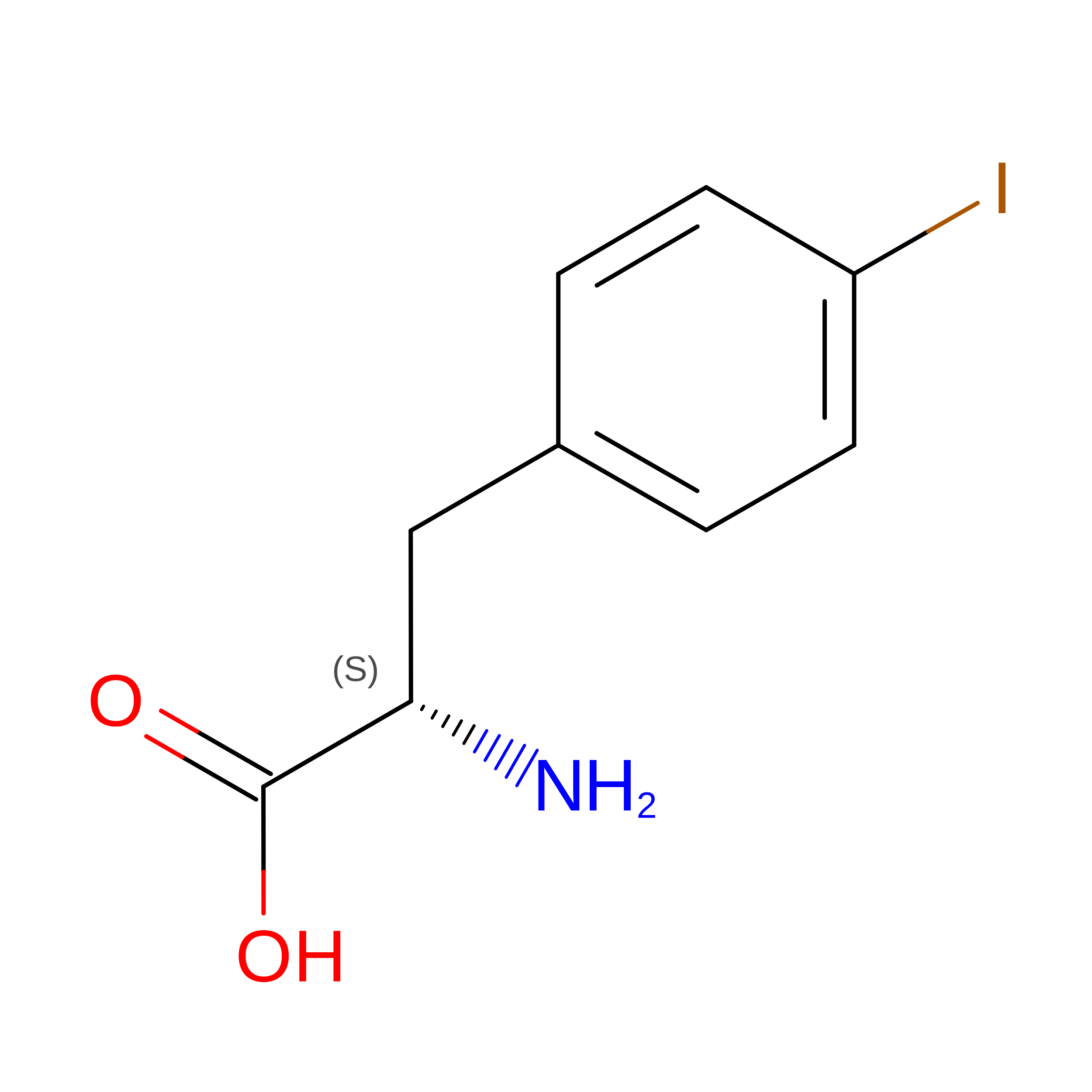
PSEUDO T4 LYSOZYME MUTANT - Y88PHE-I


Experimental Data Snapshot

  • Method: X-RAY DIFFRACTION
  • Resolution: 1.50 Å
  • R-Value Free: 
    0.184 (Depositor), 0.183 (DCC) 
  • R-Value Work: 
    0.160 (Depositor), 0.160 (DCC) 
  • R-Value Observed: 
    0.162 (Depositor) 

Starting Model: experimental
View more details

wwPDB Validation 3D Report Full Report

Validation slider image for 5KIM

Ligand Structure Quality Assessment 


This is version 1.5 of the entry. See complete history

Literature

Structure-Energy Relationships of Halogen Bonds in Proteins.

Scholfield, M.R.Ford, M.C.Carlsson, A.C.Butta, H.Mehl, R.A.Ho, P.S.

(2017) Biochemistry 56: 2794-2802

  • DOI: https://doi.org/10.1021/acs.biochem.7b00022
  • Primary Citation Related Structures: 
    5KHZ, 5KI1, 5KI2, 5KI3, 5KI8, 5KIG, 5KII, 5KIM, 5KIO

  • PubMed Abstract: 

    The structures and stabilities of proteins are defined by a series of weak noncovalent electrostatic, van der Waals, and hydrogen bond (HB) interactions. In this study, we have designed and engineered halogen bonds (XBs) site-specifically to study their structure-energy relationship in a model protein, T4 lysozyme. The evidence for XBs is the displacement of the aromatic side chain toward an oxygen acceptor, at distances that are equal to or less than the sums of their respective van der Waals radii, when the hydroxyl substituent of the wild-type tyrosine is replaced by a halogen. In addition, thermal melting studies show that the iodine XB rescues the stabilization energy from an otherwise destabilizing substitution (at an equivalent noninteracting site), indicating that the interaction is also present in solution. Quantum chemical calculations show that the XB complements an HB at this site and that solvent structure must also be considered in trying to design molecular interactions such as XBs into biological systems. A bromine substitution also shows displacement of the side chain, but the distances and geometries do not indicate formation of an XB. Thus, we have dissected the contributions from various noncovalent interactions of halogens introduced into proteins, to drive the application of XBs, particularly in biomolecular design.


  • Organizational Affiliation
    • Department of Biochemistry & Molecular Biology, Colorado State University , Fort Collins, Colorado 80523-1870, United States.

Macromolecule Content 

  • Total Structure Weight: 19.77 kDa 
  • Atom Count: 1,804 
  • Modeled Residue Count: 162 
  • Deposited Residue Count: 170 
  • Unique protein chains: 1

Macromolecules

Find similar proteins by:|  3D Structure
Entity ID: 1
MoleculeChains  Sequence LengthOrganismDetailsImage
Endolysin170Tequatrovirus T4Mutation(s): 3 
EC: 3.2.1.17
UniProt
Find proteins for P00720 (Enterobacteria phage T4)
Explore P00720 
Go to UniProtKB:  P00720
Entity Groups
Sequence Clusters30% Identity50% Identity70% Identity90% Identity95% Identity100% Identity
UniProt GroupP00720
Sequence Annotations
Expand
Reference Sequence

Small Molecules

Experimental Data & Validation

Experimental Data

  • Method: X-RAY DIFFRACTION
  • Resolution: 1.50 Å
  • R-Value Free:  0.184 (Depositor), 0.183 (DCC) 
  • R-Value Work:  0.160 (Depositor), 0.160 (DCC) 
  • R-Value Observed: 0.162 (Depositor) 
Space Group: P 32 2 1
Unit Cell:
Length ( Å )Angle ( ˚ )
a = 60.283α = 90
b = 60.283β = 90
c = 96.197γ = 120
Software Package:
Software NamePurpose
PHENIXrefinement
HKL-2000data reduction
HKL-2000data scaling
PHASERphasing
PDB_EXTRACTdata extraction

Structure Validation

View Full Validation Report


Ligand Structure Quality Assessment 


Entry History 

& Funding Information

Deposition Data


Funding OrganizationLocationGrant Number
National Science Foundation (NSF, United States)United StatesCHE-1152494

Revision History  (Full details and data files)

  • Version 1.0: 2017-04-12
    Type: Initial release
  • Version 1.1: 2017-04-19
    Changes: Database references
  • Version 1.2: 2017-06-14
    Changes: Database references
  • Version 1.3: 2017-09-27
    Changes: Author supporting evidence
  • Version 1.4: 2019-11-27
    Changes: Author supporting evidence
  • Version 1.5: 2023-09-27
    Changes: Data collection, Database references, Derived calculations, Refinement description