5KC5 | pdb_00005kc5

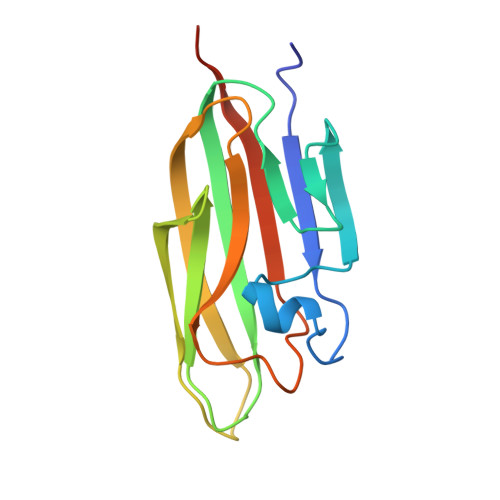
Crystal structure of the Cbln1 C1q domain trimer


Experimental Data Snapshot

  • Method: X-RAY DIFFRACTION
  • Resolution: 2.35 Å
  • R-Value Free: 
    0.197 (Depositor), 0.346 (DCC) 
  • R-Value Work: 
    0.177 (Depositor), 0.359 (DCC) 
  • R-Value Observed: 
    0.181 (Depositor) 

Starting Model: experimental
View more details

wwPDB Validation 3D Report Full Report

Validation slider image for 5KC5

Ligand Structure Quality Assessment 


This is version 1.3 of the entry. See complete history

Literature

Structural basis for integration of GluD receptors within synaptic organizer complexes.

Elegheert, J.Kakegawa, W.Clay, J.E.Shanks, N.F.Behiels, E.Matsuda, K.Kohda, K.Miura, E.Rossmann, M.Mitakidis, N.Motohashi, J.Chang, V.T.Siebold, C.Greger, I.H.Nakagawa, T.Yuzaki, M.Aricescu, A.R.

(2016) Science 353: 295-299

  • DOI: https://doi.org/10.1126/science.aae0104
  • Primary Citation Related Structures: 
    5KC5, 5KC6, 5KC7, 5KC8, 5KC9, 5KCA

  • PubMed Abstract: 

    Ionotropic glutamate receptor (iGluR) family members are integrated into supramolecular complexes that modulate their location and function at excitatory synapses. However, a lack of structural information beyond isolated receptors or fragments thereof currently limits the mechanistic understanding of physiological iGluR signaling. Here, we report structural and functional analyses of the prototypical molecular bridge linking postsynaptic iGluR δ2 (GluD2) and presynaptic β-neurexin 1 (β-NRX1) via Cbln1, a C1q-like synaptic organizer. We show how Cbln1 hexamers "anchor" GluD2 amino-terminal domain dimers to monomeric β-NRX1. This arrangement promotes synaptogenesis and is essential for D: -serine-dependent GluD2 signaling in vivo, which underlies long-term depression of cerebellar parallel fiber-Purkinje cell (PF-PC) synapses and motor coordination in developing mice. These results lead to a model where protein and small-molecule ligands synergistically control synaptic iGluR function.


  • Organizational Affiliation
    • Division of Structural Biology, Wellcome Trust Centre for Human Genetics, University of Oxford, Roosevelt Drive, Oxford OX3 7BN, UK.

Macromolecule Content 

  • Total Structure Weight: 16.86 kDa 
  • Atom Count: 1,150 
  • Modeled Residue Count: 137 
  • Deposited Residue Count: 147 
  • Unique protein chains: 1

Macromolecules

Find similar proteins by:|  3D Structure
Entity ID: 1
MoleculeChains  Sequence LengthOrganismDetailsImage
Cerebellin-1147Homo sapiensMutation(s): 0 
Gene Names: CBLN1
UniProt & NIH Common Fund Data Resources
Find proteins for P23435 (Homo sapiens)
Explore P23435 
Go to UniProtKB:  P23435
PHAROS:  P23435
GTEx:  ENSG00000102924 
Entity Groups
Sequence Clusters30% Identity50% Identity70% Identity90% Identity95% Identity100% Identity
UniProt GroupP23435
Glycosylation
Glycosylation Sites: 1Go to GlyGen: P23435-1
Sequence Annotations
Expand
Reference Sequence

Small Molecules

Ligands 1 Unique
IDChains Name / Formula / InChI Key2D Diagram3D Interactions
NAG

Query on NAG


Download:Ideal Coordinates CCD File
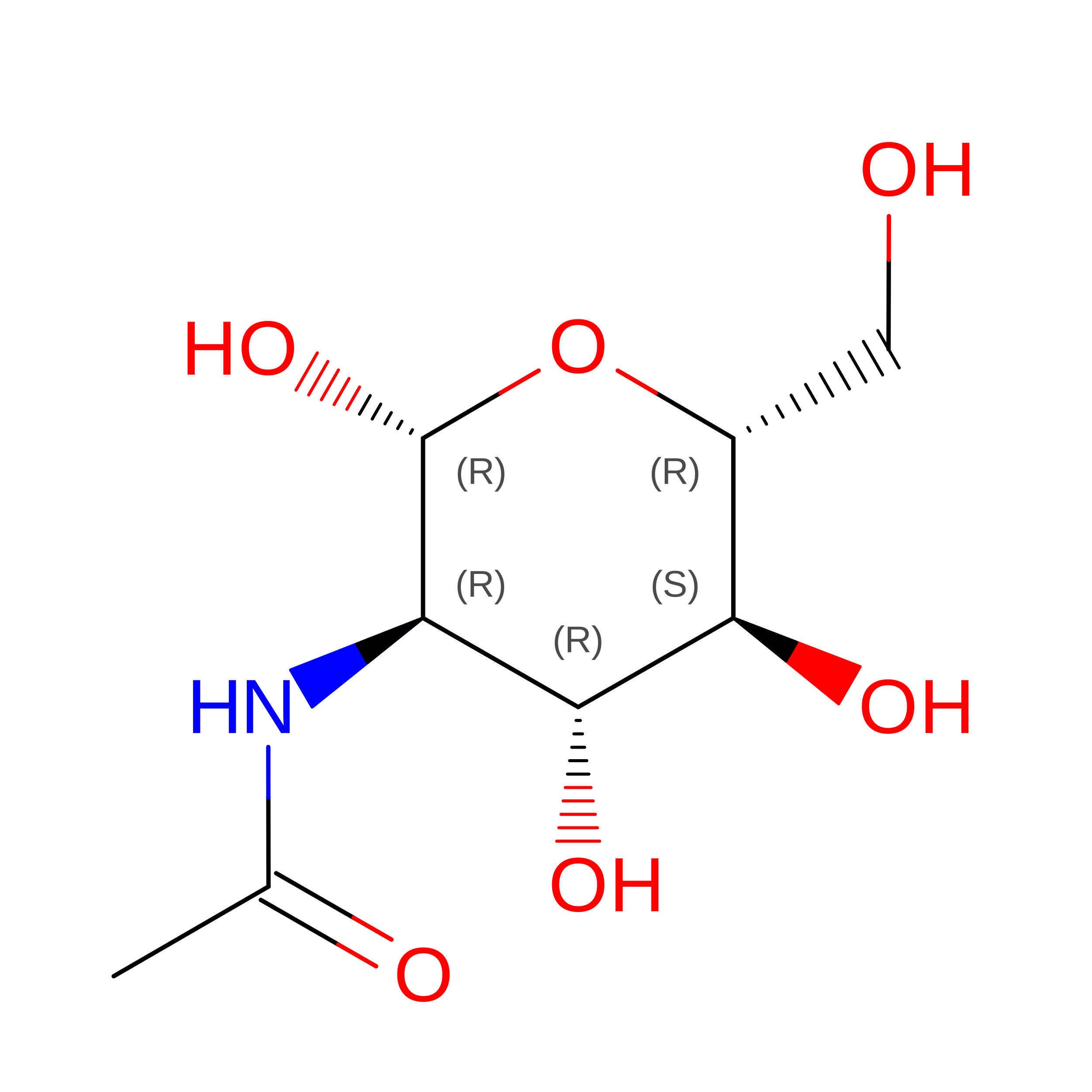
B [auth A]2-acetamido-2-deoxy-beta-D-glucopyranose
C8 H15 N O6
OVRNDRQMDRJTHS-FMDGEEDCSA-N

Experimental Data & Validation

Experimental Data

  • Method: X-RAY DIFFRACTION
  • Resolution: 2.35 Å
  • R-Value Free:  0.197 (Depositor), 0.346 (DCC) 
  • R-Value Work:  0.177 (Depositor), 0.359 (DCC) 
  • R-Value Observed: 0.181 (Depositor) 
Space Group: P 6
Unit Cell:
Length ( Å )Angle ( ˚ )
a = 83.42α = 90
b = 83.42β = 90
c = 50.57γ = 120
Software Package:
Software NamePurpose
PHENIXrefinement
XDSdata reduction
Aimlessdata scaling
PHASERphasing

Structure Validation

View Full Validation Report


Ligand Structure Quality Assessment 


Entry History 

Deposition Data

Revision History  (Full details and data files)

  • Version 1.0: 2016-07-27
    Type: Initial release
  • Version 1.1: 2020-07-29
    Type: Remediation
    Reason: Carbohydrate remediation
    Changes: Data collection, Derived calculations, Structure summary
  • Version 1.2: 2024-01-10
    Changes: Data collection, Database references, Refinement description, Structure summary
  • Version 1.3: 2024-10-16
    Changes: Structure summary