5K92 | pdb_00005k92

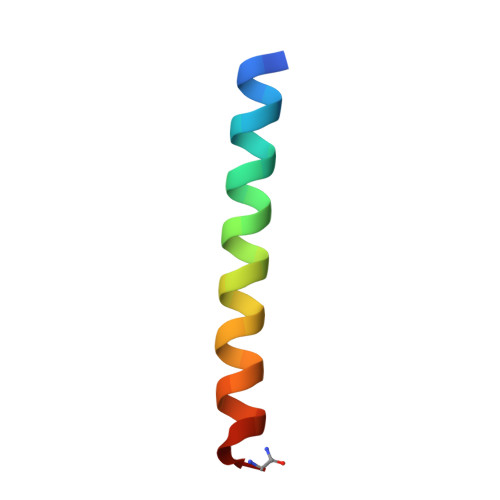
Crystal Structure of an apo Tris-thiolate Binding Site in a de novo Three Stranded Coiled Coil Peptide


Experimental Data Snapshot

  • Method: X-RAY DIFFRACTION
  • Resolution: 1.42 Å
  • R-Value Free: 
    0.230 (Depositor), 0.247 (DCC) 
  • R-Value Work: 
    0.195 (Depositor) 
  • R-Value Observed: 
    0.196 (Depositor) 

Starting Model: experimental
View more details

wwPDB Validation 3D Report Full Report

Validation slider image for 5K92

This is version 1.6 of the entry. See complete history

Literature

A Crystallographic Examination of Predisposition versus Preorganization in de Novo Designed Metalloproteins.

Ruckthong, L.Zastrow, M.L.Stuckey, J.A.Pecoraro, V.L.

(2016) J Am Chem Soc 138: 11979-11988

  • DOI: https://doi.org/10.1021/jacs.6b07165
  • Primary Citation Related Structures: 
    5K92, 5KB0, 5KB1, 5KB2

  • PubMed Abstract: 

    Preorganization and predisposition are important molecular recognition concepts exploited by nature to obtain site-specific and selective metal binding to proteins. While native structures containing an MS3 core are often unavailable in both apo- and holo-forms, one can use designed three-stranded coiled coils (3SCCs) containing tris-thiolate sites to evaluate these concepts. We show that the preferred metal geometry dictates the degree to which the cysteine rotamers change upon metal complexation. The Cys ligands in the apo-form are preorganized for binding trigonal pyramidal species (Pb(II)S3 and As(III)S3) in an endo conformation oriented toward the 3SCC C-termini, whereas the cysteines are predisposed for trigonal planar Hg(II)S3 and 4-coordinate Zn(II)S3O structures, requiring significant thiol rotation for metal binding. This study allows assessment of the importance of protein fold and side-chain reorientation for achieving metal selectivity in human retrotransposons and metalloregulatory proteins.


  • Organizational Affiliation
    • Department of Chemistry, ‡Biophysics Program, and §Life Sciences Institute, University of Michigan , Ann Arbor, Michigan 48109, United States.

Macromolecule Content 

  • Total Structure Weight: 11.03 kDa 
  • Atom Count: 858 
  • Modeled Residue Count: 92 
  • Deposited Residue Count: 93 
  • Unique protein chains: 1

Macromolecules

Find similar proteins by:|  3D Structure
Entity ID: 1
MoleculeChains  Sequence LengthOrganismDetailsImage
Apo-(CSL16C)3
A, B, C
31synthetic constructMutation(s): 0 

Small Molecules

Ligands 4 Unique
IDChains Name / Formula / InChI Key2D Diagram3D Interactions
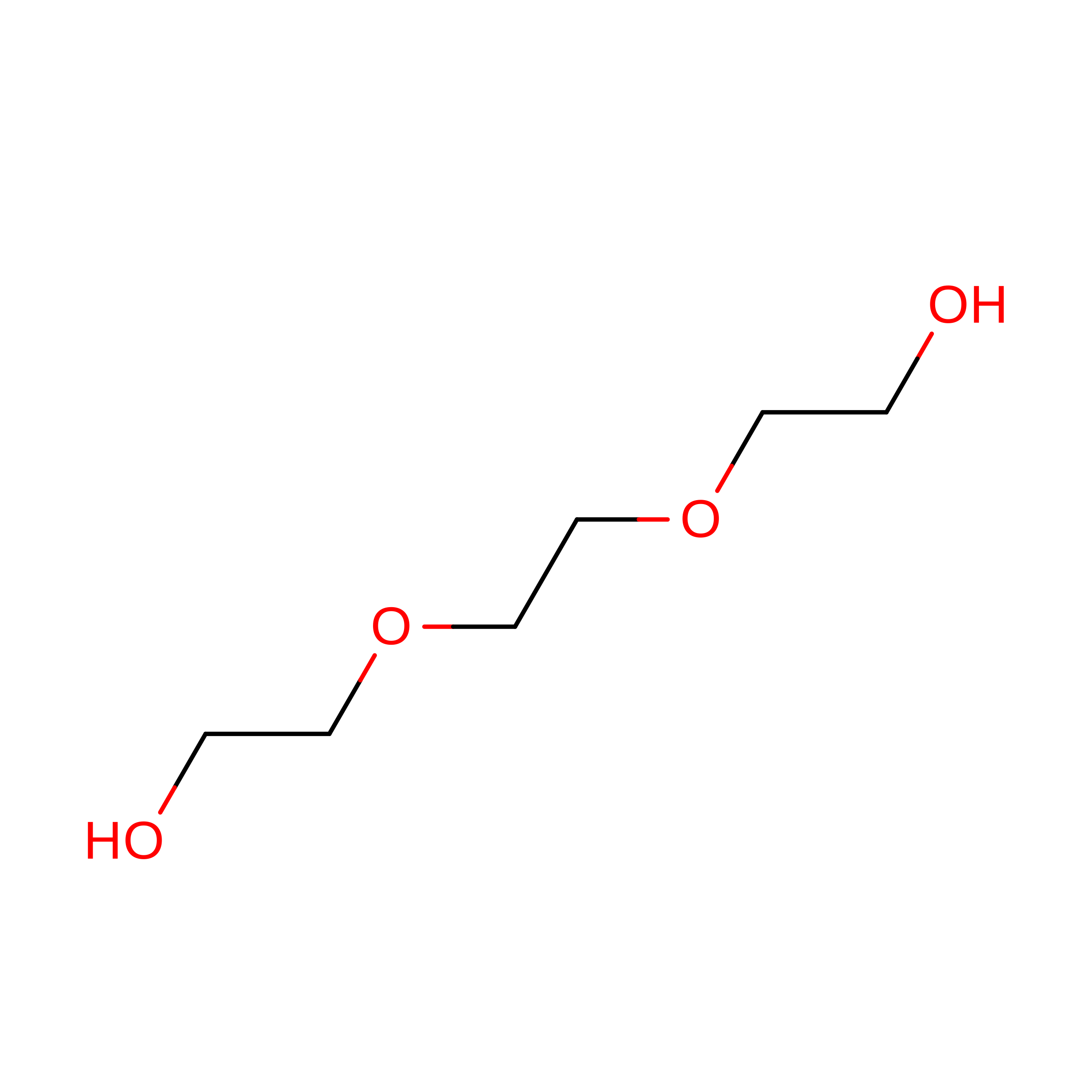
PGE

Query on PGE


Download:Ideal Coordinates CCD File
L [auth C]TRIETHYLENE GLYCOL
C6 H14 O4
ZIBGPFATKBEMQZ-UHFFFAOYSA-N
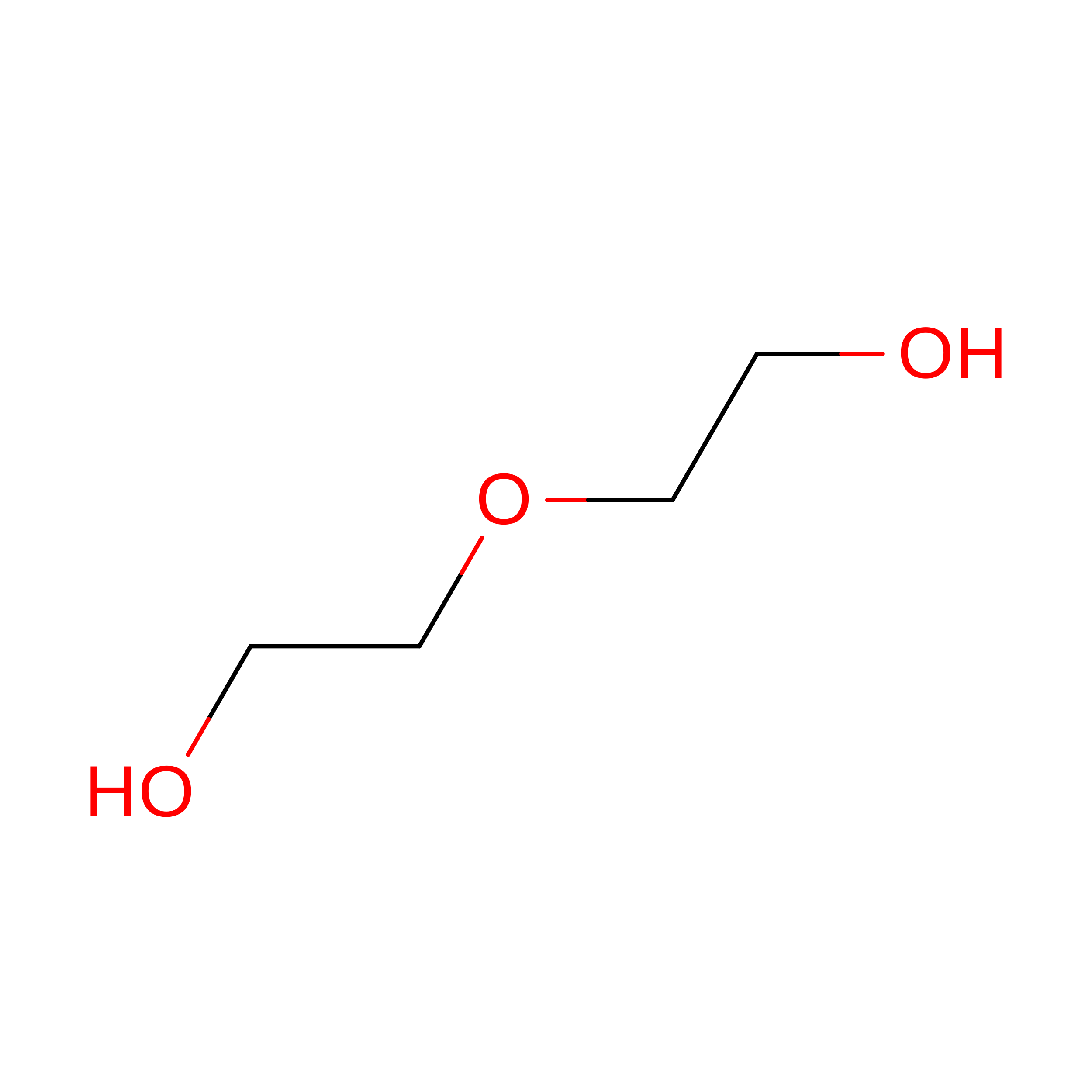
PEG

Query on PEG


Download:Ideal Coordinates CCD File
F [auth A]
G [auth A]
H [auth A]
I [auth B]
M [auth C]
F [auth A],
G [auth A],
H [auth A],
I [auth B],
M [auth C],
N [auth C]
DI(HYDROXYETHYL)ETHER
C4 H10 O3
MTHSVFCYNBDYFN-UHFFFAOYSA-N
ZN

Query on ZN


Download:Ideal Coordinates CCD File
D [auth A],
E [auth A],
K [auth C]
ZINC ION
Zn
PTFCDOFLOPIGGS-UHFFFAOYSA-N
CL

Query on CL


Download:Ideal Coordinates CCD File
J [auth B],
O [auth C]
CHLORIDE ION
Cl
VEXZGXHMUGYJMC-UHFFFAOYSA-M

Experimental Data & Validation

Experimental Data

  • Method: X-RAY DIFFRACTION
  • Resolution: 1.42 Å
  • R-Value Free:  0.230 (Depositor), 0.247 (DCC) 
  • R-Value Work:  0.195 (Depositor) 
  • R-Value Observed: 0.196 (Depositor) 
Space Group: C 1 2 1
Unit Cell:
Length ( Å )Angle ( ˚ )
a = 77.574α = 90
b = 29.409β = 118.78
c = 44.353γ = 90
Software Package:
Software NamePurpose
BUSTER-TNTrefinement
HKL-2000data scaling
PDB_EXTRACTdata extraction
HKL-2000data reduction
MOLREPphasing

Structure Validation

View Full Validation Report


Entry History 

& Funding Information

Deposition Data


Funding OrganizationLocationGrant Number
National Institutes of Health/National Institute of Environmental Health Sciences (NIH/NIEHS)United StatesES012236

Revision History  (Full details and data files)

  • Version 1.0: 2016-08-31
    Type: Initial release
  • Version 1.1: 2016-09-21
    Changes: Database references
  • Version 1.2: 2017-02-08
    Changes: Derived calculations, Non-polymer description, Structure summary
  • Version 1.3: 2017-09-27
    Changes: Author supporting evidence
  • Version 1.4: 2019-12-18
    Changes: Author supporting evidence
  • Version 1.5: 2023-09-27
    Changes: Data collection, Database references, Derived calculations, Refinement description
  • Version 1.6: 2024-12-25
    Changes: Advisory, Derived calculations, Structure summary