5K47 | pdb_00005k47

CryoEM structure of the human Polycystin-2/PKD2 TRP channel


Experimental Data Snapshot

  • Method: ELECTRON MICROSCOPY
  • Resolution: 4.22 Å
  • Aggregation State: PARTICLE 
  • Reconstruction Method: SINGLE PARTICLE 

wwPDB Validation 3D Report Full Report

Validation slider image for 5K47

This is version 2.2 of the entry. See complete history

Literature

Structure of the polycystic kidney disease TRP channel Polycystin-2 (PC2).

Grieben, M.Pike, A.C.Shintre, C.A.Venturi, E.El-Ajouz, S.Tessitore, A.Shrestha, L.Mukhopadhyay, S.Mahajan, P.Chalk, R.Burgess-Brown, N.A.Sitsapesan, R.Huiskonen, J.T.Carpenter, E.P.

(2017) Nat Struct Mol Biol 24: 114-122

  • DOI: https://doi.org/10.1038/nsmb.3343
  • Primary Citation Related Structures: 
    5K47

  • PubMed Abstract: 

    Mutations in either polycystin-1 (PC1 or PKD1) or polycystin-2 (PC2, PKD2 or TRPP1) cause autosomal-dominant polycystic kidney disease (ADPKD) through unknown mechanisms. Here we present the structure of human PC2 in a closed conformation, solved by electron cryomicroscopy at 4.2-Å resolution. The structure reveals a novel polycystin-specific 'tetragonal opening for polycystins' (TOP) domain tightly bound to the top of a classic transient receptor potential (TRP) channel structure. The TOP domain is formed from two extensions to the voltage-sensor-like domain (VSLD); it covers the channel's endoplasmic reticulum lumen or extracellular surface and encloses an upper vestibule, above the pore filter, without blocking the ion-conduction pathway. The TOP-domain fold is conserved among the polycystins, including the homologous channel-like region of PC1, and is the site of a cluster of ADPKD-associated missense variants. Extensive contacts among the TOP-domain subunits, the pore and the VSLD provide ample scope for regulation through physical and chemical stimuli.


  • Organizational Affiliation
    • Structural Genomics Consortium, University of Oxford, Oxford, UK.

Macromolecule Content 

  • Total Structure Weight: 259.41 kDa 
  • Atom Count: 15,680 
  • Modeled Residue Count: 1,936 
  • Deposited Residue Count: 2,188 
  • Unique protein chains: 1

Macromolecules

Find similar proteins by:|  3D Structure
Entity ID: 1
MoleculeChains  Sequence LengthOrganismDetailsImage
Polycystin-2
A, B, C, D
547Homo sapiensMutation(s): 0 
Gene Names: PKD2TRPP2
Membrane Entity: Yes 
UniProt & NIH Common Fund Data Resources
Find proteins for Q13563 (Homo sapiens)
Explore Q13563 
Go to UniProtKB:  Q13563
PHAROS:  Q13563
GTEx:  ENSG00000118762 
Entity Groups
Sequence Clusters30% Identity50% Identity70% Identity90% Identity95% Identity100% Identity
UniProt GroupQ13563
Glycosylation
Glycosylation Sites: 3Go to GlyGen: Q13563-1
Sequence Annotations
Expand
Reference Sequence

Oligosaccharides

Help  
Entity ID: 2
MoleculeChains Length2D Diagram GlycosylationD Interactions
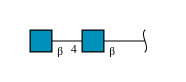
2-acetamido-2-deoxy-beta-D-glucopyranose-(1-4)-2-acetamido-2-deoxy-beta-D-glucopyranose
E, F, G, H
2N-Glycosylation
Glycosylation Resources
GlyTouCan: G42666HT
GlyCosmos: G42666HT
GlyGen: G42666HT

Experimental Data & Validation

Experimental Data

  • Method: ELECTRON MICROSCOPY
  • Resolution: 4.22 Å
  • Aggregation State: PARTICLE 
  • Reconstruction Method: SINGLE PARTICLE 
EM Software:
TaskSoftware PackageVersion
MODEL REFINEMENTREFMAC5.8.0135
RECONSTRUCTIONRELION1.3
MODEL REFINEMENTRELION1.3
MODEL REFINEMENTCTFFIND4

Structure Validation

View Full Validation Report


Entry History 

& Funding Information

Deposition Data


Funding OrganizationLocationGrant Number
Wellcome TrustUnited Kingdom092809/Z/10/Z

Revision History  (Full details and data files)

  • Version 1.0: 2016-08-24
    Type: Initial release
  • Version 1.1: 2016-12-21
    Changes: Database references
  • Version 1.2: 2017-01-11
    Changes: Database references
  • Version 1.3: 2017-02-15
    Changes: Database references
  • Version 1.4: 2017-08-30
    Changes: Data collection, Experimental preparation
  • Version 1.5: 2018-10-03
    Changes: Data collection, Refinement description
  • Version 1.6: 2018-10-10
    Changes: Data collection, Refinement description, Structure summary
  • Version 1.7: 2019-12-11
    Changes: Other, Structure summary
  • Version 2.0: 2020-07-29
    Type: Remediation
    Reason: Carbohydrate remediation
    Changes: Atomic model, Data collection, Derived calculations, Structure summary
  • Version 2.1: 2020-10-21
    Changes: Data collection, Structure summary
  • Version 2.2: 2024-10-23
    Changes: Data collection, Database references, Refinement description, Structure summary