5K1R | pdb_00005k1r

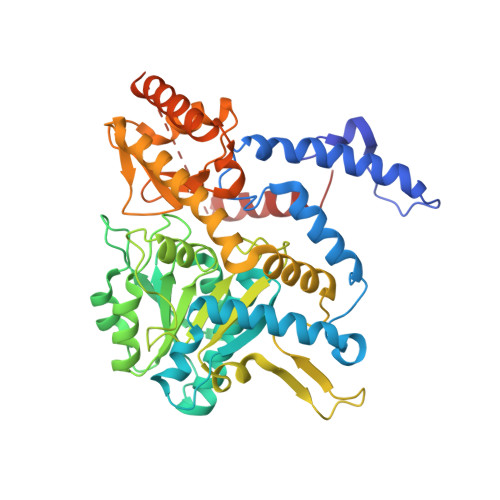
Structure of Burkholderia pseudomallei K96243 sphingosine-1-phosphate lyase Bpss2021


Experimental Data Snapshot

  • Method: X-RAY DIFFRACTION
  • Resolution: 2.10 Å
  • R-Value Free: 
    0.230 (Depositor), 0.227 (DCC) 
  • R-Value Work: 
    0.174 (Depositor), 0.170 (DCC) 
  • R-Value Observed: 
    0.176 (Depositor) 

Starting Model: experimental
View more details

wwPDB Validation 3D Report Full Report

Validation slider image for 5K1R

Ligand Structure Quality Assessment 


This is version 1.3 of the entry. See complete history

Literature

Characterization of homologous sphingosine-1-phosphate lyase isoforms in the bacterial pathogen Burkholderia pseudomallei.

McLean, C.J.Marles-Wright, J.Custodio, R.Lowther, J.Kennedy, A.J.Pollock, J.Clarke, D.J.Brown, A.R.Campopiano, D.J.

(2017) J Lipid Res 58: 137-150

  • DOI: https://doi.org/10.1194/jlr.M071258
  • Primary Citation Related Structures: 
    5K1R

  • PubMed Abstract: 

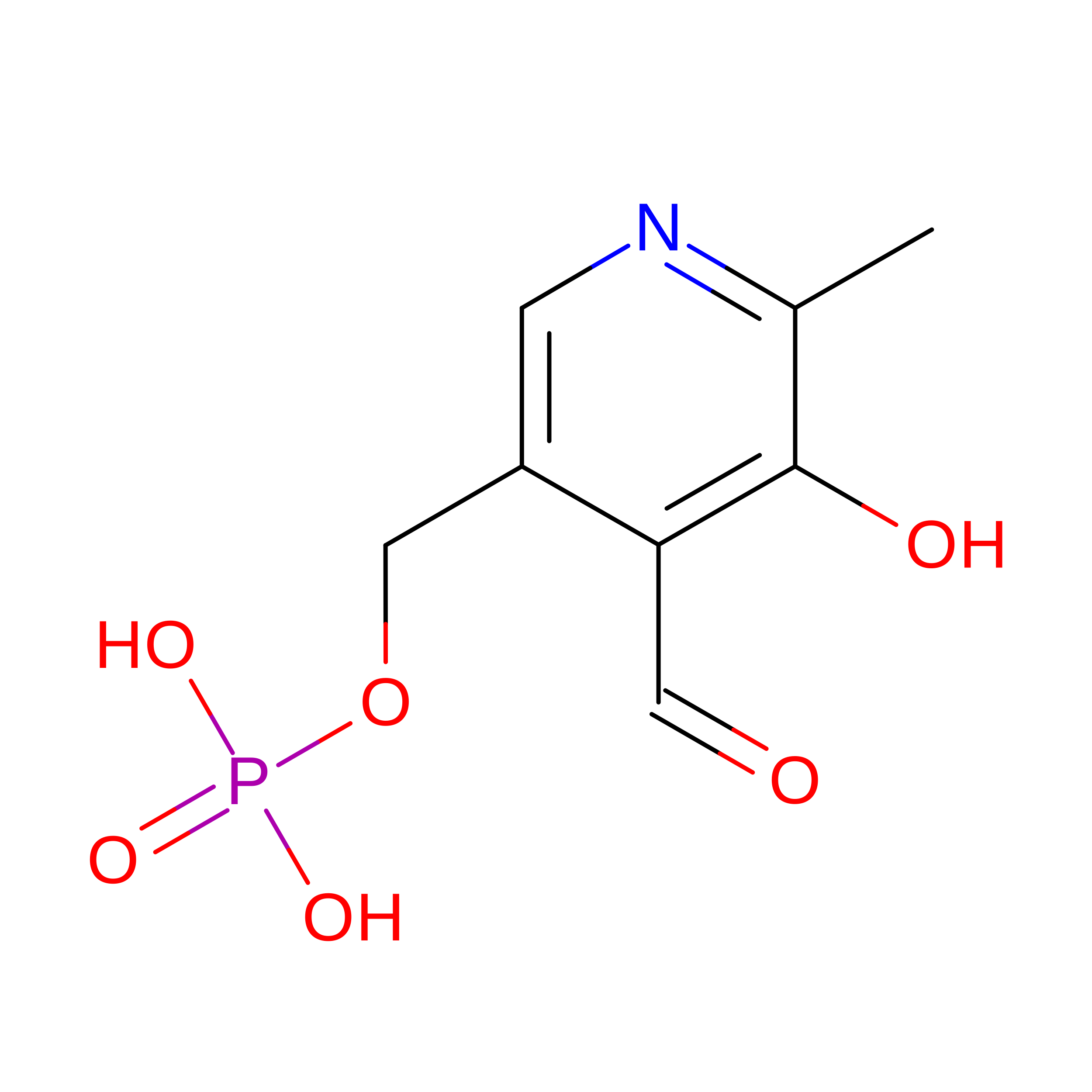
    Sphingolipids (SLs) are ubiquitous elements in eukaryotic membranes and are also found in some bacterial and viral species. As well as playing an integral structural role, SLs also act as potent signaling molecules involved in numerous cellular pathways and have been linked to many human diseases. A central SL signaling molecule is sphingosine-1-phosphate (S1P), whose breakdown is catalyzed by S1P lyase (S1PL), a pyridoxal 5'-phosphate (PLP)-dependent enzyme that catalyzes the cleavage of S1P to (2E)-hexadecenal (2E-HEX) and phosphoethanolamine. Here, we show that the pathogenic bacterium, Burkholderia pseudomallei K96243, encodes two homologous proteins (S1PL2021 and S1PL2025) that display moderate sequence identity to known eukaryotic and prokaryotic S1PLs. Using an established MS-based methodology, we show that recombinant S1PL2021 is catalytically active. We also used recombinant human fatty aldehyde dehydrogenase to develop a spectrophotometric enzyme-coupled assay to detect 2E-HEX formation and measure the kinetic constants of the two B. pseudomallei S1PL isoforms. Furthermore, we determined the X-ray crystal structure of the PLP-bound form of S1PL2021 at 2.1 Å resolution revealing that the enzyme displays a conserved structural fold and active site architecture comparable with known S1PLs. The combined data suggest that B. pseudomallei has the potential to degrade host SLs in a S1PL-dependent manner.


  • Organizational Affiliation
    • EastChem School of Chemistry University of Edinburgh, Edinburgh EH9 3FJ, United Kingdom.

Macromolecule Content 

  • Total Structure Weight: 107.09 kDa 
  • Atom Count: 7,190 
  • Modeled Residue Count: 879 
  • Deposited Residue Count: 960 
  • Unique protein chains: 1

Macromolecules

Find similar proteins by:|  3D Structure
Entity ID: 1
MoleculeChains  Sequence LengthOrganismDetailsImage
Burkholderia pseudomallei sphingosine-1-phosphate lyase Bpss2021
A, B
480Burkholderia pseudomallei K96243Mutation(s): 0 
Gene Names: BPSS2021
UniProt
Find proteins for Q63IP8 (Burkholderia pseudomallei (strain K96243))
Explore Q63IP8 
Go to UniProtKB:  Q63IP8
Entity Groups
Sequence Clusters30% Identity50% Identity70% Identity90% Identity95% Identity100% Identity
UniProt GroupQ63IP8
Sequence Annotations
Expand
Reference Sequence

Experimental Data & Validation

Experimental Data

  • Method: X-RAY DIFFRACTION
  • Resolution: 2.10 Å
  • R-Value Free:  0.230 (Depositor), 0.227 (DCC) 
  • R-Value Work:  0.174 (Depositor), 0.170 (DCC) 
  • R-Value Observed: 0.176 (Depositor) 
Space Group: P 1 21 1
Unit Cell:
Length ( Å )Angle ( ˚ )
a = 59.6α = 90
b = 126.776β = 97.51
c = 59.725γ = 90
Software Package:
Software NamePurpose
PHENIXrefinement
XDSdata reduction
XDSdata scaling
Aimlessdata scaling
PHASERphasing
Cootmodel building

Structure Validation

View Full Validation Report


Ligand Structure Quality Assessment 


Entry History 

& Funding Information

Deposition Data


Funding OrganizationLocationGrant Number
Biotechnology and Biological Sciences Research CouncilUnited KingdomBB/M010996/1

Revision History  (Full details and data files)

  • Version 1.0: 2016-11-02
    Type: Initial release
  • Version 1.1: 2017-08-30
    Changes: Author supporting evidence
  • Version 1.2: 2017-12-06
    Changes: Database references
  • Version 1.3: 2024-01-10
    Changes: Data collection, Database references, Refinement description