5JRP | pdb_00005jrp

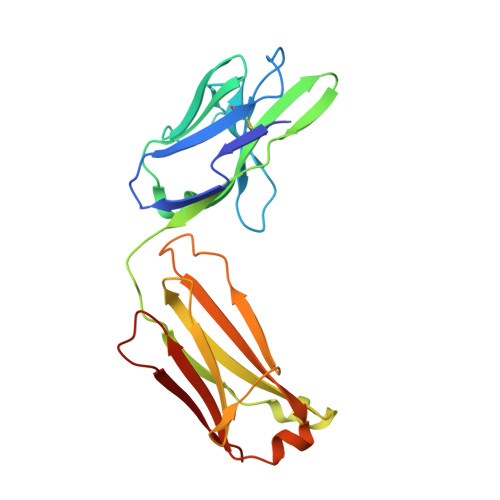
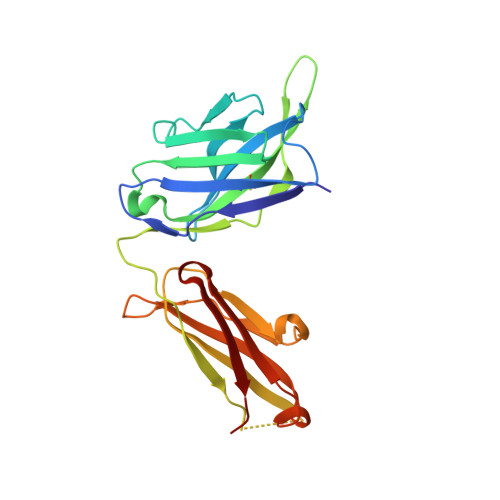
crystal structure of monoclonal antibody MR78 Fab


Experimental Data Snapshot

  • Method: X-RAY DIFFRACTION
  • Resolution: 2.00 Å
  • R-Value Free: 
    0.194 (Depositor), 0.195 (DCC) 
  • R-Value Work: 
    0.171 (Depositor), 0.174 (DCC) 
  • R-Value Observed: 
    0.172 (Depositor) 

Starting Model: experimental
View more details

wwPDB Validation 3D Report Full Report

Validation slider image for 5JRP

This is version 1.3 of the entry. See complete history

Literature

Role of Non-local Interactions between CDR Loops in Binding Affinity of MR78 Antibody to Marburg Virus Glycoprotein.

Sangha, A.K.Dong, J.Williamson, L.Hashiguchi, T.Saphire, E.O.Crowe, J.E.Meiler, J.

(2017) Structure 25: 1820-1828.e2

  • DOI: https://doi.org/10.1016/j.str.2017.10.005
  • Primary Citation Related Structures: 
    5JRP, 5WEQ, 9A0C

  • PubMed Abstract: 

    An atomic-detail model of the Marburg virus glycoprotein in complex with a neutralizing human monoclonal antibody designated MR78 was constructed using Phenix.Rosetta starting from a 3.6Å crystallographic density map. The Asp at T6 in the HCDR3's bulged torso cannot form the canonical salt bridge as position T2 lacks an Arg or Lys residue. It instead engages in a hydrogen bond interaction with a Tyr contributed by the HCDR1 loop. This inter-CDR loop interaction stabilizes the bulged conformation needed for binding to the viral glycoprotein: a Tyr to Phe mutant displays a binding affinity reduced by a factor of at least 10. We found that 5% of a database of 465 million human antibody sequences has the same residues at T2 and T6 positions in HCDR3 and Tyr in HCDR1 that could potentially form this Asp-Tyr interaction, and that this interaction might contribute to a non-canonical bulged torso conformation.


  • Organizational Affiliation
    • Department of Chemistry, Vanderbilt University, Nashville, TN 37235, USA; Center for Structural Biology, Vanderbilt University, Nashville, TN 37235, USA.

Macromolecule Content 

  • Total Structure Weight: 47.26 kDa 
  • Atom Count: 3,812 
  • Modeled Residue Count: 430 
  • Deposited Residue Count: 438 
  • Unique protein chains: 2

Macromolecules

Find similar proteins by:|  3D Structure
Entity ID: 1
MoleculeChains  Sequence LengthOrganismDetailsImage
marberg virus monoclonal antibody MR78 Fab light chainA [auth L]212Homo sapiensMutation(s): 0 
Find similar proteins by:|  3D Structure
Entity ID: 2
MoleculeChains  Sequence LengthOrganismDetailsImage
marberg virus monoclonal antibody MR78 Fab heavy chainB [auth H]226Homo sapiensMutation(s): 0 

Small Molecules

Ligands 1 Unique
IDChains Name / Formula / InChI Key2D Diagram3D Interactions
NA

Query on NA


Download:Ideal Coordinates CCD File
C [auth L]SODIUM ION
Na
FKNQFGJONOIPTF-UHFFFAOYSA-N

Experimental Data & Validation

Experimental Data

  • Method: X-RAY DIFFRACTION
  • Resolution: 2.00 Å
  • R-Value Free:  0.194 (Depositor), 0.195 (DCC) 
  • R-Value Work:  0.171 (Depositor), 0.174 (DCC) 
  • R-Value Observed: 0.172 (Depositor) 
Space Group: P 31 2 1
Unit Cell:
Length ( Å )Angle ( ˚ )
a = 117.57α = 90
b = 117.57β = 90
c = 91.8γ = 120
Software Package:
Software NamePurpose
PHENIXrefinement
iMOSFLMdata reduction
SCALAdata scaling
PHASERphasing

Structure Validation

View Full Validation Report


Entry History 

Deposition Data

Revision History  (Full details and data files)

  • Version 1.0: 2017-11-08
    Type: Initial release
  • Version 1.1: 2018-04-25
    Changes: Data collection, Database references
  • Version 1.2: 2023-09-27
    Changes: Data collection, Database references, Refinement description
  • Version 1.3: 2024-10-16
    Changes: Structure summary