5JQ9 | pdb_00005jq9

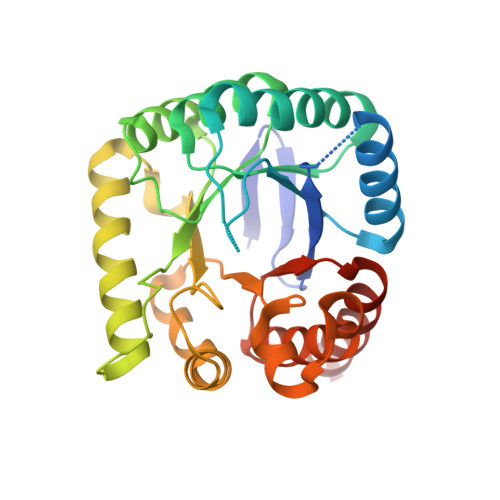
Yersinia pestis DHPS with pterine-sulfa conjugate Compound 16


Experimental Data Snapshot

  • Method: X-RAY DIFFRACTION
  • Resolution: 2.10 Å
  • R-Value Free: 
    0.254 (Depositor), 0.256 (DCC) 
  • R-Value Work: 
    0.224 (Depositor), 0.230 (DCC) 
  • R-Value Observed: 
    0.225 (Depositor) 

Starting Model: experimental
View more details

wwPDB Validation 3D Report Full Report

Validation slider image for 5JQ9

Ligand Structure Quality Assessment 


This is version 1.2 of the entry. See complete history

Literature

Pterin-sulfa conjugates as dihydropteroate synthase inhibitors and antibacterial agents.

Zhao, Y.Shadrick, W.R.Wallace, M.J.Wu, Y.Griffith, E.C.Qi, J.Yun, M.K.White, S.W.Lee, R.E.

(2016) Bioorg Med Chem Lett 26: 3950-3954

  • DOI: https://doi.org/10.1016/j.bmcl.2016.07.006
  • Primary Citation Related Structures: 
    5JQ9

  • PubMed Abstract: 

    The sulfonamide class of antibiotics has been in continuous use for over 70years. They are thought to act by directly inhibiting dihydropteroate synthase (DHPS), and also acting as prodrugs that sequester pterin pools by forming dead end pterin-sulfonamide conjugates. In this study, eight pterin-sulfonamide conjugates were synthesized using a novel synthetic strategy and their biochemical and microbiological properties were investigated. The conjugates were shown to competitively inhibit DHPS, and inhibition was enhanced by the presence of pyrophosphate that is crucial to catalysis and is known to promote an ordering of the DHPS active site. The co-crystal structure of Yersinia pestis DHPS bound to one of the more potent conjugates revealed a mode of binding that is similar to that of the enzymatic product analog pteroic acid. The antimicrobial activities of the pterin-sulfonamide conjugates were measured against Escherichia coli in the presence and absence of folate precursors and dependent metabolites. These results show that the conjugates have appreciable antibacterial activity and act by an on target, anti-folate pathway mechanism rather than as simple dead end products.


  • Organizational Affiliation
    • Department of Chemical Biology and Therapeutics, St. Jude Children's Research Hospital, 262 Danny Thomas Place, Mail Stop 1000, Memphis, TN 38105, United States.

Macromolecule Content 

  • Total Structure Weight: 61.31 kDa 
  • Atom Count: 3,875 
  • Modeled Residue Count: 509 
  • Deposited Residue Count: 558 
  • Unique protein chains: 1

Macromolecules

Find similar proteins by:|  3D Structure
Entity ID: 1
MoleculeChains  Sequence LengthOrganismDetailsImage
Dihydropteroate synthase
A, B
279Yersinia pestis KIM D27Mutation(s): 0 
Gene Names: folPYPD27_2690
EC: 2.5.1.15
UniProt
Find proteins for A0A2S9PLG4 (Yersinia pestis)
Explore A0A2S9PLG4 
Go to UniProtKB:  A0A2S9PLG4
Entity Groups
Sequence Clusters30% Identity50% Identity70% Identity90% Identity95% Identity100% Identity
UniProt GroupA0A2S9PLG4
Sequence Annotations
Expand
Reference Sequence

Small Molecules

Ligands 2 Unique
IDChains Name / Formula / InChI Key2D Diagram3D Interactions
6MB

Query on 6MB


Download:Ideal Coordinates CCD File
C [auth A],
E [auth B]
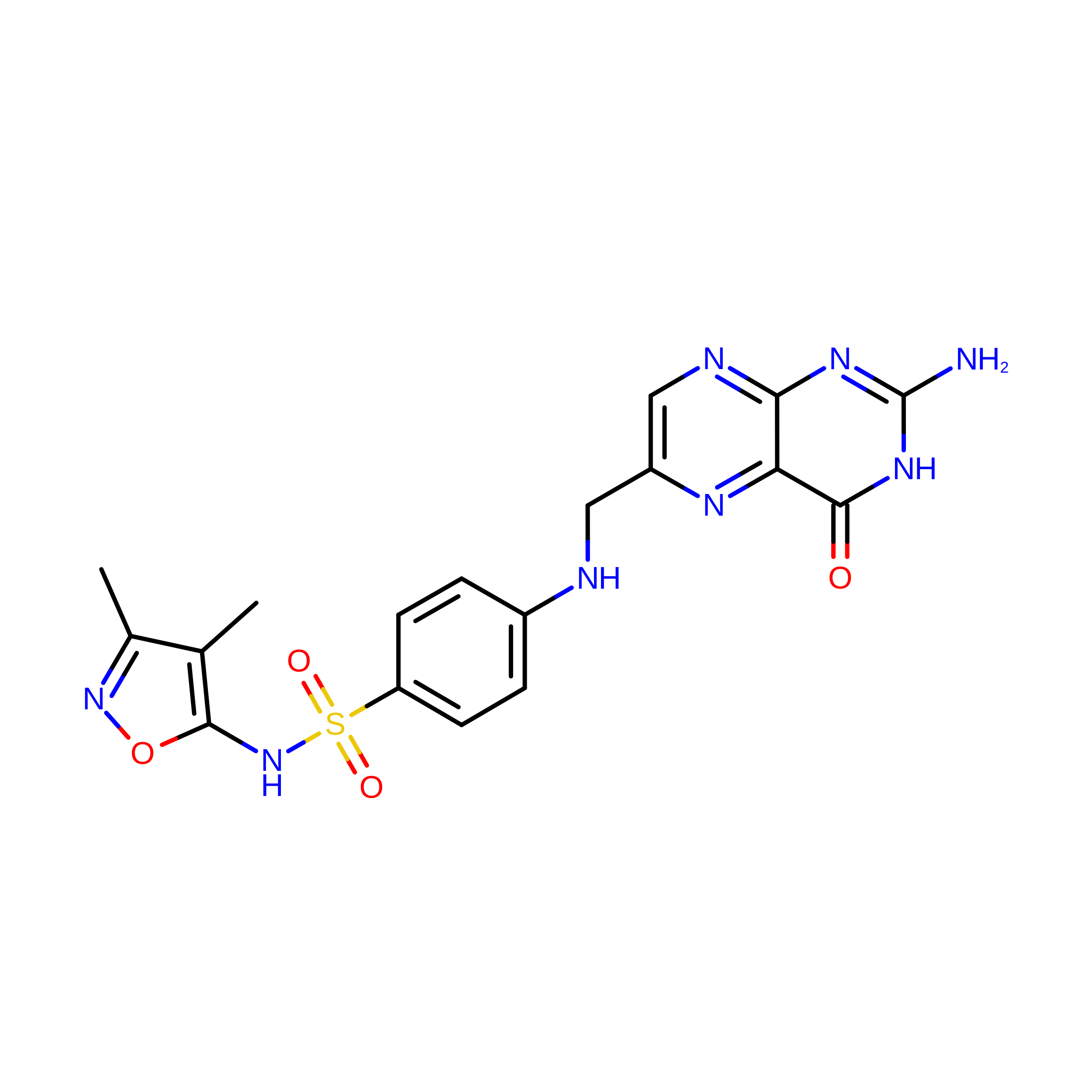
4-{[(2-amino-4-oxo-3,4-dihydropteridin-6-yl)methyl]amino}-N-(3,4-dimethyl-1,2-oxazol-5-yl)benzene-1-sulfonamide
C18 H18 N8 O4 S
JJZFSJXETRBCPR-UHFFFAOYSA-N
EDO

Query on EDO


Download:Ideal Coordinates CCD File
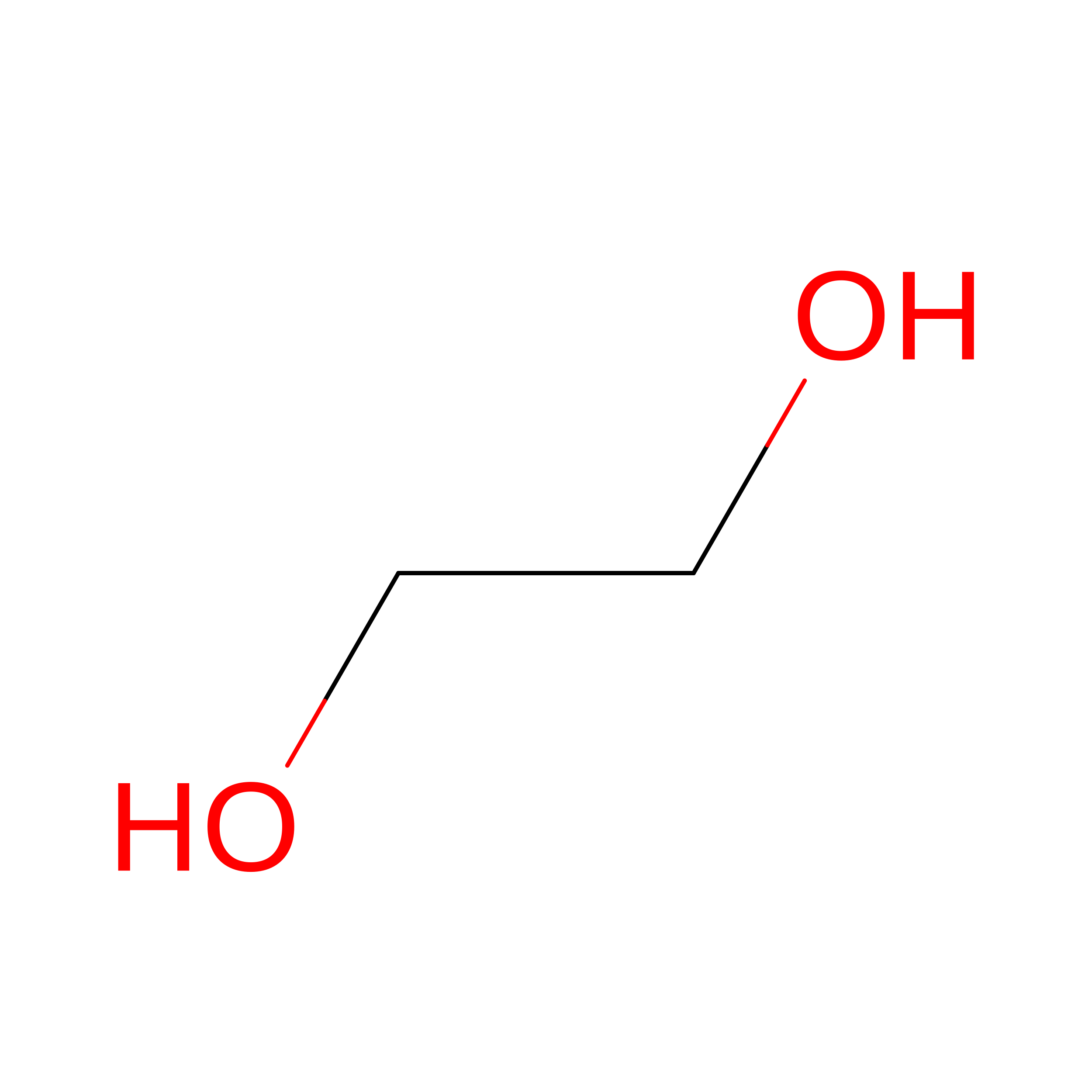
D [auth A]1,2-ETHANEDIOL
C2 H6 O2
LYCAIKOWRPUZTN-UHFFFAOYSA-N

Experimental Data & Validation

Experimental Data

  • Method: X-RAY DIFFRACTION
  • Resolution: 2.10 Å
  • R-Value Free:  0.254 (Depositor), 0.256 (DCC) 
  • R-Value Work:  0.224 (Depositor), 0.230 (DCC) 
  • R-Value Observed: 0.225 (Depositor) 
Space Group: P 1 21 1
Unit Cell:
Length ( Å )Angle ( ˚ )
a = 70.687α = 90
b = 49.897β = 89.78
c = 74.279γ = 90
Software Package:
Software NamePurpose
PHENIXrefinement
XDSdata reduction
Aimlessdata scaling
PHASERphasing

Structure Validation

View Full Validation Report


Ligand Structure Quality Assessment 


Entry History 

Deposition Data

Revision History  (Full details and data files)

  • Version 1.0: 2016-08-10
    Type: Initial release
  • Version 1.1: 2017-09-27
    Changes: Author supporting evidence, Database references, Derived calculations
  • Version 1.2: 2023-09-27
    Changes: Data collection, Database references, Refinement description