5I8S | pdb_00005i8s

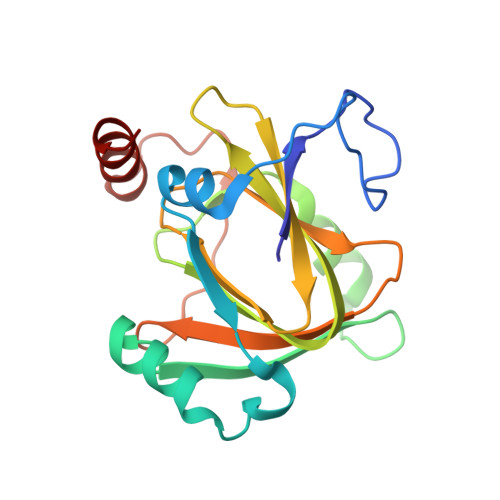
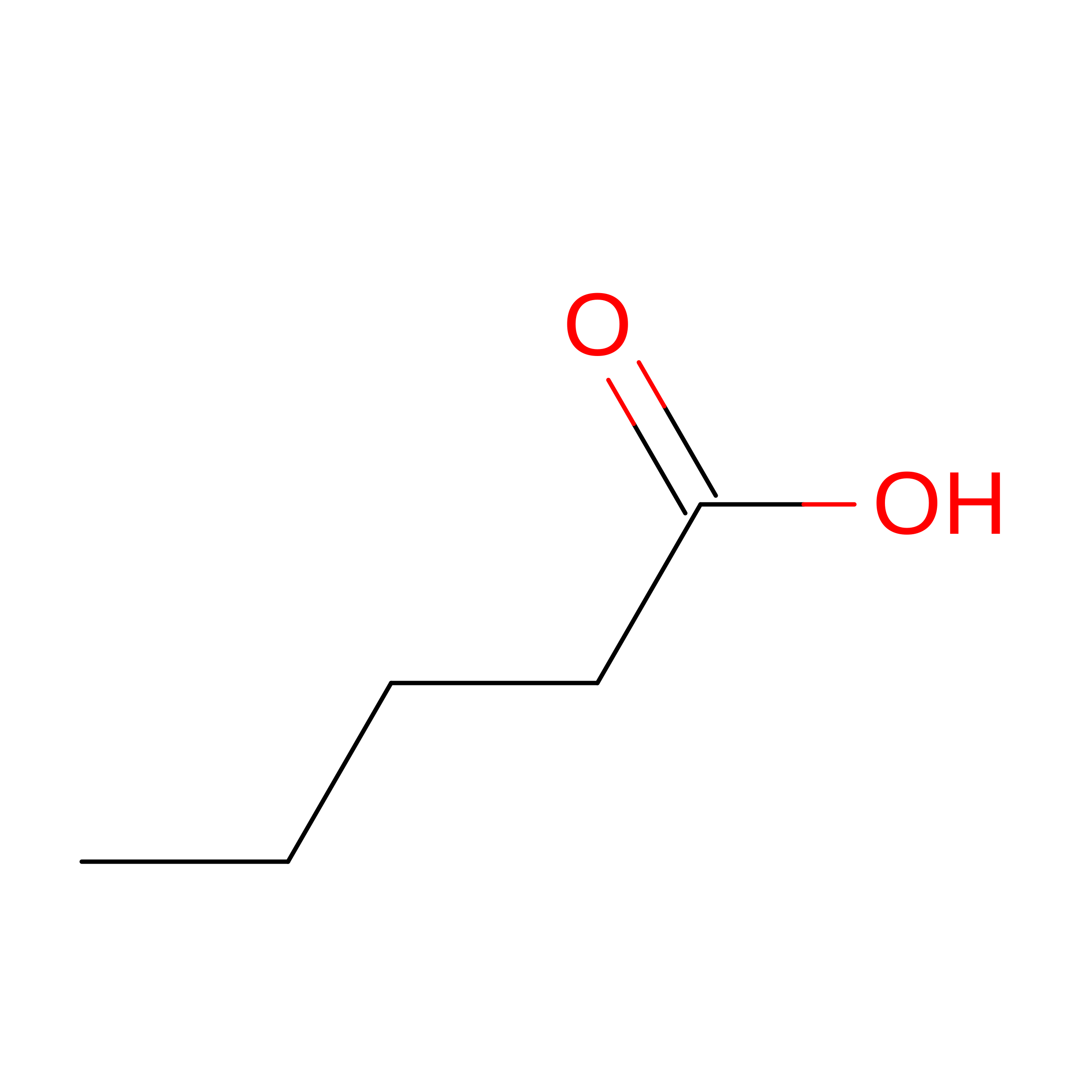
Structure of Mouse Acireductone dioxygenase with Ni2+ ion and pentanoic acid in the active site


Experimental Data Snapshot

  • Method: X-RAY DIFFRACTION
  • Resolution: 1.89 Å
  • R-Value Free: 
    0.200 (Depositor), 0.206 (DCC) 
  • R-Value Work: 
    0.173 (Depositor), 0.184 (DCC) 
  • R-Value Observed: 
    0.174 (Depositor) 

Starting Model: experimental
View more details

wwPDB Validation 3D Report Full Report

Validation slider image for 5I8S

This is version 1.4 of the entry. See complete history

Literature

Metal-Dependent Function of a Mammalian Acireductone Dioxygenase.

Deshpande, A.R.Wagenpfeil, K.Pochapsky, T.C.Petsko, G.A.Ringe, D.

(2016) Biochemistry 55: 1398-1407

  • DOI: https://doi.org/10.1021/acs.biochem.5b01319
  • Primary Citation Related Structures: 
    5I8S, 5I8T, 5I8Y, 5I91, 5I93

  • PubMed Abstract: 

    The two acireductone dioxygenase (ARD) isozymes from the methionine salvage pathway of Klebsiella oxytoca are the only known pair of naturally occurring metalloenzymes with distinct chemical and physical properties determined solely by the identity of the divalent transition metal ion (Fe(2+) or Ni(2+)) in the active site. We now show that this dual chemistry can also occur in mammals. ARD from Mus musculus (MmARD) was studied to relate the metal ion identity and three-dimensional structure to enzyme function. The iron-containing isozyme catalyzes the cleavage of 1,2-dihydroxy-3-keto-5-(thiomethyl)pent-1-ene (acireductone) by O2 to formate and the ketoacid precursor of methionine, which is the penultimate step in methionine salvage. The nickel-bound form of ARD catalyzes an off-pathway reaction resulting in formate, carbon monoxide (CO), and 3-(thiomethyl) propionate. Recombinant MmARD was expressed and purified to obtain a homogeneous enzyme with a single transition metal ion bound. The Fe(2+)-bound protein, which shows about 10-fold higher activity than that of others, catalyzes on-pathway chemistry, whereas the Ni(2+), Co(2+), or Mn(2+) forms exhibit off-pathway chemistry, as has been seen with ARD from Klebsiella. Thermal stability of the isozymes is strongly affected by the metal ion identity, with Ni(2+)-bound MmARD being the most stable, followed by Co(2+) and Fe(2+), and Mn(2+)-bound ARD being the least stable. Ni(2+)- and Co(2+)-bound MmARD were crystallized, and the structures of the two proteins found to be similar. Enzyme-ligand complexes provide insight into substrate binding, metal coordination, and the catalytic mechanism.


  • Organizational Affiliation
    • Helen and Robert Appel Alzheimer's Disease Research Institute, Weill Cornell Medical College , New York, New York 10065, United States.

Macromolecule Content 

  • Total Structure Weight: 21.72 kDa 
  • Atom Count: 1,817 
  • Modeled Residue Count: 179 
  • Deposited Residue Count: 179 
  • Unique protein chains: 1

Macromolecules

Find similar proteins by:|  3D Structure
Entity ID: 1
MoleculeChains  Sequence LengthOrganismDetailsImage
1,2-dihydroxy-3-keto-5-methylthiopentene dioxygenase179Mus musculusMutation(s): 0 
Gene Names: Adi1Mtcbp1
EC: 1.13.11.54 (PDB Primary Data), 1.13.11.53 (UniProt)
UniProt
Find proteins for Q99JT9 (Mus musculus)
Explore Q99JT9 
Go to UniProtKB:  Q99JT9
Entity Groups
Sequence Clusters30% Identity50% Identity70% Identity90% Identity95% Identity100% Identity
UniProt GroupQ99JT9
Sequence Annotations
Expand
Reference Sequence

Experimental Data & Validation

Experimental Data

  • Method: X-RAY DIFFRACTION
  • Resolution: 1.89 Å
  • R-Value Free:  0.200 (Depositor), 0.206 (DCC) 
  • R-Value Work:  0.173 (Depositor), 0.184 (DCC) 
  • R-Value Observed: 0.174 (Depositor) 
Space Group: P 41 21 2
Unit Cell:
Length ( Å )Angle ( ˚ )
a = 79.09α = 90
b = 79.09β = 90
c = 115.355γ = 90
Software Package:
Software NamePurpose
HKL-2000data scaling
PHENIXrefinement
PDB_EXTRACTdata extraction
HKL-2000data reduction
PHENIXphasing

Structure Validation

View Full Validation Report


Entry History 

& Funding Information

Deposition Data


Funding OrganizationLocationGrant Number
National Institutes of Health/National Institute of General Medical Sciences (NIH/NIGMS)United StatesGM26788

Revision History  (Full details and data files)

  • Version 1.0: 2016-03-09
    Type: Initial release
  • Version 1.1: 2016-03-23
    Changes: Database references
  • Version 1.2: 2017-09-27
    Changes: Author supporting evidence, Database references, Derived calculations
  • Version 1.3: 2019-12-25
    Changes: Author supporting evidence
  • Version 1.4: 2023-09-27
    Changes: Data collection, Database references, Refinement description